
South Carolina road trips: Explore nature, from weird formations to hidden waterfalls
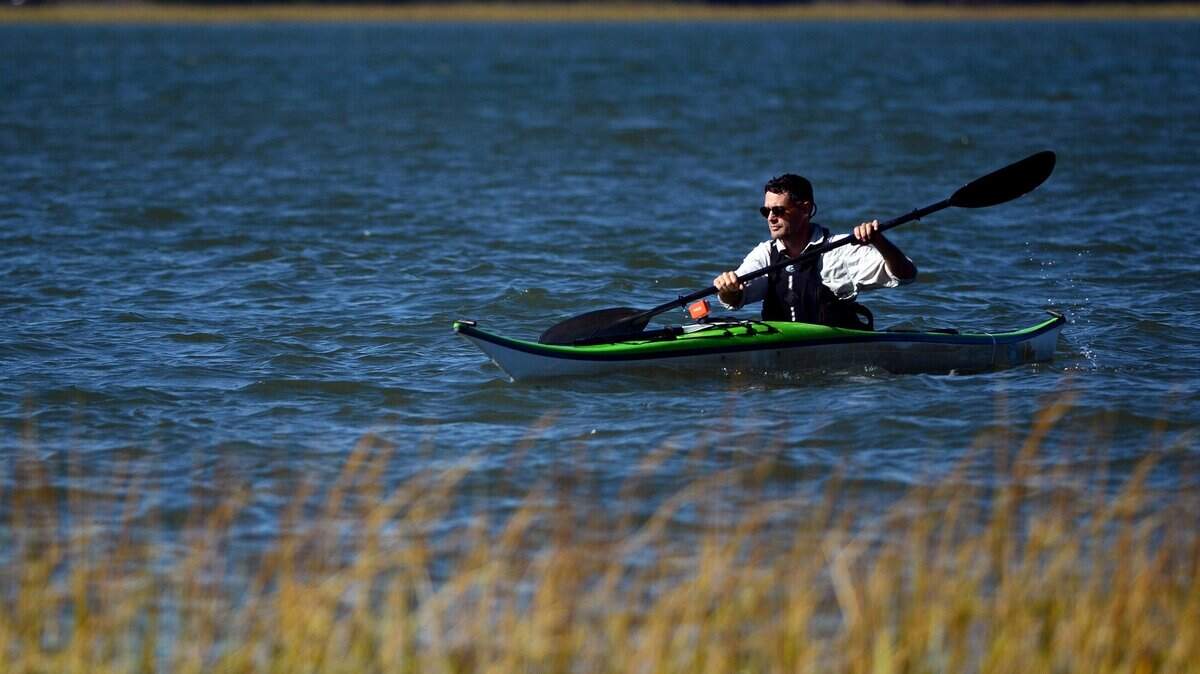
Even when the heat and humidity join forces to make it somewhat stifling during a South Carolina summer, many Columbia adventurers still want to be outdoors.
And some of us not-so-adventurous travelers would like to be outdoors if we could find a less stifling place to go.
The Palmetto State offers many, many options — all of which are a day trip away from Columbia. Many of these scenic spots are in the Upstate, where nearby mountains offer a respite from the Columbia heat. At others, shade or water makes being outside bearable. And we did include a few where it’s going to be hot, but it’s worth it.
South Carolina has 47 state parks that cover more than 80,000 acres of protected lands stretching from the Blue Ridge Mountains to the sand dunes of the Atlantic Ocean. We included a few — but not all of them.
These parks offer forested mountains and towering waterfalls, blackwater rivers and scenic inland lakes, white sand beaches and ancient inland shores, treasured American historic sites and priceless cultural treasures — far too much to cover in one article. Go to www.southcarolinaparks.com for a list of all 47 state parks and information on each of them.
Lake Jocassee
(143 miles; 2 hours, 35 minutes)
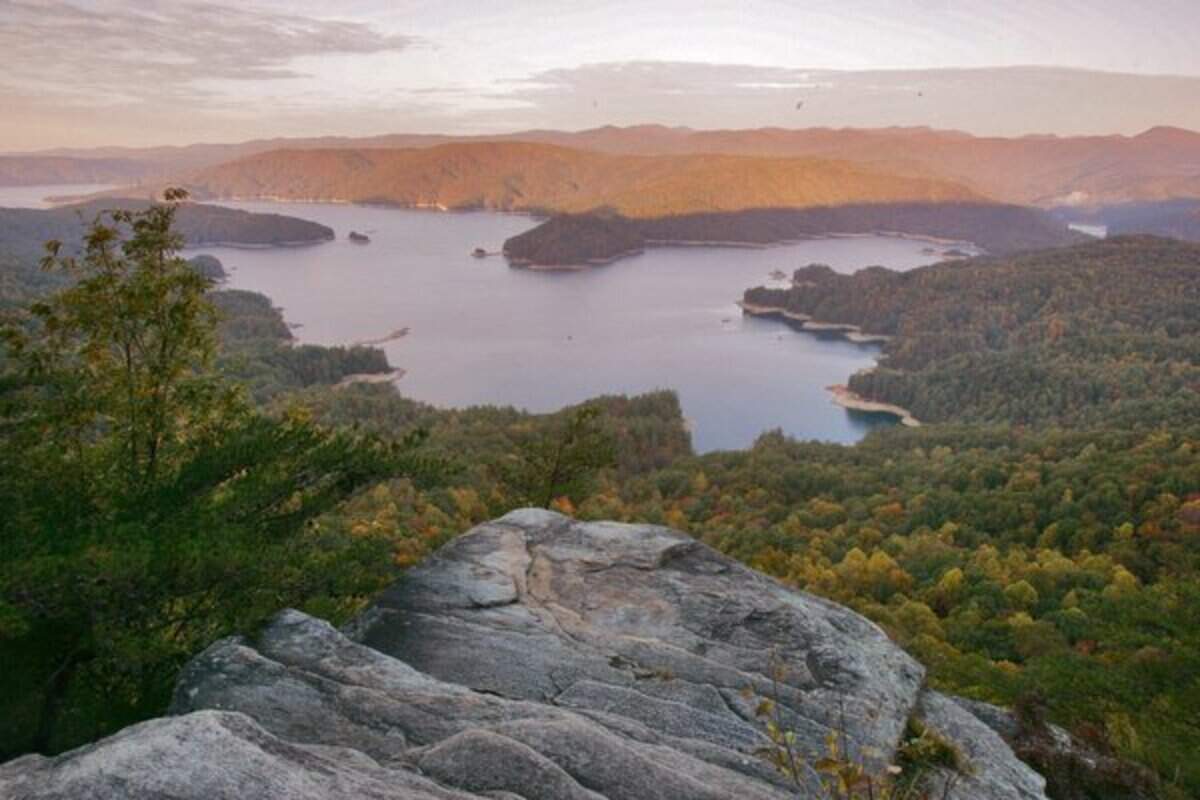
If you only take one day trip out of Columbia this summer, you won’t regret choosing Lake Jocassee in Salem.
This 7,565-acre lake is a hidden gem, surrounded by mountains with four major waterfalls and several smaller that cascade into its clear, cool water. The lake is formed by the Whitewater, Thompson, and Toxaway rivers.
Much of its shoreline is undeveloped, with views of the Jocassee Gorges Wildlife Management Area and surrounding mountains. A variety of fish live in the clear, cold water including brown and rainbow trout, small-mouth bass, and sunfish.
Access Lake Jocassee through Devils Fork State Park (Source: www.discoversouthcarolina.com).
Garden & Gun magazine recently included Lake Jocassee in its Southern Lake Escapes list.
Devils Fork State Park, 161 Holcombe Circle, Salem. www.southcarolinaparks.com/devils-fork; www.lakejocassee.com.
Jumping-Off Rock
(144 miles; 2 hours, 55 minutes.)
Jumping-Off Rock — not to be confused with North Carolina's Jump Off Rock — is an iconic viewpoint above Lake Jocassee within the Jocassee Gorges in northern Pickens County.
Jumping-Off Rock offers beautiful views and supports one of South Carolina's two pairs of nesting peregrine falcons. When the falcons assumed residency, a new overlook was created near Jumping-Off Rock to avoid disturbance of the nesting pair of falcons.
The overlook is one of the most remarkable vistas in the Upstate, with a view of Lake Jocassee and the Blue Ridge Mountains with few signs of human development.
National Geographic identified Jocassee Gorges as one of 50 Last Great Places in the world. Several overlooks along the 9-mile ride on the Horsepasture Road to Jumping-Off Rock allow visitors to grasp a true sense of the vast extent of undisturbed landscape.
Kiosks at the Jocassee entrances contain maps and a complete list of regulations pertaining to the property. Jocassee Gorges maps are available at many state parks along the S.C. 11 corridor and at the Clemson DNR office.
And quick PSA: We know the name sounds like this is a fun swimming hole, but absolutely do not jump. A story in The State's archives notes, "The sheer drop ranges from about 25 feet (to a skinny ledge) to nearly 300 feet."
Jocassee Gorges Wilderness Area, 1344 Cleo Chapman Highway, Sunset. www.visitpickenscounty.com; http://www.dnr.sc.gov.
Stumphouse Mountain Tunnel
(153 miles; 2 hours, 48 minutes.)
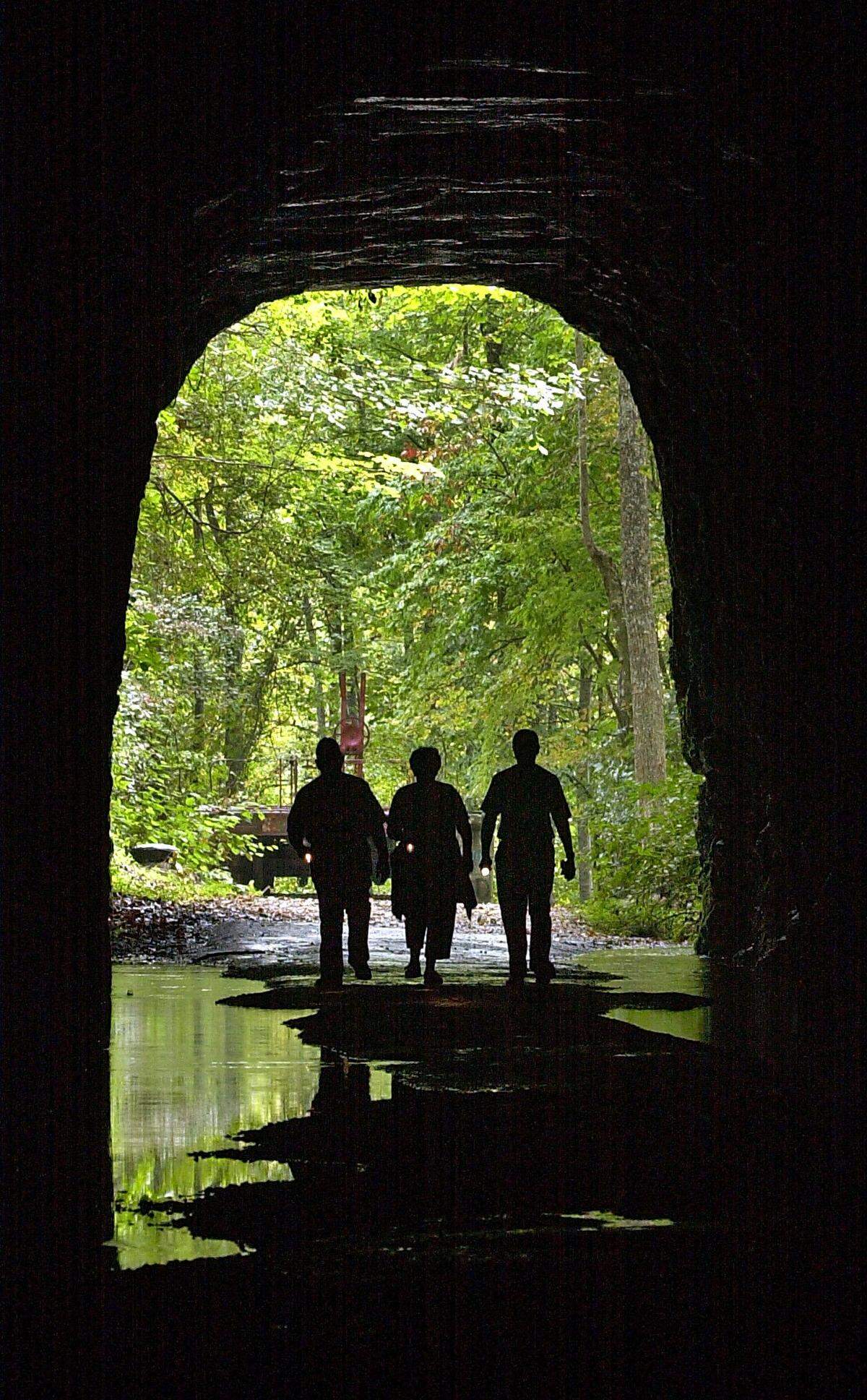
This should be another trip at the top of your list. Stumphouse Mountain Tunnel is a 1,617-foot path near Walhalla that leads to Issaqueena Falls, a 200-foot cascade.
According to legend, Issaqueena was an Indian girl who rode to the nearby fort to warn of a pending Indian attack and escaped pursuit by pretending to leap over the falls, actually hiding beneath them. The park has picnic facilities and trails.
An easy hike takes you to the top of the falls, but a short path to the right will give you a grand view of the entire scene.
Construction began on Stumphouse Tunnel in 1852 to connect Charleston to Knoxville, Tennessee, and eventually on to Cincinnati. The Civil War — and lack of funds — brought construction to a halt. While there were various efforts by the Blue Ridge Railroad to revive the tunnel, none succeeded.
The tunnel measures 17 feet wide by 25 feet high. About midway in, a 16-foot-by-20-foot air shaft that extends 60 feet upward to the surface, causing a consistent cool breeze to flow out of the tunnel.
Located about 7 miles northwest of Walhalla on SC 28 (aka Stumphouse Mountain Tunnel Road). www.oconeecountry.com/stumphouse
Long Shoals Wayside Park
(141 miles; 2 hours, 14 minutes.)
Nestled along the Cherokee Foothills National Scenic Highway (technically S.C. 11), Long Shoals Wayside Park offers a natural slide into the cool waters of Little Eastatoe Creek.
The park sits a few miles east of Keowee-Toxaway State Natural Area in Poe Creek State Forest. The 10-acre park overlooks Little Eastatoe Creek. Visitors can slide down the flat, gently sloping shoals. Anglers fish for trout; the S.C. DNR stocks this portion of the Little Eastatoe on a regular basis with 9- to 12-inch brook and brown and rainbow trout.
Several picnic tables are in a shaded area above the parking lot. Trail signs mark the path down to the scenic Long Shoals. You can amble along the rocks by the water or take a mostly flat trail that loops through the forest alongside the creek back up to the parking area.
Along Scenic Highway 11, Pickens. www.visitpickenscounty.com.
Waterfalls
South Carolina has several waterfalls. Here are a few:
▪ Eastatoe Falls/Twin Falls(137 miles; 2 hours, 32 minutes): These waterfalls are nestled in the Eastatoe Valley. They are an easy hike of about 1 mile. The falls consist of two falls. The larger of the two is about 75 feet high. Water Falls Road, Sunset.
▪ Laurel Fork Falls (141 miles; 2 hours, 30 minutes): Spills 80 feet directly into Lake Jocassee. Located at the head of a narrow cove at the northeastern tip of Toxaway arm of Lake. (Lake maps available at area stores.) May be reached via a 30-minute boat ride, or by an 8-mile hike along the Foothills Trail from U.S. 178 at Rocky Bottom, Sunset. www.visitpickenscounty.com.
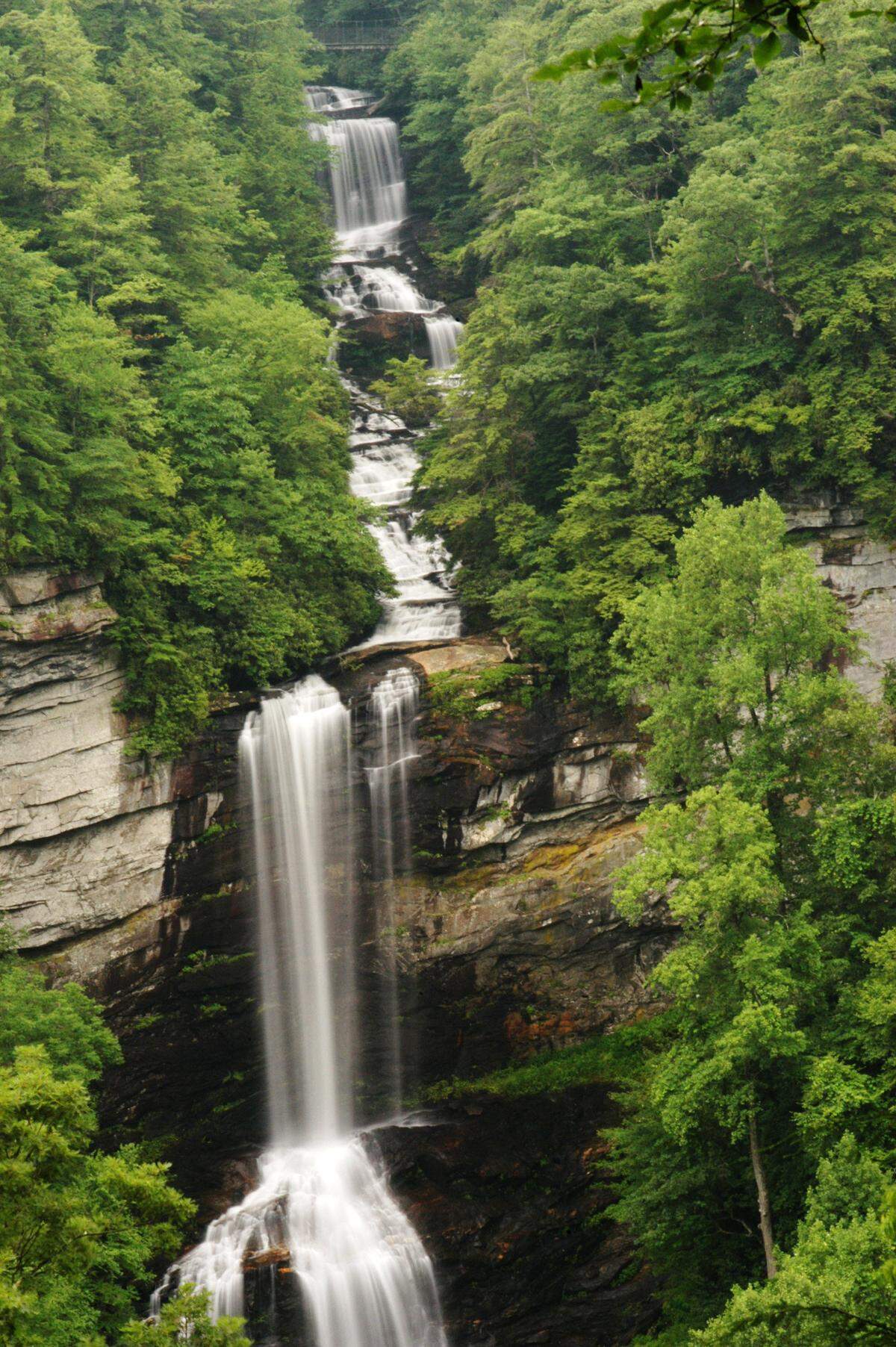
▪ Raven Cliff Falls (136 miles; 2 hours, 30 minutes): The highest waterfall in South Carolina tumbles 400 feet as Matthews Creek descends to The Dismal in the Mountain Bridge Wilderness. Located in Caesars Head State Park, the trail to the falls is a moderate 2.2-mile hike. The Gum Gap and Foothills Trail leads to the top of the falls. Caesars Head State Park, 8155 Geer Highway, Cleveland. www.discoversouthcarolina.com.
▪ Falls Creek Falls (128 miles; 2 hours, 21 minutes): This 100-foot waterfall has two major levels; over each, the cascades drop in the form of lovely ribbons and streamers of water. Above the waterfall, Falls Creek is a charming mountain brook. The hike involves a steep climb up an old logging road through a boulder-choked ravine in Jones Gap State Park along the North Carolina state line. But it sounds more daunting than it is — the moderate 1.5-mile hike takes about an hour. Jones Gap State Park, 303 Jones Gap Road, Marietta. www.discoversouthcarolina.com.
▪ Rainbow Falls (143 miles; 2 hours, 43 minutes): These falls drop 100 feet over steep walls streaked with black and tan from the alternating layers of amphibolite gneiss, granitic gneiss, and mica schist. In the spring, azaleas, meadow rue, and Solomon's plume envelop many of the boulders. Reaching Rainbow Falls is a very strenuous 5-mile round-trip hike. You have to climb approximately 1,000 feet over a distance of 1.6 miles to the base of the falls. YMCA Camp Greenville, 4399 YMCA Camp Road, Cleveland. www.discoversouthcarolina.com.
▪ Wildcat Wayside Falls (127 miles; 2 hours, 13 minutes): This waterfall is located roadside on S.C. 11 — no hiking required. The 30-foot waterfall is last in a series of three formed by the Wildcat Branch. About 100 feet to the left of the falls are steps that lead to the 10-foot middle falls and the 100-foot upper falls. Around 5325 Geer Highway, Cleveland. www.upcountrysc.com.
Poinsett Bridge
(126 miles; 2 hours, 4 minutes.)
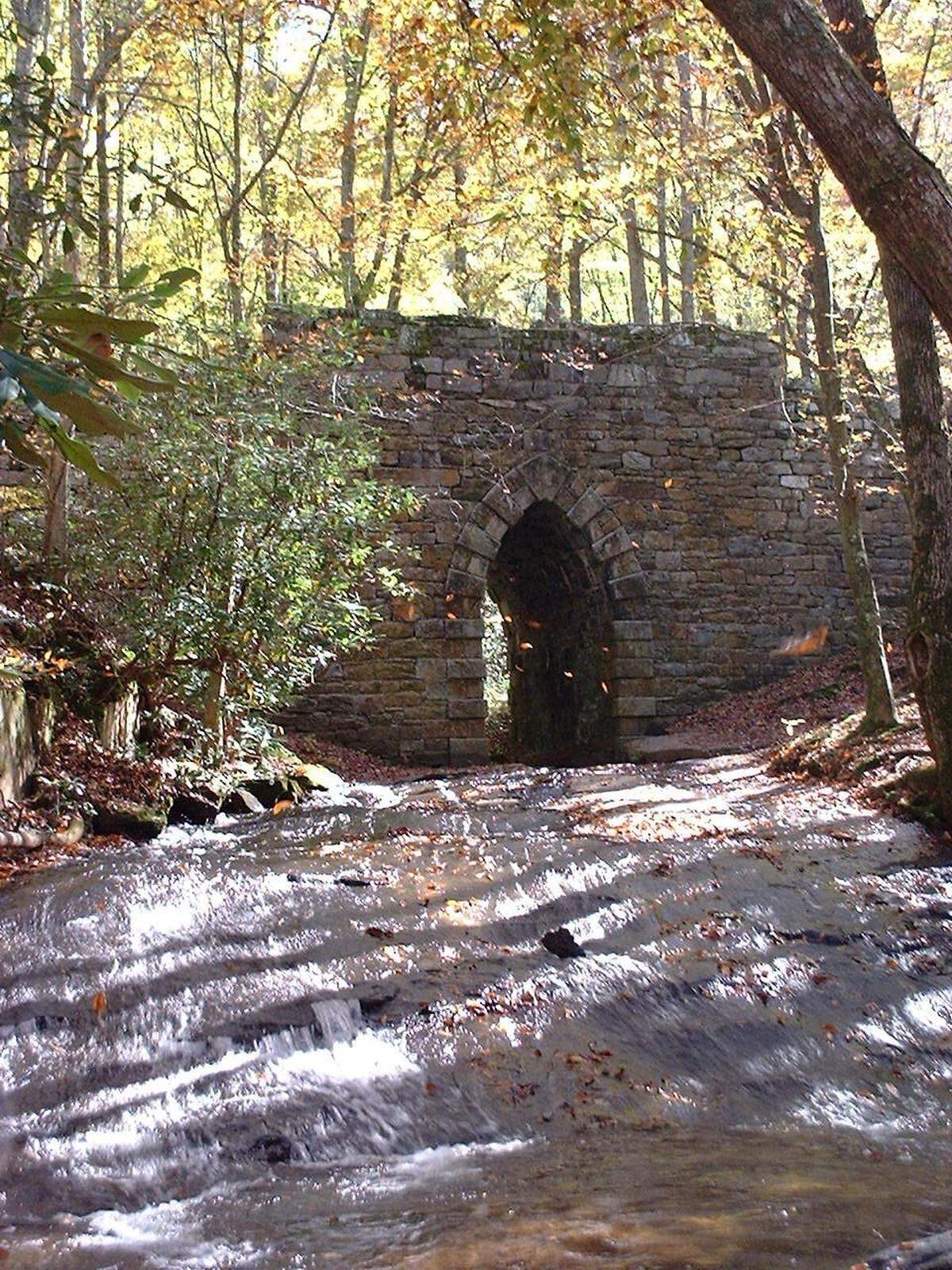
Constructed in 1820, Poinsett Bridge is believed to be the oldest surviving bridge in South Carolina. It was named after Joel Poinsett, a prominent early resident of Greenville and a U.S. ambassador to Mexico.
The bridge was part of a road that connected Charleston and Columbia with the North Carolina mountain communities into Tennessee. It is a 14-foot Gothic arch stone structure and stretches 130 feet over Little Gap Creek.
Historians believe the bridge was designed by Robert Mills, architect of the Washington Monument and the S.C. State House. The bridge is part of the 120-acre Poinsett Bridge Heritage Preserve.
580 Callahan Mountain Road, Travelers Rest. https://greenvillerec.com.
Heritage Trust Preserves
The Nature Conservancy launched the South Carolina Heritage Trust Program in 1974 to document and protect rare, threatened, and endangered species and communities.
A variety of habitats have been protected throughout the state including in the Blue Ridge Mountains, where visitors can see granite outcrops, hardwood coves, montane bogs, seeps, water slides and waterfalls; in the Piedmont, where you can visit a seepage forest, a granitic monadnock (isolated mountain), a Piedmont cove forest, or the remnant of a Carolina prairie; in the Sandhills and Coastal Plains, where preserves feature bottomland hardwood forests, Atlantic white cedar bogs, sandstone outcrops, various longleaf pine ecosystems which require fire to maintain their open nature, and Carolina bays, in which vegetation ranges from dense pocosin to sparsely wooded to open pond; and in the Coastal Zone preserves, where attractions inlcude maritime forests, nesting bird sanctuaries, undeveloped beaches, tidal marshes, and manmade impoundments that attract wading birds and migrating waterfowl.
The 17 cultural preserves are located across the state and contain 43 known archaeological sites. On other DNR lands, about 300 archaeological sites have been found.
Protected areas include 12,000-year-old Native American camp sites, 4,500-year-old shell rings, soapstone quarries, the oldest tabby structure in South Carolina, the home site of C.C. Pinckney (who helped frame the Constitution), early 19th-century Edgefield pottery kilns, and Civil War forts in Georgetown, Charleston, and Beaufort counties.
See www.heritagetrust.dnr.sc.gov/history for a list of the preserves and more information.
Angel Oak
(128 miles; 2 hours, 16 minutes.)
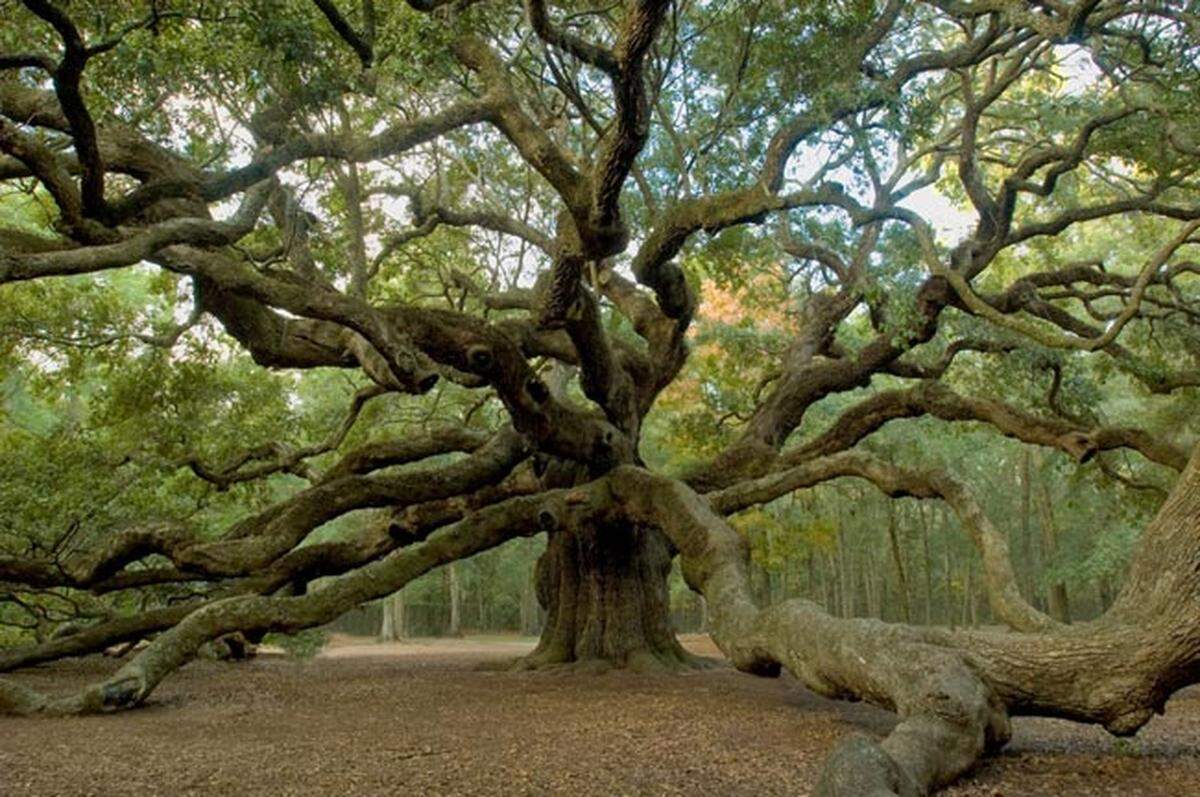
The Angel Oak Tree — estimated to be at least 400-500 years old — stands 66.5 feet tall, measures 28 feet in circumference, and produces shade that covers 17,200 square feet. From tip to tip, its longest branch distance is 187 feet.
The Angel Oak's age has been the source of debate. Some say it could be as old as 1,500 years old, but most think the more conservative estimates are more accurate.
Sassafras Mountain
(143 miles; 2 hours, 40 minutes.)
At 3,553 feet, Sassafras Mountain in Pickens County is the highest point in South Carolina.
The summit — where you can view parts of Tennessee, North Carolina, South Carolina and Georgia — can be reached by walking a 100-yard paved trail. Four states can be viewed from there: Tennessee, North Carolina, South Carolina, and Georgia.
You can drive to the peak, but if you choose to walk, you could find yourself on one of the most rugged trails in the Eastern United States.
A viewing plaza, under contruction at the top of Sassafras Mountain, will include a picnic shelter; several viewing platforms; a central viewing tower; multiple trails, including a section of the Foothills Trail; educational signage; and restrooms.
1399 F. Van Clayton Memorial Highway, Sunset. www.visitpickenscounty.com.
Landsford Canal State Park
(65 miles; 1 hour, 5 minutes.)
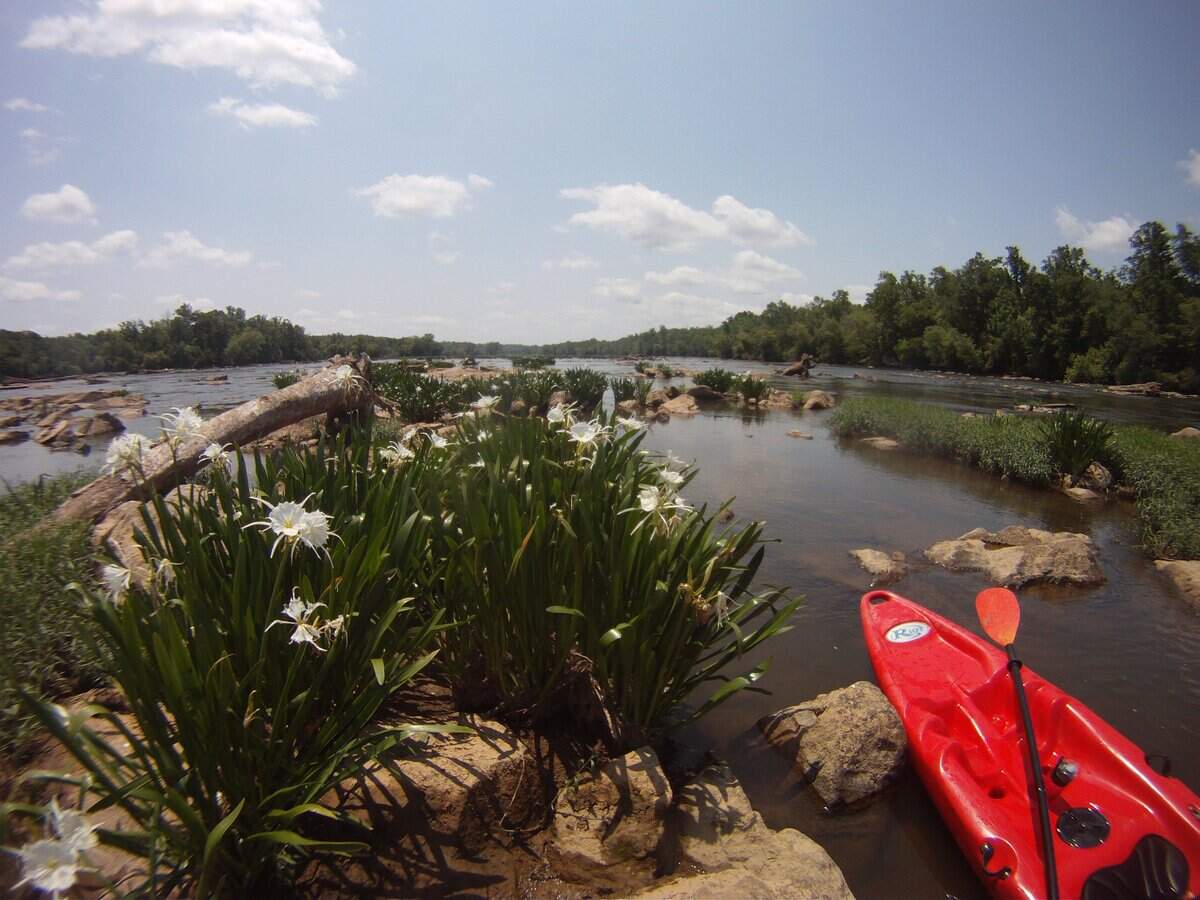
Stretched along the Catawba River on the South Carolina fall line, Landsford Canal State Park is home to the well-preserved remains of the canal system that made the river commercially navigable from 1820 to 1835.
The Catawba River is home to the largest known stand of the Rocky Shoals spider lily, a flower species found predominantly in the Southeast. Peak bloom season is during May and June.
The park offers picnicking, nature watching and a study of the canal structures. Fishing is permitted along the Catawba River, and a paddling trail runs through the park for canoes and kayaks.
A 1.5-mile canal trail provides views of the historic canal remains and the Rocky Shoals spider lilies.
2051 Park Drive, Catawba. www.southcarolinaparks.com/landsford-canal.
Forty Acre Rock Heritage Preserve
(66 miles; 1 hour, 21 minutes.)
The Forty Acre Rock Heritage Preserve encompasses 2,965 acres of the most diverse protected area in the Piedmont region, including granitic flatrocks, waterslides, waterfalls, a beaver pond, caves, hardwood and pine forests, and a variety of wildflowers and wildlife.
A moderately strenuous out-and-back trail provides a unique break from the normal terrain of South Carolina. Starting from the lower trailhead, you will wind through sandy, high grass — but the well-marked section is easy to follow. You will pass through a thick forest, continue along a flat creek, and come to a beaver pond, which is small, but full of water lilies and very colorful during the summer months.
A small waterfall overlookslooks the moderate climb to your destination, the vast opening on top of a huge standing rock called Forty Acre Rock.
2207 Conservancy Road, Kershaw. www.sctrails.net.
Peachtree Rock Heritage Preserve
(17 miles; 32 minutes.)
Peachtree Rock Heritage Preserve feels like a trip back in time.
Layered sandstone formations, riddled with the fossils of ancient marine creatures, crop up on either side of the well-kept trails. Native longleaf pines tower overhead. Near the preserve’s entrance, the only natural waterfall on the state’s coastal plain splashes into a small pool.
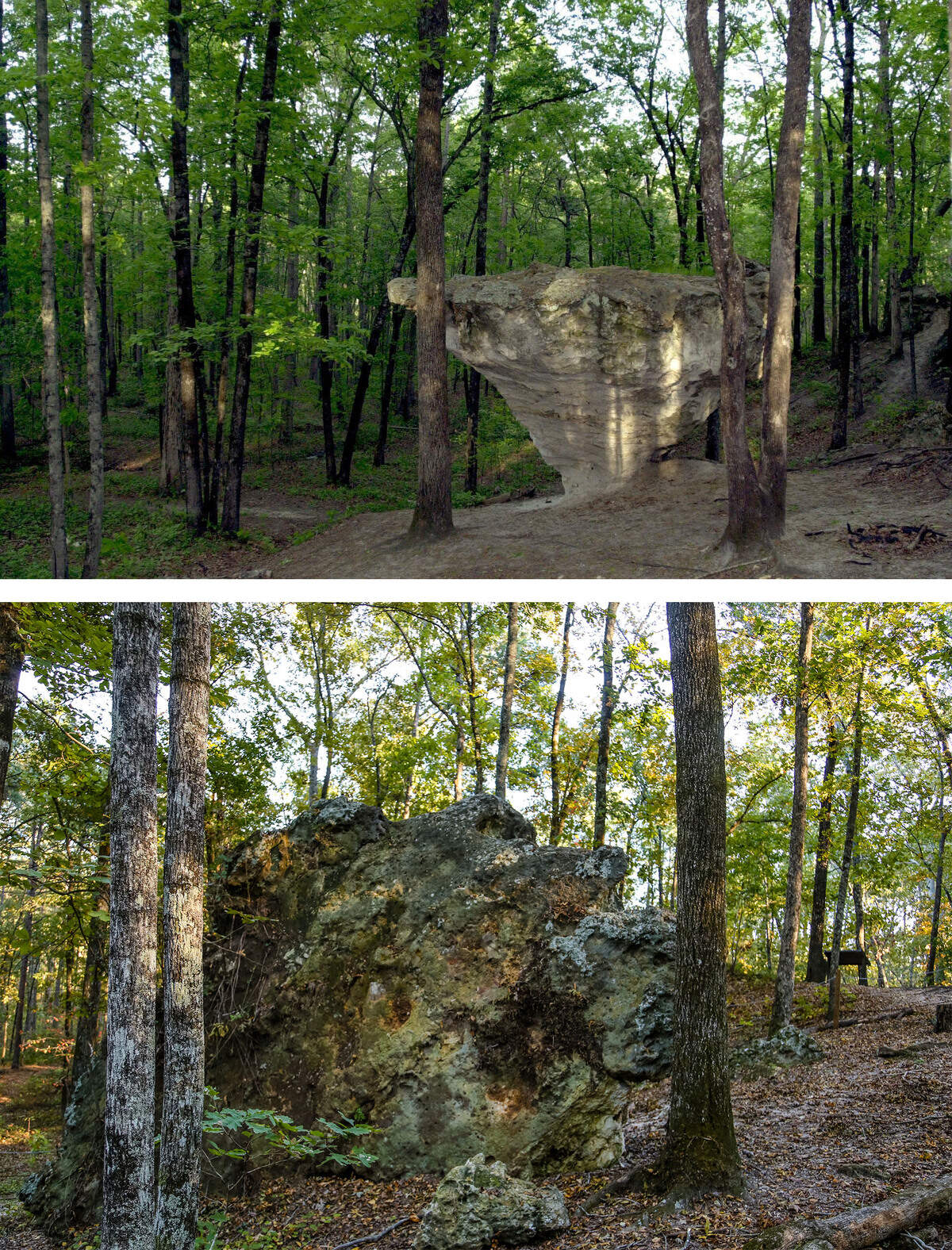
Rich in culture, history, unusual geology, plants and wildlife, Peachtree Rock Heritage Preserve is a wonderful and educational place to visit. A new kiosk near the preserve’s titular formation — the now-toppled Peachtree Rock — describes the area’s unique natural offerings.
The “big rock” for which Peachtree Rock Heritage Preserve was named took the shape of an inverted pyramid, balanced on its tip. As the Atlantic Ocean receded long ago, lower layers of the rock eroded more quickly than higher layers, creating a wide top and narrow base.
Erosion, storms and visitors carving into the rock gradually wore away at that fragile pedestal, and in 2013, it toppled.
The sandstone’s crumbly nature made it impossible to hold up the rock artificially, so officials left it on its side. The Nature Conservancy and DNR continue to monitor its position and stability.
While the big rock has fallen, a smaller, similar formation — affectionately known as “Little Peachtree Rock” — stands just off the trail near the back of the preserve.
883 Peachtree Rock Road, Lexington. www.nature.org.
Palmetto Trail
Established in 1994, the Palmetto Trail's purpose is to access the outdoors from Walhalla in the Blue Ridge Mountains to Awendaw on the Intracoastal Waterway. It will be 500 continuous miles when finished.
Currently, 350 trail miles are complete, with 26 passages ranging from 1.3 to 47 miles. The trail connects state and county parks, national forests, nature preserves, wildlife management areas, Revolutionary War battlefields, Native American paths, and urban and rural areas.
The entire Palmetto Trail is open to hiking and backpacking. Designated passages and sites are available for mountain biking, horseback riding and camping.
One of the most scenic portions of the trail is the Peak to Prosperity Passage, which proceeds west from the Alston trailhead, about a 45-minute drive from downtown Columbia, across the scenic Broad River trestle in Peak. The view from the 1,100-foot-long bridge is spectacular.
Trail maps and information: www.palmettoconservation.org/palmetto-trail.
Campbells Covered Bridge
(119 miles; 1 hour, 56 minutes.)
Campbells Covered Bridge is the only remaining covered bridge in South Carolina. The 38-foot-long, 12-foot-wide pine structure was built by Charles Irwin Willis in 1909 and spans Beaverdam Creek.
Locals believe the bridge was named for Lafayette Campbell — who, at the time of the bridge’s construction, owned 194 acres in the immediate area.
The bridge and surrounding acreage are owned by Greenville County and have been transformed into a passive park, where visitors can picnic, explore the foundations of the old grist mill and home site, wet their feet on a hot summer day in Beaverdam Creek, and learn about the area through interpretive signage.
171 Campbells Bridge Road, Landrum. www.greenvillerec.com.
ACE Basin
(119 miles; 2 hours, 11 minutes.)
Strategically positioned around the Ashepoo, Combahee and Edisto rivers, the 1.6 million-acre ACE Basin watershed is one of the largest areas of undeveloped wetlands or uplands ecosystems remaining on the Atlantic Coast.
This remarkable interlocking web of ecosystems includes forested uplands and wetlands, extensive tidal marshes, managed wetlands, barrier islands, and peatlands. It supports 33 types of natural plant communities and provides critical habitat for waterfowl, migratory birds and endangered species. To date, the Conservancy has helped to protect 203,000 acres in the ACE Basin.
Botany Bay Island, located in the ACE Basin, is the yearly nesting site for approximately 50 to 100 sea turtles. The nests are screened to protect them from raccoon predation, and 3,000 to 10,000 sea turtles hatch on the island annually. Source: www.nature.org.
Visit by car or by boat. www.acebasin.net.
Pearl Fryar Topiary
(52 miles; 50 minutes.)

Since the early 1980s, Pearl Fryar has created topiary at his garden in Bishopville. The living sculptures are feats of artistry and horticulture. Many of his plants were rescued from the compost pile at local nurseries.
Visitors experience a place that is beautiful, whimsical, educational and inspiring. The garden contains more than 300 plants — and few are untouched by his shears. The topiary are complemented by Fryar's “junkyard” sculptures throughout the garden.
145 Broad Acres Road, Bishopville. www.pearlfryar.com.
Harbison State Forest
(12 miles; 24 minutes.)
Right here in Columbia is a hidden forest that encompasses 2,137 acres. Bounded along its northeastern edge by the Broad River, Harbison Environmental Education Forest has more than 31 miles of roads and trails that weave through the pine and hardwood forest, crossing wandering streams and descending through leafy glades to the Broad River.
Trails may be closed temporarily during wet weather; check trail statuses at 803-896-8897.
5600 Broad River Road. www.state.sc.us/forest/refharb.htm.
About this series
This is the third in a series about road trips within South Carolina. Throughout the summer, GoColumbia will explore some of the state's lesser-known attractions. Travel distances and times are calculated from the S.C. State House. Previous installments include:
▪ Places every South Carolinian should visit at least once.
▪ Scare yourself silly with a ghost tour of South Carolina.
▪ Explore South Carolina's lesser known historic sites.
Do you know of some “undiscovered” spots in South Carolina that could make for a fun day trip? Please share! Tweet any suggestions you have to @gocolumbiasc.
This story was originally published June 11, 2018 at 5:23 PM with the headline "South Carolina road trips: Explore nature, from weird formations to hidden waterfalls."