
Manufacturing still powering South Carolina’s recovery
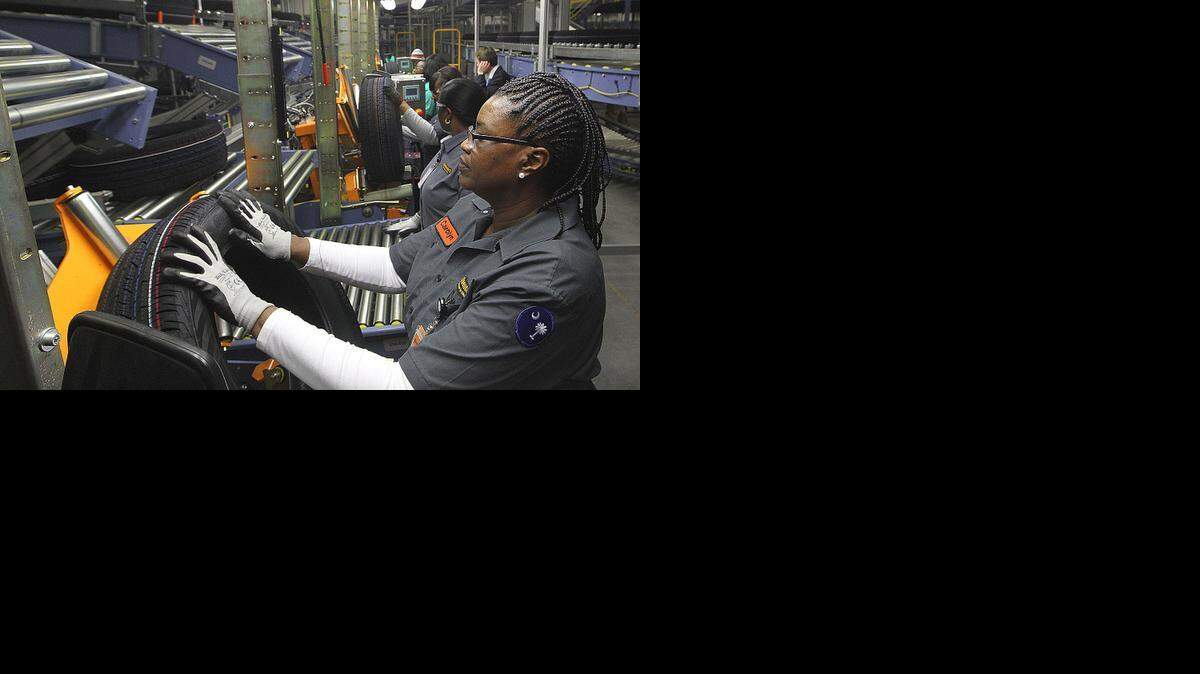
Manufacturing has powered the recovery in South Carolina since the end of the Great Recession in 2009, and is continuing to post strong numbers in investment and job growth even as other industries begin to flex their muscle.
Manufacturing job growth in South Carolina rose 13.5 percent from January 2011 – the beginning of Gov. Nikki Haley’s administration – to December 2014. That is nearly double the 7 percent average of all other Southeastern states.
However, economists warn that the rate of growth could level off as companies slow their post-recession expansion and skilled workers become harder to find. Also, a stronger dollar and rising interest rates would have a negative affect on the state’s export-heavy industries, as they will cause the prices of cars, planes and tires to rise overseas.
“Anytime you have pent up demand coming out of a recession, there will be a leveling-off period,” said University of South Carolina economist Joey Von Nessen.
South Carolina’s post-recession highs in manufacturing employment and investment came in 2011. Job growth posted gains for the first time since the beginning of the recession – 3.5 percent growth – and investment logged its biggest gain – $4.71 billion, according to the state Commerce and Employment and Workforce departments.
Since then, manufacturing job growth slowed to 2.3 percent in 2012, 2 percent in 2013 and 2.46 percent in 2014, calculating yearly averages. Capital investment has remained very strong, however, but at slightly lower levels – $3.28 billion in 2012, $4.46 billion in 2013 and $4.42 billion in 2014.
Those investment numbers are powered by recent big-time announcements such as last year’s Giti Tire plant in Chester and its promised 1,700 jobs. And already this year, Chrysler subsidiary Dailmer announced the conversion of its Charleston assembly plant to a full-fledged manufacturing plant, touting 1,300 jobs.
Also, another “whale,” as recruiters call big manufacturing plants, may be surfacing. South Carolina is said to be in the hunt for a Volvo auto manufacturing plant, although Commerce officials won’t comment on their efforts.
“I don’t think it’s going to slow down a bit,” Commerce secretary Bobby Hitt of Charleston, a former BMW executive, said of manufacturing job growth. “We’ve got a lot of jobs out there that are going to hit.”
Pro-business environment
But other sectors of the economy are catching up with manufacturing in South Carolina, as those industries finally ramp back up after the recession..
In 2014, business and professional services grew 18,200 jobs, compared with manufacturing’s 8,900, although many of its jobs are temporary positions offered by companies still too leery of the future to pull the trigger on full-time workers.
Leisure and hospitality jumped to third, adding 7,100 jobs, as consumers had enough confidence in the economy to begin spending money on vacations and eating out, and businesses started beefing up their travel budgets.
Construction showed a mini-comeback in 2014 by adding 2,100 jobs; and, a recovered housing market means more demand for manufactured products, from refrigerators and dish washers to heating and air conditioning systems.
“You can’t pick one industry in the Southeast anymore,” said College of Charleston economist Frank Hefner, saying the recovery is progressing in pretty much the same manner throughout the South.
While some industries are catching up, don’t look for a downturn in manufacturing, experts say.
“I don’t think we’re going to see a decline because of trends that transcend South Carolina,” Von Nessen said.
Increasingly, companies are choosing to build new plants and expand in the South, where labor is cheaper, unions are almost nonexistent and the climate, both business and meteorological, is favorable.
Recently, BMW opened a plant in Mexico for the same reasons, said Lewis Gossett, president and CEO of the S.C. Manufacturers Alliance.
Hitt added that what separates South Carolina from the rest of the pack is the port of Charleston. He said that South Carolina has become the nation’s leading producer and exporter of tires, has created an entirely new aviation cluster with Boeing, and is growing its established automotive industry with BMW and Dailmer – much of it directly related to the port.
“All the numbers are going in the right direction,” he said.
But Von Nessen warned that a stronger dollar and rising interest rates “are something we have to be on the lookout for. On the margins, all that has a negative impact on export activity.”
Lean, mean operations
Is the state’s success in creating manufacturing jobs outpacing its ability to train workers to fill them?
“The problem we are going to run into is the skill gap for people who are technically savvy for the jobs that are being created,” Hefner said. “I don’t know how we are going to overcome that.”
Hitt responded that while the “labor force is something we have to work on all the time,” the state’s track record shows that when the rubber meets the road, South Carolina technical schools and apprentice programs can deliver the workers.
“Twenty years ago when BMW came here we didn’t have any automotive workers,” he said. “Boeing has 7,500 people working there and (when it was recruited) we didn’t have any aviation workers. We’re inventing new sectors in this state and its not lost on our education community. We have young people coming out of our high schools and two-year colleges and four-year universities every day.”
Workers following the jobs here from other states also will help bridge the skill gap, Hitt said.
Gossett agreed.
“Frank’s concern is valid,” he said of the College of Charleston economist. “But we’ve had tight labor markets before. The good news is we are going to meet that need as we have in the past. And every part of the country has trained workers who need jobs. There is going to be in-migration.”
Gossett doesn’t buy the premise that companies have exhausted their post-recession expansion plans. He said most companies have concentrated on making their plants more efficient with less workers, and now will be forced to expand as the economy improves and demand for products increases.
“We are talking about some lean, mean operations that are poised to be more profitable and productive than they ever have been,” the manufacturers’ alliance executive said. “And that’s when you see hiring.”
Manufacturing capital investment and jobs in South Carolina
2006 $1.98 billion, 253,780 workers
2007 $3.57 billion, 249,324 workers
2008 $3.61 billion, 242,200 workers
2009 $2.15 billion, 213,866 workers
2010 $3.71 billion, 207,826 workers
2011 $4.71 billion, 215,137 workers
2012 $3.28 billion, 220,119 workers
2013 $4.46 billion, 224,533 workers
2014 $4.42 billion, 230,067 workers
SOURCE: S.C. Department of Commerce, SC. Department of Employment and Workforce
Biggest jobs announcements since 2011
2,000 workers 2013 Boeing expansion, Charleston
1,700 workers 2014 Giti Tire plant, Chester
1,620 workers 2011 Continental Tire plant, Sumter
1,300 workers 2015 Dailmer expansion, Charleston
1,000 workers 2012 BMW expansion, Spartanburg
800 workers 2014 BMW expansion, Spartanburg
SOURCE: S.C. Department of Commerce
Climbing out of the recession
Manufacturing investment and jobs numbers since the end of the recession almost 5 years ago.
Low point: $2.15 billion investment, 213,866 jobs in 2009
Climbing out: $3.28 billion investment, 220,119 jobs in 2012
High point: $4.42 billion investment, 236,800 jobs in 2014
SOURCE: S.C. Department of Commerce, SC. Department of Employment and Workforce
This story was originally published April 10, 2015 at 3:46 PM with the headline "Manufacturing still powering South Carolina’s recovery."