South Carolina wildlife officials to boaters: Watch out for dolphins, whales, turtles
Wildlife experts in South Carolina have a message for coastal boaters and beachgoers as winter gives way to spring: Please look out for dolphins.
The S.C. Department of Natural Resources said Friday that the Palmetto State is home to several hundred bottlenose dolphins. These large, fish-eating mammals can reach up to 12 feet in length and can weigh upwards of 400-600 pounds.
They are highly intelligent creatures and, yes, they are also very cute. But bottlenose dolphins are also at great risk, and their biggest threat is us.
Interactions with humans, including boat strikes and crab trap entanglements, are among the top causes of death for bottlenose dolphins in South Carolina.
“They are such curious creatures and anybody who’s spent time boating around here knows they are curious about people and they will follow boats,” said Erin Weeks, a spokeswoman for DNR in Charleston. “It can give folks the impression that they are not wild animals.”
As temperatures creep back up and residents and visitors flock to South Carolina’s beaches and coastal waterways, wildlife officials are reminding boaters and tourists to keep their distance from marine life, including dolphins, sea turtles, manatees and whales.
All of these creatures are essential members of South Carolina’s coastal ecosystem, and they are also federally protected.
Under federal guidelines, boaters must remain at least 50 yards from dolphins, porpoises and sea turtles, and 100 yards away from large whales. Fifty yards is equal to 150 feet, which is roughly the length of half a football field or three semi-trucks.
Federal law also states that vessels must stay at least 500 yards away from critically endangered North Atlantic right whales, which have seen their population numbers plummet from about 480 in 2010 to fewer than 350 today, as many of these creatures succumb to man-made threats like entanglements and boat strikes.
But dolphins can be harder to see than large whales and slow-moving manatees.
“The dolphins are a lot trickier to spot,” Weeks said, noting that their gray coloring can camouflage into the water, especially on a cloudy or overcast day.
Polarized sunglasses, Weeks said, can make it much easier to spot marine wildlife through the glare and on the water.
“But at the end of the day, it’s a matter of being alert of what’s behind and in front and around you as you move through the water, especially when traveling in smaller tidal creeks where these animals like to feed,” she said.
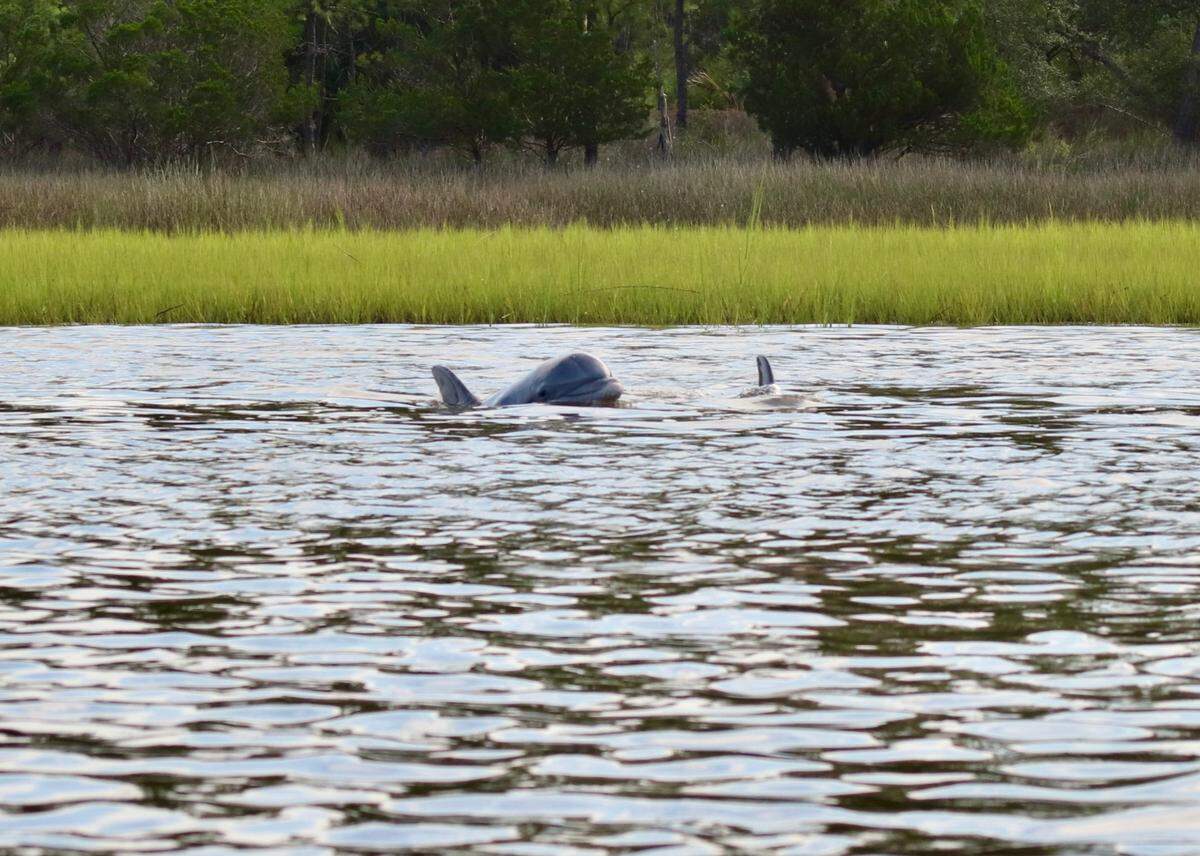
Collisions between boaters and dolphins are more likely to occur in shallow waters, particularly in small tidal creeks and along marsh edges, according to state wildlife officials. But beachgoers need to keep an eye out for dolphins, too.
Lowcountry dolphins engage is a practice called strand feeding, a hunting behavior seen in only a few dolphin populations worldwide. When strand feeding, a small group of dolphins will move in a tight circle to herd a school of fish onto the shore, driving the fish out of the water and onto the banks before the dolphins then jump onto the shore to eat the fish.
The phenomenon, however, can be interrupted by beachgoers who get too close. Wildlife officials urge people who are lucky enough to see this behavior to follow similar distancing requirements of boat vessels: Stay about 50 yards away and give these animals a wide berth.
Bottlenose dolphins are also protected under federal law by the Marine Mammal Protection Act of 1972, which makes it illegal to harass, hunt, capture or kill any marine mammal. Conviction at the federal level is punishable by fine of up to $50,000 and/or one year in prison.
Lauren Rust, the executive director of the Lowcountry Marine Mammal Network, said there have not been any cases of dolphins being entangled or struck by boats so far this year, as winter months tend to be slower. But she stressed there were entanglement cases last year.
Likewise, Weeks said DNR has not had any reports of sea turtles struck by boats this year, but said biologists and volunteers documented 47 cases of turtles killed by watercraft in 2021.
Boat strikes are the top cause of death for sea turtles in South Carolina.
All of South Carolina’s marine wildlife is part of what makes the Lowcountry so special, Weeks said.
“There’s a lot of dolphins that live year-round in our waters,” she said.
Sea turtles also call the Lowcountry waters home, with nesting sea turtles arriving on its beaches in late April and early May.
And when the waters warm up in late April or May, manatees also begin bobbing through these waters.
“Because of our mild climate, our waters are pretty busy year-round,” Weeks said. “For us, looking out for these creatures is not just a seasonal thing. Folks need to be aware and alert year-round.”
To report an injured, stranded or dead dolphin, please immediately call the 24/7 S.C. DNR wildlife hotline at 1-800-922-5431. If a boat accidentally collides with a dolphin, biologists also ask that the boater stand by and immediately contact S.C. DNR or the U.S. Coast Guard on VHF Channel 16.
Tips for being dolphin-friendly in South Carolina:
▪ Use caution when navigating in shallow waters and tidal creeks
▪ Always heed “no wake” zones, operating boat at the lowest possible speed while maintaining steerage
▪ Never feed dolphins. This teaches animals to approach boats and docks, putting them at greater risk of a boat strike, and it is illegal. Do not dispose of fish carcasses when dolphins are nearby
▪ Never pursue, harass or interact with dolphins. It is dangerous for the animals and illegal
▪ Report any wildlife violations to SCDNR’s 24/7 hotline: 1-800-922-5431
This story was originally published March 18, 2022 at 12:44 PM.