
Amid coronavirus quarantine, SC parents become teachers whether they’re ready or not
Parenting has always been a bit unconventional for Shea Harley.
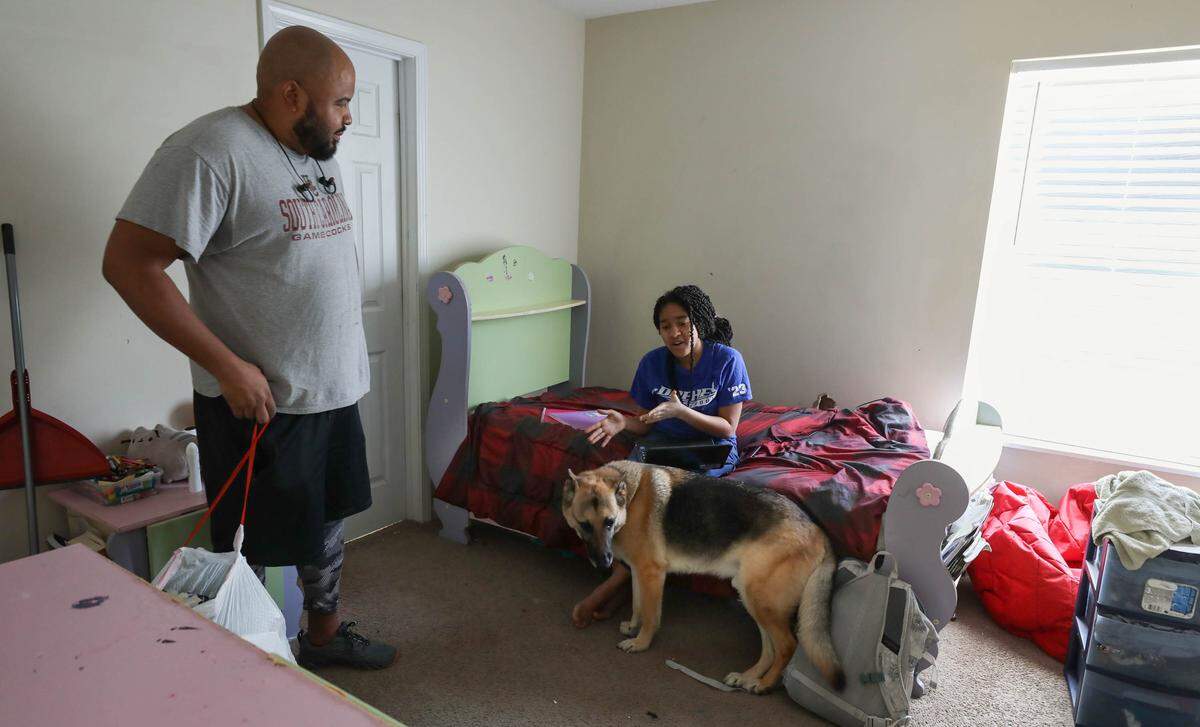
But since coronavirus caused school to be held from home, the military veteran, business owner and single father has picked up another role: teacher.
Harley has 14-year-old twins, a boy who is an eighth grader at Hand Middle School and a girl who is a ninth grader at Dreher High School, he said. Both of them have autism, he said.
Since Harley’s kids are older, he’s not necessarily walking them through math equations or helping them understand long passages. Rather, one of his biggest roles is to keep them on track and keep them up to date with what’s going on in the world.
“One of the biggest things I have to do is keep them informed,” Harley said. “I can’t sugarcoat it. I can’t hide it from them. I just have to tell them.”
Harley is one of thousands of parents throughout South Carolina who are filling in as educators after their children were kept home from school to avoid spreading coronavirus. Parents are having to learn how to teach from home as they go, and in many cases, as they also work from home. The actual lessons themselves vary from worksheets and readings to sending their teachers pictures of handwritten essays or videos of musical instrument practices.
While Harley adapts to his new reality, his kids bring home some of their school habits. For example, when he leaves the room he will often hear his kids’ phones making video game noises. Then, once he starts to walk back to the room, he’ll hear them toss the phone out of their hands and thump on the floor, he said.
“I’m learning more about them in terms of what they do or may not do in school,” Harley said. “I’m learning a lot about my kids.”
To break things up, Harley will take his kids outside to shoot hoops or ride bikes, he said.
“It’s kind of weird,” Harley said. “We’ve never been in a situation like this.”
Harley didn’t seem as overwhelmed as some other parents who talked to The State, but perhaps that’s in part because Harley has been preparing for this. He thinks that between coronavirus, school bullying and school shootings, it’s likely more and more students will be learning from home, Harley said.
“Who knows, this may be a new reality,” Harley said.
‘I’m not a teacher’
Harley’s role was more keeping his kids on track with their education. But for parents with younger children, they’re also having to operate as quasi-teachers.
As the mother of an 8-year-old and a 4-year-old, and who works two, part time jobs as a bookkeeper, Jacqueline Marshall already had her plate full, she told The State.
And being a teacher was not something she thought she had time for, she said.
But since schools throughout South Carolina have closed until at least the end of March, and lessons are done remotely or online, parents like Marshall are having to learn how to become teachers.
“I’m not a teacher, and it’s hard to know how actually (my son’s teacher) is instructing him and getting him to do his work,” said Marshall, whose 8-year-old son is a second-grade student at Brennen Elementary School in Richland 1.
During the days, Marshall tries to keep her kids entertained while she works from home, she said. But since her son does not have a laptop to complete his schoolwork, he has to wait until Marshall is done working to do his schoolwork, she said.
“I spend half the day working on my work, then in the afternoon he does his work,” Marshall said.
To make things worse, her whole family is sick.
“We have all of the coronavirus symptoms, but they won’t test us because we have no known contacts,” Marshall said.
Marshall is just one of many parents who find themselves struggling with both getting themselves through the coronavirus and learning to teach their children.
“The stuff they are learning in school now is completely different than what we learned so I am pretty much worthless at helping them,” Richland 1 parent Brandy Harper said on Facebook.
Harper’s concern that parents may not have enough expertise to teach students has been a common theme Richland 1 administrators have heard, said district spokeswoman Karen York.
Richland 1 has been telling parents to slow down when doing assignments, build in time for physical activity and take breaks, York said.
Jessamine Grice, who has two sons — a second grader and fourth grader at Meadowfield Elementary — said one of her biggest challenges was figuring out how much information to assign to her sons in a given day.
“The challenge is ... fitting in all this work,” Grice said. “I don’t know how a teacher would really do it, when they give them breaks, when they let them go on their own.”
Staying flexible
While parents might feel pressure to help teach their kids as their teachers would, parents should realize that isn’t the expectation for them at this time, said Angela Baum, an associate professor of early childhood education at the University of South Carolina’s College of Education.
“I think it’s natural for parents to feel like they don’t know how to do it. ... I don’t want parents to worry about that,” Baum said. “Everyone has different styles and personalities. Make it work for what works for you, and that’s OK. That time with you as a parent is important enough.”
Baum, who has two elementary-aged children of her own learning from home now, recommends setting some structure to your family’s day at home but leaving plenty of room for flexibility.
For many children, she said, it’s “unrealistic” to expect them to sit at a table and do their school work in one long block of time. After all, that’s not how they work at school, either.
“They’re working with friends, having recess, going to special areas,” Baum said. “Some scheduling is important … but have a lot of flexibility to account for things that aren’t working well.”
An important reminder for families spending days at home with their children at this time, Baum said, is that perfection is not the goal.
As parents spend more time using e-learning, they’re starting to adjust.
Marcia Rodriguez, who has a fifth grader and a second grader at Brockman Elementary, said she has been using online resources, such as materials provided by the schools and YouTube videos to fill the gaps.
“It was a rough start,” Rodriguez told The State. “But I feel like we’re starting to get in a rhythm.”
‘One day at a time’
For many teachers, however, the transition hasn’t been as jarring.
“My kids are logging on. We were already connected online,” said Christi Lewis, a teacher at W.G. Sanders Middle School. “It was just a continuation of what we were already doing, for me.”
Lewis, who teaches orchestra, has been asking students to submit videos of them practicing in lieu of class, she said.
Students who do not have laptops at home were sent home with hard copies of worksheets and other classroom material.
The information packets — whether in paper form or digital — often have scores of pages in them and can look intimidating to people unfamiliar with designing lesson plans, Lewis said.
Lewis encourages parents and students to look at the e-learning materials “one day at a time.” Making sure students aren’t overloaded with information is one of the jobs of a teacher, Lewis said.
Rather than a student being able to raise his or her hand when they have a question, teachers have been answering emails during office hours, which for Lewis are 9:30-11 a.m. and 1-2:30 p.m., she said.
Not all students have internet access, so Richland 1 will be driving wifi-equipped buses to areas where students can access it, although the locations have not been determined yet, York said.
Asked how the parents were handling the remote learning, Lewis laughed and said, “When we get to the end of this, we’re going to have some more supporters for education.”
BEHIND THE STORY
MOREWhat you should know about the coronavirus
The coronavirus is spreading in the United States. Officials are urging people to take precautions to avoid getting sick, and to avoid spreading the disease if they do contract it.
Click the drop-down icon on this card for more on the virus and what you should do to keep yourself and those around you healthy.
What is coronavirus?
Coronavirus is an infection of the respiratory system similar to the flu. Coronaviruses are a class of viruses that regularly cause illnesses among adults and children, but this outbreak has spawned a new disease called COVID-19, a particularly harsh respiratory condition that can lead to death.
Health officials believe COVID-19 spread from animals to humans somewhere in China. It spreads among humans by physical person-to-person contact, including via coughs. That’s why health officials urge sick individuals to avoid contact with other people.
For more information, visit the website for the Centers for Disease Control and Prevention.
What are the symptoms?
Symptoms are similar to the flu and include fever, coughing and shortness of breath.
How can I stop the spread of the coronavirus?
Wash your hands regularly with soap and water, and cover your mouth and nose when you cough or sneeze.
If you develop symptoms similar to the coronavirus, you should seek medical attention. Stay home from work or school and avoid contact with others. It can take up to 14 days after coming into contact with the virus to develop symptoms.
COVID-19 is a new condition and there’s much about the disease we still don’t understand. For now, taking precautions is the best way to stop the spread of the coronavirus.