Is COVID-19 surging in SC? Data show increased activity as businesses reopens
As more and more businesses have reopened across South Carolina over the last two weeks, inviting people to venture out of isolation and into the public despite the ongoing threat of the coronavirus, health experts also have seen a surge in confirmed infections.
Across the board, Department of Health and Environmental Control’s data used to measure COVID-19’s spread across the state have shown an increase in disease activity over the last two weeks.
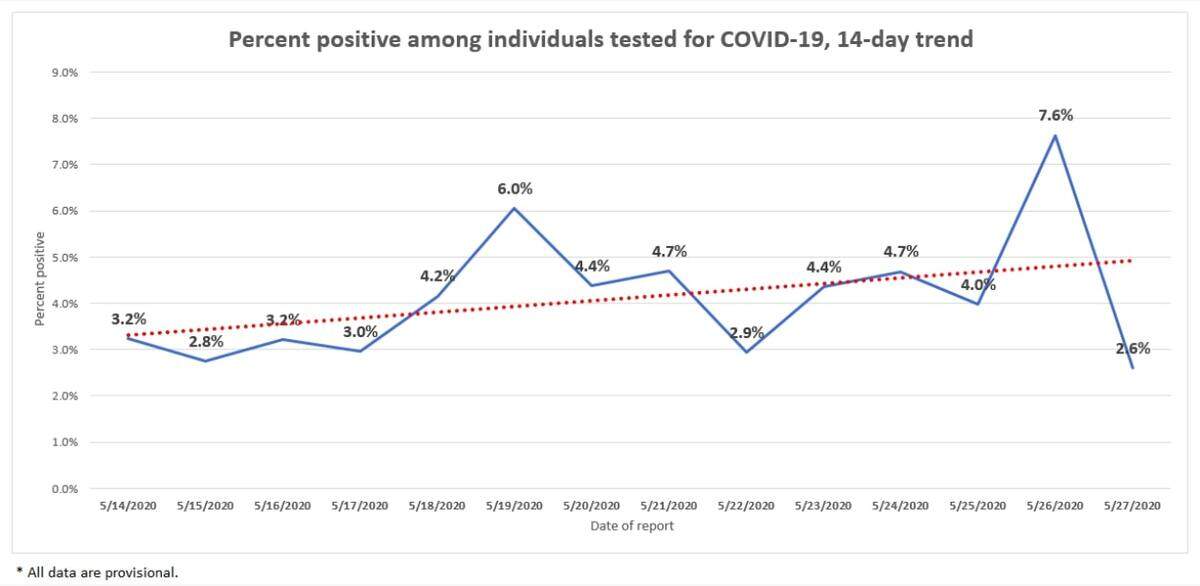
While some increases — like the leaps in cases per week and the seven day average number of cases — may be due to DHEC’s increase in testing, state health officials have said that the percentage of tests that turn up positive will serve as a bellwether for determining how quickly the coronavirus is spreading across South Carolina.
That proportion has increased over the last two weeks, according to DHEC data. From May 13 to May 26, the percent of positive cases trended upward, changing from 2.7% to a peak of 7.7%.
That could mean that the virus is spreading more rapidly than in weeks past, as the economy reopens and people worry less about adhering to social distancing guidelines.
DHEC officials did not respond to questions about the data trends emailed to them Wednesday, but during a call with reporters Friday, DHEC Chief of Staff Jennifer Read said state health officials are “continuing to study and look at the trend lines.”
Read said the percentage of positive cases remains relatively low, much lower than the average 9-11% officials saw during March and early April.
“We’re talking about very small percentages here,” Read said. “In epidemiology, we tend to look at the long term trend.”
Director of Public Health Joan Duwve added that it was too soon to talk about the affects of businesses reopening on COVID-19’s progress in South Carolina.
The increase likely doesn’t indicate that South Carolina is headed toward another exponential jump in cases — like what the state saw in March and early April — but it does raise concerns about possible future outbreaks, said Medical University of South Carolina global and community health expert Michael Sweat.
“It is probably a little early still to know if this will be sustained,” Sweat said. “Most of us are concerned that we will indeed see some outbreaks in the coming weeks.”
More people are moving about as the economy has reopened, and around Memorial Day especially, it seemed as though fewer people were adhering to social distancing guidelines, he added.
This month, S.C. Gov. Henry McMaster has lifted restrictions on several types of businesses. On May 1, McMaster lifted his “home or work” order, and three days later, he allowed restaurants to reopen outdoor seating.
Restaurants reopened indoor seating May 11, and businesses that have close contact between customers or clients and workers, such as salons and gyms, reopened on May 18. The governor also lifted restrictions on attractions in time for Memorial Day weekend.
South Carolina is one of 20 states to see increases in case numbers as they reopen, Reuter’s reported. From the week of May 3 to the week of May 10, the state saw a 12% increase in cases per week. That number increased again by 6% the following week.
Seven of the last 14 days have seen more than 200 people test positive, according to data released daily by DHEC. On Friday, the state saw its highest single day increases in cases with 331. About 6.2% of the tests performed the day before were positive, one of the highest percentages in the previous two weeks.
DHEC officials project that the number or cases reported each week will continue to increase until at least the second week of June.
The Palmetto State was joined by its southern neighbors North Carolina, which saw a 26% increase, and Alabama, which saw a 28% increase in new cases as their economy’s reopened.
DHEC officials and McMaster have long warned the state would see an increase in some metrics as DHEC implemented their new testing plan, which includes testing 2% of the state’s population during both May and June. State health officials announced Tuesday they had met that goal after completing more than 110,000 tests in May alone. Officials have also tested all staff members and residents at nursing homes across the state.
Speaking to reporters Thursday after a meeting of his AccelerateSC COVID-19 task force, McMaster said the state is “seeing what we’re expecting.”
McMaster pointed to the “great volume of testing” taking place in all nursing homes and at sites all over the state as the reason for the increased numbers.
“Because of the testing — ... because of the opening up of testing, all of the testing sites, mobile and static, all over the state, with no limitation of who can go in and get the test — we expected to have the numbers go up,” McMaster said. “That’s what’s happening. The main thing to watch is to watch the trend. We are satisfied with the trends.”
The percentage of positive tests has trended up over the last 14 days, according to DHEC’s data. But Wednesday, DHEC Director Rick Toomey, who announced this week he would be leaving the agency, said it has overall been trending down over the last 28 days. McMaster also pointed to the longer term view Thursday.
“There are snap shots of any two week period that are positive or negative,” Toomey said. “I think we’ve done a good job, and it is plateauing. There’s a little down, and there’s a little peak up, but we are better off than we were six weeks ago.”
Joseph Bustos contributed to this report.
This story was originally published May 29, 2020 at 12:27 PM.