
’Everybody loved her.’ Family mourns Columbia matriarch who died from COVID-19
Willie Mae Wright was the woman at the center of it all, the warm heart her family would gather around. You couldn’t walk by Wright at a family gathering or cookout without saying hello. If you tried, she’d teasingly call you out: “What? You’re not going to speak to me?”
In her younger days, Wright and her sisters started a yearly tradition of taking a family-wide vacation during the summer. Children, grandchildren, great grandchildren, nieces and nephews, sometimes 20 or 30 people would all go to the beach together. Last summer, the Wrights went to Disney World. Willie Mae wasn’t the type to go on roller coaster rides. All she needed was to see the joy on her grandchildren’s faces. That was enough for her.
She had three children, four grandchildren and five great grandchildren, and she had a special relationship with every one of them. They’d all cling to her on the couch, laughing together as they watched Steve Harvey’s “Family Feud.”
Willie Mae was especially close with her daughter Tress Wright, and Tress’ daughter, LaToya. The three shared the same northeast Columbia home for more than 20 years.
Willie Mae helped Tress raise LaToya, who was born with a mental disability as well as heart issues. Over the years, Willie Mae and LaToya developed a bond that went far beyond the typical grandmother-granddaughter relationship.
“Oh my gosh, they were more like the best of best friends,” Tress said. “That was (LaToya’s) role person. Whenever my mom moved, my daughter moved. When my daughter moved, my mom moved. Sometimes I had to tell her, ‘Mom, she’s all right. Let her go.’”
Willie Mae was 74. LaToya is 34. Those 40 years of difference never mattered. They were inseparable. Their home was defined by love, by joy, by faith.
On February 26, everything changed.
Final goodbyes over the phone
On that day, Tress found Willie Mae collapsed in her bathtub, unable to get up. Tress called 911 and an ambulance took Willie Mae to Prisma Health Richland Hospital. She never came home again.
What hurts Tress and her family the most now is that Willie Mae never went to the hospital for COVID-19. Her injuries from her fall in the tub were never expected to be lethal. Doctors performed neck surgery, she spent a couple of weeks in the hospital, and the plan was for Willie Mae to receive rehab for a couple more weeks and then come home.
Willie Mae was transferred to a rehabilitation center in Columbia on March 16. Tress helped her get checked in and brought her clothes and belongings to aid in her adjustment to the new facility. A day later, as the coronavirus crisis reached full bloom around the country, Encompass locked down the facility to all outside visitors.
Tress could only stand by in horror, from afar, as she heard that her mother might have been exposed to the coronavirus while rehabbing. On March 26, she called the office and learned that her mother tested positive. The virus struck quickly, and the prognosis grew worse daily. In early April, Willie Mae went back to the hospital and found herself in the medical ICU, struggling to breathe.
The last time Tress spoke to her mother was over the phone, just before she went on a respirator.
“Me and my daughter, we got to talk to her for a little while,” Tress said. “And I said, ‘Mama, I love you, and we’re here. I’m sorry we can’t see you, but just do the best you can to get better.’”
Willie Mae’s alertness waxed and waned on the call. She was a little disoriented and confused, but she knew who was on the other line. The woman who insisted on family togetherness, who put her family above everything else, was able to say “I love you” to her daughter and granddaughter one last time.
She died on April 13, of heart failure.
‘Everybody loved her.’
Tress and her family know the devastating, gut-wrenching pain of loss all too well. When Tress was a middle schooler, she lost two grandparents — Willie Mae’s mom and dad — on the same day.
Her grandfather had been sick for some time at what is now Prisma Health Richland Hospital. When her grandmother heard he had died, she suffered a heart attack in front of the entire family. Tress remembers yelling, “What’s wrong with my grandmama? What’s wrong with my grandmama?” as the adults directed her and the other children into another room.
That moment is forever etched in her memory. It changed the course of her life, as trauma often can. She sought a career in medicine because of it, and she has worked as a certified nursing assistant for the last 25 years.
“I got into this field because I love people,” Tress said. “I love to see people get better. We can’t save everybody, but we do our best.”
Over the last couple of decades, Willie Mae lost each of her four sisters. The thought that she could be reunited with them now is one that provides the Wrights at least some measure of solace.
Tress’ cousin Calvin Wright was the first in the family to lose a mother, in 2001, shortly after his daughter was born. She sustained severe injuries, including to her head, in a car accident. At 24 years old, Calvin had to attempt to teach his mother how to read and write again before a blood clot ultimately ended her life.
“I know how it feels to lose a mom,” Calvin said. “It’s something you’ll never get over. You just have to try to deal with it, and it’s still going to be hard to try to deal with it.
“My mom has been gone 19 years, and I still have her obituary on my closet door. It’s hard. It’s going to take some time for the family to heal.”
Willie Mae, Calvin’s aunt, was one of the people who helped steer Calvin’s life back on track after his mother’s death sent him down a dark path. Calvin is trying to lend that same support to his cousin Tress now.
Tress said her mother’s death brings her back to that day she lost her grandparents and the devastation she felt then. Trauma is an inescapable part of life, but the trauma caused by COVID-19 is an especially sinister kind. The Wrights have experienced a cacophony of emotions, from pure grief, to shock to anger — anger over the fact that Willie Mae contracted the virus while under medical care and while rehabbing from a non-life-threatening injury. Willie Mae was supposed to come home on the day she was tested for the virus.
In addition to processing her own emotions, Tress has had to help LaToya, Willie Mae’s granddaughter and best friend, process hers too.
“My mom was a sweet lady; everybody loved her,” Tress said. “Everybody loved her. Nobody had harsh words to say about her. It was difficult for everybody, friends, family. It’s been difficult. She was just a loving person, loved her God. And she helped me raise my daughter, and when I saw how my daughter reacted, it really got to me that they took somebody away from us.”
Added Calvin: “It’s a big heartbreak in the family right now. It’s hard. We can’t believe it’s going on. I know we all must leave one day, but this wasn’t her time. It really wasn’t her time to leave.”
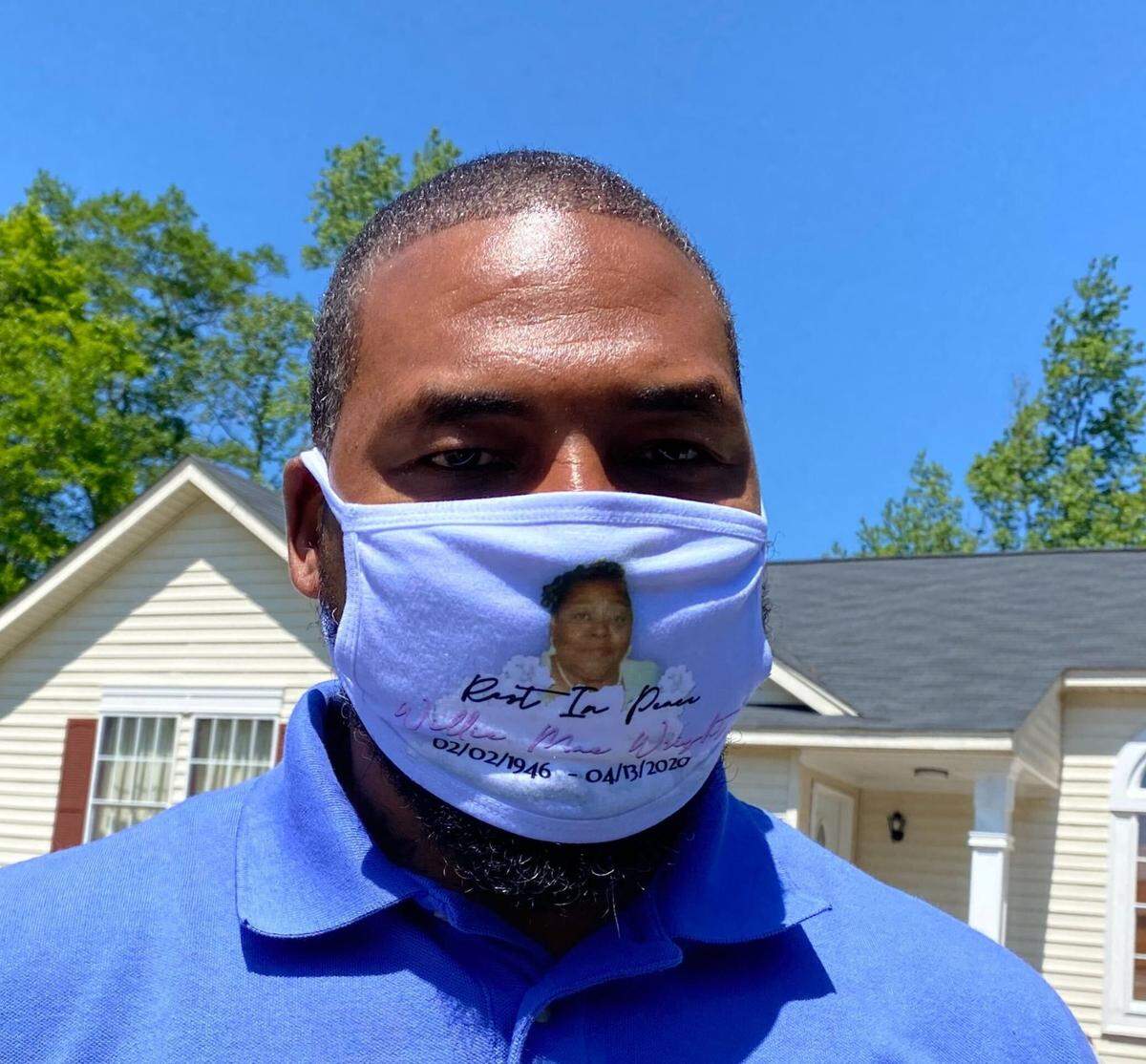
Mourning in the time of social distancing provides its own set of challenges, but the Wrights found a way to honor her nonetheless. They held a funeral at Memorial Gardens of Columbia on April 18 — the birthday of one of Willie Mae’s great granddaughters. Knowing firsthand about the dangers of the coronavirus, the Wrights encouraged guests to wear face masks and maintain a safe distance. They even designed custom face masks for the funeral — sky-blue ones with a picture of Willie Mae smiling above a cloud and the words, “Rest in Peace” below her.
Willie Mae was the kind of person who could walk into a grocery store and walk out with two or three new friends, whose laughter and joy could fill a room, who was always — always — the life of the party. Social distancing or not, her funeral was destined to be flooded with friends and loved ones. Immediate family stood with her casket under a tent, while many, many others paid their respects on the grass surrounding Lot 28. There were even people who mourned from their cars, parked outside of the gardens.
And, just as she lived, Willie Mae was the woman at the center of it all.
This story was originally published June 30, 2020 at 5:00 AM.