‘Nothing we can do.’ Thousands of SC tenants evicted despite COVID moratorium.
A microwave. A bright pink pair of children’s sneakers. A plush blue sectional. A rolled up area rug.
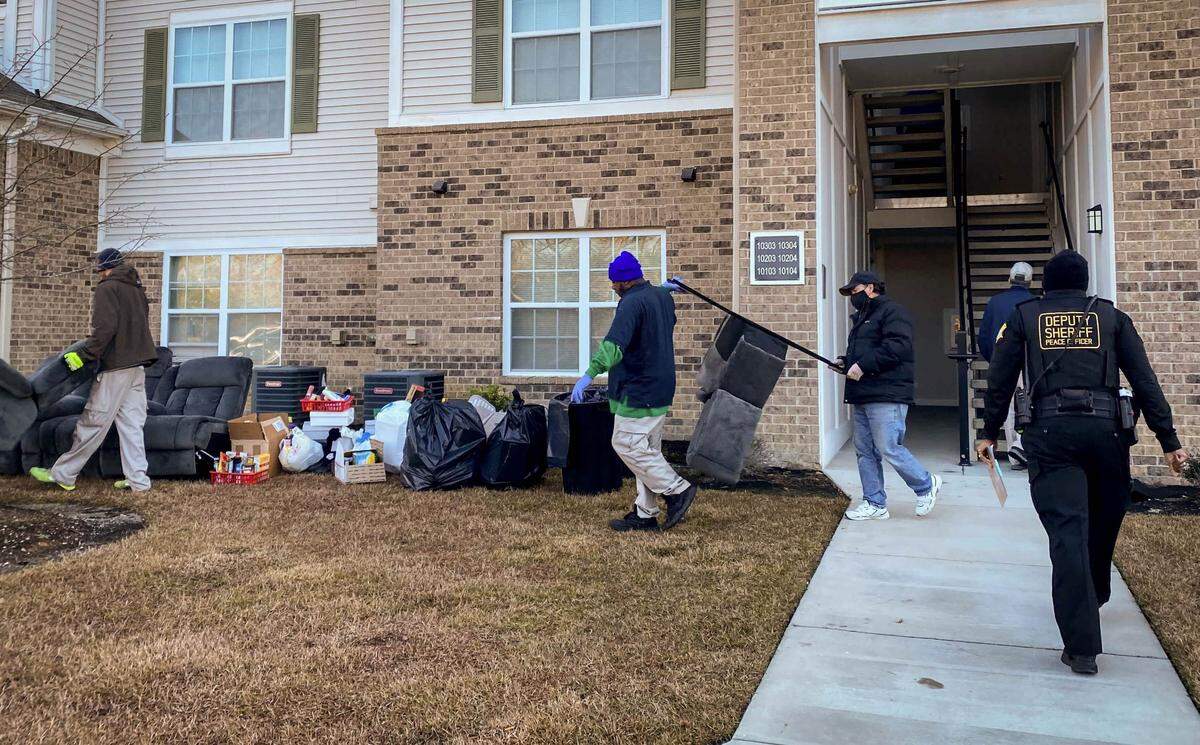
Sgt. Erin Hill from the Richland County Sheriff’s Office watched as a crew of maintenance workers from the Killian Lakes apartment complex placed the random assortment of discarded items outside building No. 10. They were the only remnants of the family Hill was called in to evict that morning, just two weeks before Christmas.
Though the tenants had moved out by the time she arrived, Hill said it’s not always that easy. She’s seen irate young men threaten moving crews for going through their belongings and had sobbing mothers beg her to let them stay for a few extra days.
“It’s the worst part of the job,” Hill said. “Having to put people out of their homes, it’s extremely emotional. But there’s nothing we can do. We’re just carrying out the judge’s orders.”
Though a federal eviction moratorium went into effect in September, Hill said her unit has enforced between 10-15 removals a week since then. Once the moratorium expires at the end of January, “we’re expecting to see many, many more,” she said.
South Carolina renters at risk
The Centers for Disease Control and Prevention issued the moratorium to keep millions of families off the street, preventing further spread of the virus that has killed over 300,000 people and plunged the U.S. into an economic crisis. Congress extended the moratorium to the end of January as part of a $900 billion coronavirus relief package approved this week. But after months of inconsistent enforcement and confusion about the rules, housing advocates say it’s unclear how many people have already fallen through the cracks and how many more will suffer once the protections run out.
“While I do believe the CDC’s intentions were good, it’s clear that this was a very hastily issued order,” said Nicole Paluzzi, a housing attorney for Charleston Pro Bono Legal Services. “I think we’ll see a lot of the negative repercussions of this come January when cases resume.”
The moratorium does not put a full stop on evictions. Protections only apply to tenants who sign and submit a declaration under threat of perjury stating that they are unable to pay rent because of the pandemic. Tenants who violate the terms of their lease — for instance, by having unauthorized pets or long term guests — can still be evicted. So can tenants whose leases are expiring.
There were 4,400 evictions filed statewide in the first month after the moratorium, according to court data collected by SC Housing, the state’s housing finance and development corporation. As of last week, 21,192 eviction cases have been filed across five of South Carolina’s most populous counties — Richland, Charleston, Lexington, Greenville and Horry.
Of the nearly 21,200 eviction cases filed in the five counties examined by The State and The Sun News, 2,162 — or just over 10% — resulted in a “writ of ejectment,” meaning tenants could be forced to vacate.
According to a memo from SC Legal Services sent to housing groups, eviction cases filed during the moratorium have three possible outcomes: the case is dismissed due to the moratorium, the hearing is delayed until the moratorium expires, or, in the most extreme cases, the ejectment is carried out.
Gladys Sheckleford found herself on the brink of homelessness after her partner lost his job, leaving her unable to come up with the $250 she needed for rent in September.
Though she should have been safe, she was unaware of the requirement to submit a signed declarationto the magistrate and her landlord. Among other things, the declaration states that residents are unable to make rent because of financial setbacks caused by COVID-19, that they have sought out all forms of rental assistance and that they will make an effort to pay partial rent if possible.
Within days of missing rent, Sheckleford found an eviction notice on her doorstep. Soon after, the magistrate ordered her to vacate her apartment.
“We literally had 48 hours to work a miracle,” said Sonya Lewis, chief communications liaison for local social justice organization One Common Cause. She helped Sheckleford file a last minute appeal that halted the eviction.
Infiniti Calloway, of Columbia, said she did not know about the moratorium and that her landlord tried to take advantage of that. For instance, hours after she submitted the CDC declaration, “my landlord told me they were going to do an inspection of my apartment,” Calloway, 21, said. “I feel like because I filled out the form they were just trying to look for a different reason to evict me.”
One Common intervened on Calloway’s behalf and an inspection was never performed.
Lewis said state and federal governments have failed to publicize the moratorium, forcing grassroots groups like hers to step in. Though her group has helped at least 15 Columbia residents stay in their homes, she fears that those who didn’t know where to turn for help may have ended up homeless.
“Just think of how many people we couldn’t save,” she said.
Inconsistent guidelines from CDC
Other states have set explicit guidelines for how courts should handle the moratorium. Some have even required landlords to attach the necessary declaration to all eviction notices. But housing rights advocates say South Carolina has allowed the magistrates to interpret the rules as they see fit.
“The CDC order left a lot of gray area and that leads to inconsistencies,” said Adam Protheroe, an attorney for South Carolina Appleseed Justice Center. “For instance, there were some courts that were saying if the eviction was filed before the moratorium was issued then the moratorium didn’t apply. Others were less strict about when it was filed.”
Horry County Chief Magistrate Judge Christopher Arakas said the Myrtle Beach Magistrate Court has mostly been dismissing eviction cases during the moratorium, but there is some discrepancy over the time frame of when the signed declaration must be submitted to the landlord.
Arakas said because the CDC’s order doesn’t have a specific time frame attached to it, he’s seen the declaration given to the landlord up until the court date, and in some cases, in court. In his interpretation of the moratorium, the declaration is supposed to halt an eviction proceeding at that time, similar to an appeal.
Landlords have criticized the moratorium because they say it makes it their responsibility to assume tenants’ debts.
“It doesn’t make any sense that this expense is falling on the shoulders of a niche group of people instead of the federal government,” said David Krausz, a landlord who owns 135 units across South Carolina. Since the moratorium went into effect, Krausz has lost tens of thousands of dollars, he said.
Though the CDC’s ruling states that tenants must make a good faith effort to seek out all forms of housing assistance and make partial payments if they are able, Krausz said there’s no way to enforce those requirements.
“I can’t find a handbook anywhere for how I should proceed with these things,” he said. “I’ve asked about evicting tenants who clearly violated these rules and are guilty of perjury, but the courts said they weren’t interested in hearing about it.”
More SC evictions on the horizon
Arakas, the Horry County magistrate judge, said the courts are bracing for an even greater wave of evictions once the CDC moratorium expires.
“When that ends, unless the federal government does something else, I have no idea what’s coming down the pipe,” he said.
For residents like Sheckleford, 58, who is the primary caretaker for her 13-year-old grandson, the stakes are high. Losing her housing could also mean losing custody.
“It’s not just me I have to worry about, it’s him too. And we both have health problems so it’s scary to think about it with this virus,” she said. Though Sheckleford said she’s spent the past few months looking for a new place, so far she hasn’t been able to find one she can afford.
“I just pray,” she said. “It’s the best I can do.”
This story was originally published December 22, 2020 at 2:07 PM with the headline "‘Nothing we can do.’ Thousands of SC tenants evicted despite COVID moratorium.."