
After Fort Jackson training, America’s newest soldiers focus on Army careers
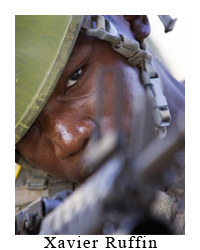
His squad of a dozen soldiers was moving to attack an enemy formation. Suddenly, firing broke out and the squad leader ordered his team to “shift fire right” rather than “shift fire left.” The result was four members of Ruffin’s squad were “dead” on the field.
The remaining soldiers had to take off their dead comrades’ boots, place them at the base of the victims’ inverted rifles, place the helmets on top of the rifles and wrap the dead soldiers’ dog tags around the base as a memorial to their fallen comrades. It’s called a battlefield cross.
“That’s when things really hit home,” the 17-year-old Ruffin said. “It really affected a lot of people. In combat that’s something you can never take back. And I never want to see it again.”
Ruffin is a member Company D, 2nd Battalion, 60th Infantry Regiment. It’s one of 11 battalions running constant 10-week basic training cycles at the nation’s largest basic training installation.
The fort churns out about 45,000 new soldiers each year.
As part of the yearlong celebration of Fort Jackson’s centennial, The State newspaper followed five South Carolinians in 4th Platoon of Company D as they endured the grueling rigors of basic training.
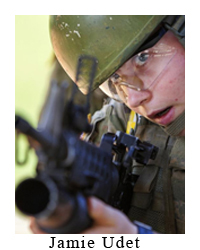
For 18-year-old Jamie Udet of Myrtle Beach, the two dates seem more than coincidental.
“It must mean something for us,” she said.
‘Very, very young’
The five represent a cross section of South Carolina and, for that matter, the Army. But they differ from many recruits in that they all are high school graduates.
Many who join the Army do it because they have nowhere else to go, or just need a job or a change of life.
The future soldiers we followed were recommended by the U.S. Army Recruiting Battalion based in Columbia, and several had attended Junior ROTC:
▪ Devon Clarkson, a tall, athletic 18-year-old from Hopkins
▪ Udet, 18, a soccer star from Socastee High School in Myrtle Beach
▪ Allicia Wiggs, 18, a Beaufort High School graduate and basketball player
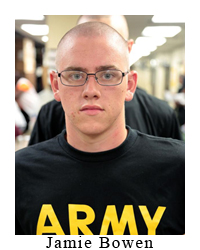
▪ Jamie Bowen, 18, of St. Matthews, a baseball player at Calhoun County High School
▪ Ruffin, 17, a JROTC graduate from Bamberg
The person who knows them the most and participated in every aspect of their training is the platoon’s senior drill sergeant, Staff Sgt. Alfonzo Branch.
Branch, 26, a veteran of two deployments to Iraq and one to Kuwait, was interviewed on Friday after the new soldiers had departed Columbia for the next phase of their military career: advanced individual training.
He said the group was unusual in that they were all so young. Since it was a summer cycle, the company was filled with recent high school graduates.
“Every platoon is different,” said Branch, who has been a drill sergeant for two years and is not one to mince words. “This cycle was very, very young and really immature. We had to be on our best game.”
‘I wasn’t Army ready’
Recruits go through three phases of training – Red, White and Blue.
Red Phase is more challenging physically as recruits are shocked out of their civilian temperament and whipped into physical and mental shape by their drill sergeants. It is the closest to the traditional recruit-drill sergeant relationship often portrayed in the movies.
It is not pretty.
For instance, the very first minute they arrive at the company barracks, they are “smoked” by circling, bellowing, often cursing drill sergeants in a tradition unofficially known as the “shark attack.” After this indoctrination, they are are required, on the first day, to rappel down a 40-foot wall called Victory Tower.
“No,” is not an option. Welcome to the Army.
“I’m scared of heights,” Ruffin said. “But I was more scared of my drill sergeant. So I did it.”
The three- to four-week Red Phase is also a time when physical assessments begin.
“I thought I was in shape,” said Udet, who had earned a soccer scholarship to Auburn University but decided to join the Army Reserve first to become a better teammate and broaden her horizons. “But with soccer it’s all legs. I struggled with my upper body strength. I thought I was ready, but I wasn’t Army ready.”
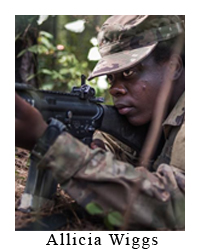
“I fail more soldiers on situps than anything else,” Branch said. “Core strength is one of their weakest attributes. Wiggs was great. She was prepared and she knew her stuff. She just didn’t put the effort in on that.”
The 18-year-old is now in a Fitness Training Company to work on that one aspect of her training.
“She’s not done,” Branch said. “She’s going to pass. She’s going to move forward.”
‘Quitting is not right’
White phase is geared more to weapons training.
In addition to learning how to handle their rifles, they are also instructed in orientation, communication and how to move and shoot.
They also are instructed in heavy weapons like 50-caliber machine guns, hand grenades and chemical weapons potection.
At one point they are led into a gas chamber, and told to remove their gas masks. The results are predictable and messy.
“I liked it,” said Ruffin. “It was fun, exciting. I had never done anything like that before.”
Red Phase is also when the throes of homesickness begin to set in, and a prime time for recruits to begin to quit.
“At first it’s the physical aspect,” Branch said. “But then after about three or four weeks, they get homesick and want to go back to their old way of life. That’s when we have to address the whole mental aspect of being a soldier.
“And with a group of young people like this, people sometimes think quitting is the easiest way to go,” he said. “We have to convince them that quitting is not the right path.”
Recruits purposely have only very limited opportunities to call home. And the number of calls are earned by merit.
It is also the time when parents begin feeling the pangs of separation. And it’s especially hard for families that live close to Fort Jackson.
“It was horrible,” said Udett, who had never been away from her mother, Danyl, and twin sister, Samantha. “I never want it to happen again. But I guess if I’m deployed ...”
‘What a soldier does’
Blue Phase is the final phase of the soldiers’ training.
It is the culmination of all the training that occurred to that point. It focuses on the soldiers working as a group and identifying leaders.
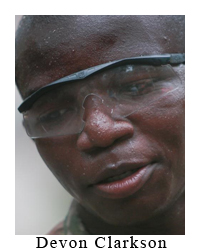
Clarkson of Hopkins, for instance, is a “phenomenal leader,” Branch said, but he had to learn to be more disciplined.
“My attitude was my best part and my worst part,” Clarkson said. “A lot of people were doing stupid stuff and I don’t like stupid stuff. It got me in trouble. I have to be more patient.”
Branch laughed: “Yes, he does. His attitude played against him because he didn’t know how to choose his battles.”
Ruffin “carried the platoon on his back behind the scenes,” Branch said. “I asked for 100 percent and he gave 200 percent. He did everything well. He was competing for soldier of the cycle.
“Ruffin, Clarkson and Udet were the leaders,” he said.
But Branch said he was perhaps most proud of Bowen.
“He was a little bit below average, like he had never done anything,” Branch said. “But he came in with the mindset that he wanted to be trained. He was hurting. But I asked for more and he gave it. He pushed and he pushed and towards the end he showed a different spark.
“He became more hungry to work and he gave it everything he’s got. I didn’t think he would make it, and he proved me wrong. That’s what a soldier does.”
America’s newest soldiers
These five South Carolinians graduated from basic training at Fort Jackson in Columba on Thursday. The State newspaper followed them and the other member of Platoon 4, Company D, 2nd Battalion, 60th Infantry Regiment, since they started their 10-week cycle in early July.
▪ Devon Clarkson, an athletic 18-year-old from Hopkins, whose family is steeped in military service and is joining the Army as a career
▪ Jamie Udett, 18, a star soccer player from Myrtle Beach, who turned down a scholarship from Auburn University to enlist in the Army Reserves and broaden her experiences
▪ Allicia Wiggs, 18, a Beaufort High School graduate and basketball players who wants to use the Army as a bridge between high school and “the real world”
▪ Jamie Bowen, an 18-year-old from St. Matthews who is preparing to study engineering at the University of South Carolina and is preparing to become a radio operator in the Army
▪ Xavier Ruffin, a 17-year-old from Bamberg, who wants to be a soldier to keep other people safe
ABOUT FORT JACKSON
▪ On June 2, 1917, Congress approved opening an Army training center near Columbia. In July 1917, the center was named Camp Jackson in honor of the late Andrew Jackson, a former Army major general and the nation’s seventh president.
▪ Up to 50,000 recruits undergo basic training at Fort Jackson every year. The fort is the nation’s largest military basic training facility.
▪ By next June, 5 million soldiers will have trained at Fort Jackson since it opened.
▪ Brig. Gen. John P. Johnson became the fort’s 49th commanding general on June 24.
▪ Other training facilities at Fort Jackson include the Army’s Drill Sergeant Academy, the U.S. Army Chaplain Center and School, and the Soldier Support Institute.
▪ Fort Jackson has a $2 billion economic impact on the Midlands area, according to a 2015 study by the Darla Moore School of Business at the University of South Carolina.
▪ The fort covers 52,000 acres.
Sources: Fort Jackson, ArmyBases.org, U.S. Army
This story was originally published September 10, 2016 at 4:38 PM with the headline "After Fort Jackson training, America’s newest soldiers focus on Army careers."