
McCarty left mark during tenure as Lexington County sheriff
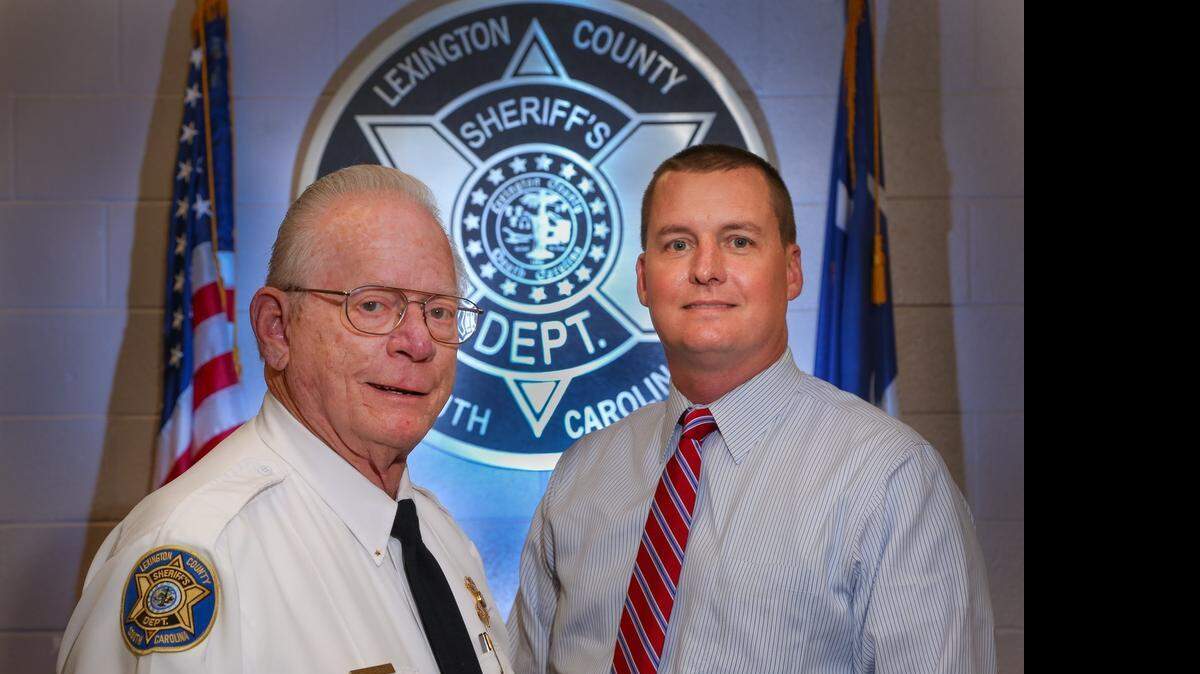
Dozens of congratulatory plaques that lined the walls of the office and adjoining hallway under his predecessor disappeared shortly after Lewis McCarty became Lexington County sheriff in June.
Their replacement with two prints of the skyline of downtown Columbia marked a new style, as McCarty settled in as top county lawman for a temporary tenure slated to end Friday after 10 months.
McCarty is credited with erasing the black eye left by the ouster of his predecessor and refocusing deputies on traditional policing.
“He righted the ship and operated from a lawman’s perspective,” said County Councilman Todd Cullum.
Becoming sheriff was a rare step into the public eye for McCarty, who stayed largely in the background during a 30-year career in law enforcement in his home area.
In his first interview since taking the job, McCarty said he felt compelled to return from retirement when asked to serve because “I love this organization.”
Much of his career in law enforcement was as the top aide of former Sheriff James Metts overseeing day-to-day operations and crime investigations from 1973-99.
Metts awaits sentencing April 27 after pleading guilty to a federal charge stemming for interference in the handling of two illegal immigrants at the county jail in 2011.
McCarty won’t say much about the conduct that got his former boss into trouble. “His guilty plea speaks for itself,” he said.
‘Out of the blue’
Metts’ indictment June 17 meant that he was suspended from office automatically until charges that initially included accepting bribes were resolved.
McCarty’s name was at the top of every list when Gov. Nikki Haley sought recommendations on whom to appoint as sheriff temporarily, according to former Haley aide Ted Pitts.
More importantly, McCarty was the choice of State Law Enforcement Division Chief Mark Keel.
McCarty’s reputation among fellow officers was that of a straight arrow who demanded the best and took care of the deputies he supervised.
That longtime respect made McCarty “the only one who could pull this off,” 11th Circuit Solicitor Donnie Myers said.
McCarty said he had just finished mowing the lawn at his home near Lexington when Keel called the day before Metts’ indictment to leave word that Haley would be in touch.
As regularly happened since his retirement as Metts’ right hand, McCarty thought he would be asked for advice.
The offer to become sheriff came “out of the blue,” he said.
McCarty said he felt duty-bound to accept the job even through returning to law enforcement at age 72 after a 15-year absence would be a challenge.
“The department is very important to me, the men and women in this department are very important to me and the people of Lexington County are very important to me,” he said.
Those prints he put up in his office reflect his interest in local history instead of personal accolades.
One is of the Gervais Street bridge, a span that was often a starting point from which he floated as a youngster down the Congaree River.
The other is a montage of buildings in Columbia that reflect partnerships he developed in law enforcement on both sides of the river.
Back on the job
McCarty moved quickly to put his imprint in place, dismissing four top deputies that county leaders feared may have known about Metts’ misdeeds but raised no alarm.
Long-time friends Butch Reynolds and Carl Young came on board immediately as top assistants. Added later were Rich Roberson as legal adviser and, in a loan arranged with Lexington, town Assistant Police Chief Jay Koon to oversee many aspects of daily operations.
Metts’ downfall was “a culture shock” for a force of 500 deputies and employees for whom he had been its leader for nearly 42 years, McCarty said.
He told deputies to concentrate on law enforcement as a first step in rebuilding trust with residents shaken by Metts’ disgrace.
“Do your best – that’s all I ask of everybody,” he said, an approach that others say makes him a father figure to many officers.
Fellow police leaders say McCarty made subtle changes that improved performance and enhanced morale.
“With what he stepped into, he made it look easy,” said Pelion Police Chief Chris Garner, a former deputy. “He’s a doer, not a talker.”
McCarty and top aides regularly appeared at crime scenes to offer perspective and assess events.
While computers have have revolutionized many aspects of law enforcement, solving crime still requires old-fashioned shoe leather, he said.
“You’ve got to go out and talk with people, gathering evidence,” he said.
McCarty won plaudits for assuring more deputies were in neighborhoods by telling investigators and other specialists to respond to calls for help when demand was high.
Meanwhile, formerly common steps such as assisting community clean-up efforts went by the wayside to keep more deputies on the road.
“It was about getting back to the basics,” County Councilman Jim Kinard said.
McCarty also promoted better cooperation with other law enforcement agencies, particularly smaller municipal forces that rely on deputies to supply expertise in investigating major crimes.
“The difference in camaraderie was night and day,” Garner said. “He made it clear – pick up the phone or call on the radio and you’ll get what you need.”
McCarty followed that practice in calling in the FBI and SLED to help track down Timothy Ray Jones Jr. last summer in connection with the deaths of his five children.
It’s sensible to obtain assistance from agencies with more resources, McCarty said.
At his suggestion, police chiefs across the county now gather every few months to exchange ideas and information.
During McCarty’s tenure, deputies dealt with two major killings.
The first was the deaths of the Jones children at their Red Bank home in August.
McCarty occasionally choked up at a news conference outlining what happened following Jones’ arrest for one of the largest recent mass murders in the Midlands.
“It’s one of those cases that has an impact on every one of us who was involved with it,” he said.
The other was the arrest of five Swansea area teenagers two weeks ago in connection with the murder of a homeowner during a home robbery. It’s a crime that McCarty described as “the most senseless homicide that I have seen in my life.”
McCarty oversaw many murder investigations during his time as assistant sheriff from 1973-99, notably to capture murderer Larry Gene Bell in 1985.
And his passion for justice went beyond the county.
McCarty passed along tips to federal investigators about State House corruption that led to the conviction of more than two dozen lawmakers in the 1980s and 1990s.
Road map for future
McCarty opened the way for Koon to win election as the next sheriff with an early endorsement as the race among four candidates started in January.
Koon is similar in demeanor and outlook, the outgoing sheriff said. “He’s going to do good – I’m not worried,” McCarty said.
As he departs, McCarty sent county leaders a plan of what’s needed for law enforcement to keep pace with steady population growth.
As many as 80 deputies patrolling neighborhoods and 60 jail guards are needed during the coming decade, he said.
McCarty knows those additions are not affordable soon said but feels that blueprint is necessary. By some estimates, that’s a $13 million plan that would require spending nearly a third more on law enforcement.
Renovations also are needed at the 40-year-old sheriff’s headquarters in Lexington, particularly a new $1.5 million roof for a building that “leaks like a sieve,” he said.
It’s uncertain if those dreams will happen.
County leaders are preparing for their first major scrutiny of law enforcement spending in 20 years after repealing an agreement that largely let Metts do what he wanted.
After retiring again, McCarty will be on call for advice that sometimes is dispensed while hunting with officers past and present.
“I’ll help the Lexington County Sheriff’s Department any way that I can,” he said.
But McCarty’s immediate plan is enjoying life with two new grandchildren born April 4, one of whom is his namesake.
“I look for them to occupy a good bit of my time,” he said.
Reach Flach at (803) 771-8483
At the polls
Lexington County voters go to the polls Tuesday to pick the successor to outgoing Sheriff Lewis McCarty.
The only candidate is Assistant Lexington town Police Chief Jay Koon, who won the Republican primary contest March 3 to serve through the end of 2016.
Holding the election is required even though Koon is unopposed. It will cost as much as $70,000, county election officials estimate.
Plans call for Koon to take office as sheriff Friday unless there is an unforeseen successful write-in challenge. He’s busy contacting supporters to remind them of the ballot.
A turnout of less than 10 percent of the county’s 162,000 voters is likely, county election director Dean Crepes said.
For this election, 21 of 96 sites for voting are different for this ballot since some schools, churches and other sites normally used are unavailable. Some precincts will share the same site. Go to thestate.com for locations.
McCarty was appointed to the post to serve temporarily last June after former Sheriff James Metts was suspended following his indictment on federal corruption charges.
Metts resigned in December before pleading guilty to a charge related to interference in the handling of two illegal immigrants at the jail he formerly supervised.