An LGBTQ-rights group wants Columbia to be more welcoming. Here’s how
In the last year, the city of Columbia passed ordinances to protect LGBTQ residents, appointed a liaison to the police department and formed a city advisory group to continue that work.
Those efforts were in part a response to Columbia’s fall from grace on a national scorecard that rates municipalities on how equitable they are for LGBTQ residents.
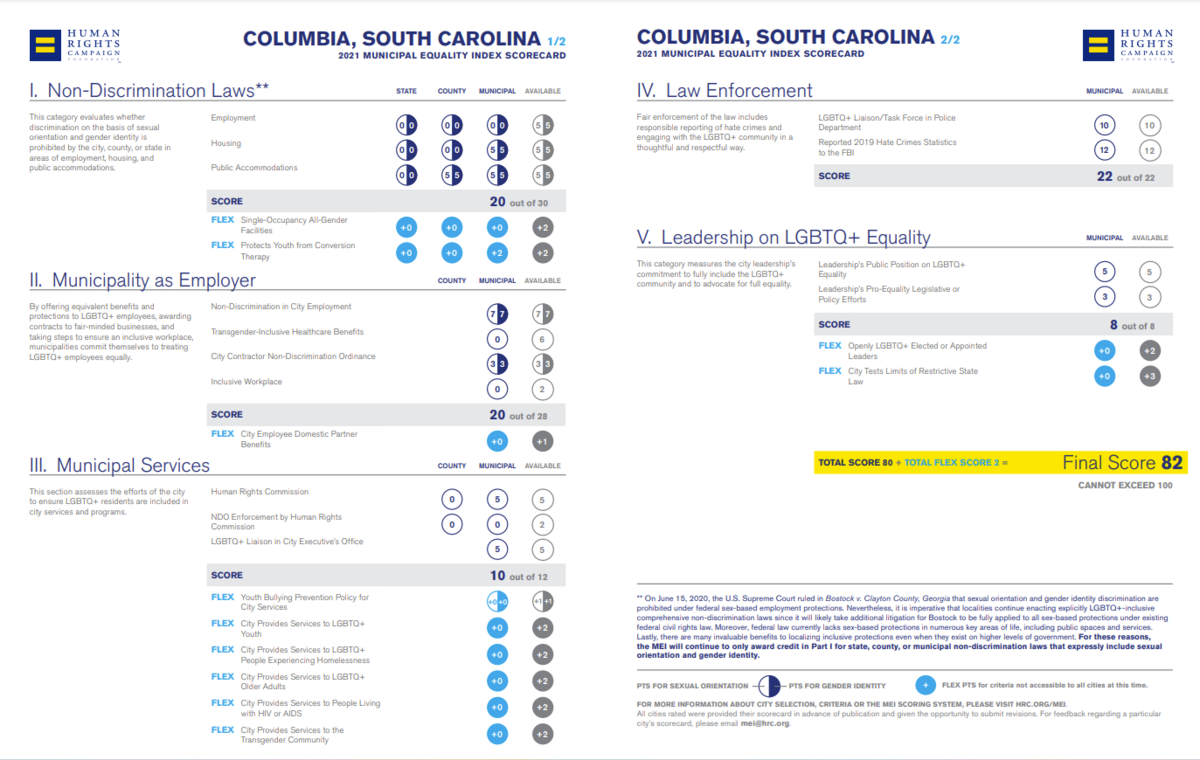
The work has paid off, advocates say. Not only does the city have a new slate of policies promoting equality, but that national rating has also improved — rising from a 60 in 2020 to an 82 in 2021. The national average was 67.
In the 2021 report, published in late November, Columbia improved in every category possible and earned perfect scores for law enforcement and leadership on equality. Columbia’s 82 is the highest score statewide and the most points the city has ever been awarded.
The national LGBTQ-rights group the Human Rights Campaign issues the scorecards and offers similar reports for all 50 states.
The city report “examines how inclusive municipal laws, policies, and services are of LGBTQ+ people who live and work there,” according to the description.
Cities are rated on a 100-point scale and can earn points for legislative action such as nondiscrimination ordinances for housing and employment; and for administrative policies like appointing liaisons and establishing city commissions. A city could earn bonus points for having openly LGBTQ residents hold elected office, or for offering more focused municipal services.
Making up lost ground
In 2019, Columbia earned a 59 on that scorecard, after several years in the mid 70s. In 2020, the city scored 60 points.
“It didn’t reflect the population, and I don’t think it reflected the mood and the views of the people of the city of Columbia toward the LGBTQ community,” said Tyson Lusk, an LGBTQ community organizer in Columbia who helped arrange the Columbia Fireflies’ first Pride Night last summer.
When he looked at why Columbia lost marks, however, he agreed the capital city had room to improve.
Lusk and other organizers approached the city and the Human Rights Campaign about ways to improve the low rating. He said it was important to know how the city could be a better resource for LGBTQ residents, but improving the score also makes it clear to outsiders that Columbia is a welcoming place.
Passing ordinances banning conversion therapy for licensed therapists and forbidding discrimination in awarding city contracts earned Columbia points in 2021, as did appointing an LGBTQ liaison to the police department and establishing a city advisory group on LGBTQ issues.
Former Columbia council woman Tameika Isaac Devine helped lead those efforts on the city council.
“As a capital city, you look at a lot of the cities people compare us to, those are the places taking strides toward equality,” Devine said.
Improving the lives of LGBTQ residents makes the city more attractive for everyone by announcing a welcoming economy and quality of life, she added.
“We tend to look at these issues in a silo, but there’s intersectionality with all of these issues,” Devine said.
Devine is no longer a member of the city council but said she hopes the committee will keep the city intentional about building on the changes made in the last year.
Dylan Gunnels, founder of the Christian LGBTQ group the Agape Table and one of the organizers responsible for the slate of new policies, said he is hopeful the advisory group can help shape how the city evolves. He said part of the work includes getting people excited about the role a city can have in a person’s quality of life.
“Oftentimes big sweeping movements that have happened for our community started in cities,” Gunnels said. “It has started with movements within the city that then led to municipal legislation that then went farther than that.”
San Francisco and New York City are famous examples of that dynamic for the LGBTQ community.
Municipal government is important in many facets of a person’s life, Gunnels said, “but I think that once we get people to realize that it’s important because of trash and roads, that they need to expand their horizon and realize that it’s also about what type of city you’re creating, what type of city do you want to live in.”
Past hurdles and what to expect
Those who spoke to The State agreed the conversion therapy ban was the most controversial, even among the city council.
The measure, which bans licensed therapists from providing conversion therapy to a minor within city limits and fines those in violation $500, passed 4-3 in June, with then-Mayor Steve Benjamin, current Mayor Daniel Rickenmann, and District 2 councilman Ed McDowell voting against it.
Rickenmann, who was elected mayor in November, was the sole “no” vote on a separate resolution urging the state to ban the practice. He explained his vote afterward.
“After a great deal of time talking to folks on both sides, and families who actually have been affected on both sides of the issue, I believe this is a family choice, and we need to allow the families to make those decisions,” he said at the time. “There are cases to study on both sides, but the reality is it is a family decision.”
Gunnels said the group is excited to work with a new city administration, but he added there is uncertainty about how their recommendations will be received by Rickenmann.
Rickenmann declined to answer specific questions sent via email for this article, but offered a statement through a spokesperson.
“We want everyone to have a voice in our city moving forward. We are all stakeholders in our collective future. Columbia has open arms for anyone and we want to make sure our community is a part of the team,” he said via spokesperson Logan McVey.
Gunnels is happy with the progress Columbia has made so far, but said there is more that can be done.
He and Lusk said they will reference the national scorecard to determine where the group will focus its energy next. Areas for improvement identified in the report include providing different programs for LGBTQ youth and older adults, transgender residents and people living with HIV or AIDS.
Gunnels also suggests offering training programs about those varied experiences for law enforcement, city staff and even other LGBTQ residents.
Lusk added he hopes the group can reach out to support LGBTQ high school and college students as well. Whatever the group does, he said the mission is concrete action.
“Right where the rubber meets the road. We don’t want to just talk about these ideas, but how can we put them into practice,” Lusk said.
This story was originally published January 31, 2022 at 5:00 AM.