Will Columbia ever have a real riverfront? The dream inches closer to reality
Standing on the Blossom Street bridge looking north, it is abundantly clear Columbia is missing something.
Look to the left, toward Cayce, and you see joggers, dog walkers, parents with strollers, all enjoying a finely groomed greenway complete with benches, picnic tables and public art.
To the right, toward Columbia, you see a rusty shopping cart, overgrown foliage and, to many, obvious untapped potential.
Since the early 1990s, Columbia leaders, land owners and University of South Carolina officials have floated a grand vision for the city’s riverfront between the Blossom and Gervais street bridges.
It imagines a sprawling public park with an amphitheater and boardwalks, an ornate fountain and easy river access for a variety of recreational activities, as well as room for shops, restaurants and apartments along the bank of the Congaree River.
If you’ve been in Columbia a while, you may have heard these plans before. Every few years a news report surfaces about how this could be what moves things vitally forward for a “crown jewel” waterfront park replete with well-behaved dogs and children enjoying ice-cream cones.
Until now, a grand vision is all it’s been.
But two major projects — one nearing completion and one recently approved — may be the needed catalysts that finally get Columbians to the river. A major road expansion costing tens of millions of dollars and an environmental cleanup that has been kicked down the road for nearly a decade have waterfront enthusiasts feeling hopeful that development is around the corner.
“If you look at award-winning cities, cities who have opened up their waterfront, it’s public access,” said Mike Dawson of the greenway-building River Alliance. “As you go through these economic cycles, I think now is the time that we need it.”
But just how close is Columbia to realizing its Congaree waterfront dreams?
Road to the river
To develop Columbia’s riverfront, you need to be able to get to it. Before any developers can come in with plans for apartments or office space, let alone a grand park, they need to be able to get trucks and equipment to the parcels they plan to build on.
That’s been impossible, but as construction on Greene Street nears completion, the doorway to developing Columbia’s riverfront is about to swing wide open. And behind that effort, largely, is the University of South Carolina, which decades ago set forth a plan for westward campus growth along the Greene Street corridor toward the river.
“Greene Street was pivotal to this. (It’s) what connects the city and the university to the river,” explained Derek Gruner, the University of South Carolina’s architect and associate vice president of planning, design and construction. “It becomes this spine that would connect the river back to the Assembly Street corridor as well as the university.”
Efforts to establish this spine go back to 1991, when USC hired Richard Galehouse and other consultants from Boston-based Sasaki Associates to help correct an unpopular approach to university growth.
The university had been pushing into the historic neighborhoods to the north, east and south of campus, creating tension with residents. Galehouse was among those who urged the institution to change course and find a friendlier way to expand South Carolina’s flagship public university.
“At the time, there were a lot of abandoned parking lots (to the west). There was an old steel mill that had been abandoned,” Galehouse recalled. “That’s when we created that vision of moving to the river and culminating that move with a great waterfront park.”
Greene Street was determined to be the most logical thoroughfare, but it would need a lot of work.
The street runs from Five Points through USC’s campus along the iconic Horseshoe, all the way down to Colonial Life Arena. The road stops at the CSX and Norfolk Southern railroad crossing before reemerging for one block between Pulaski and Huger streets.
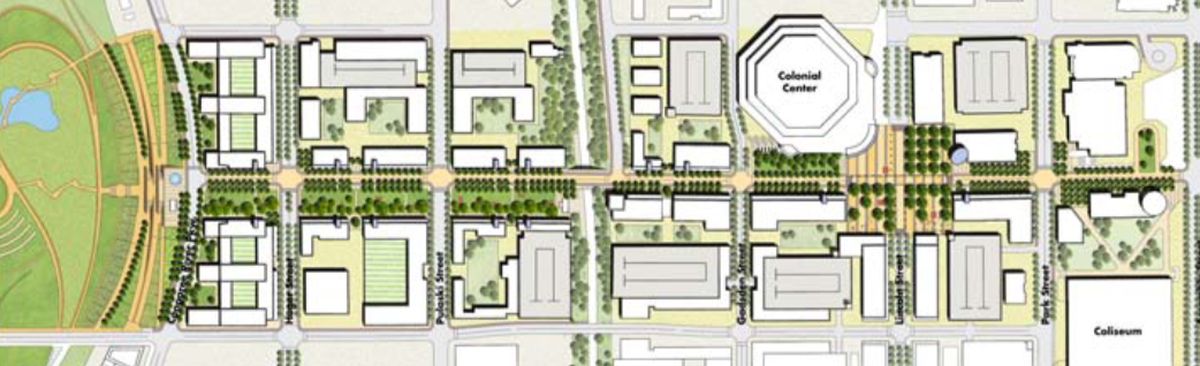
Turning it into the arterial passage envisioned by university leaders would require a bridge across the railroad and another connection past Huger to an as-yet unconstructed extension of Williams Street parallel to the riverbank.
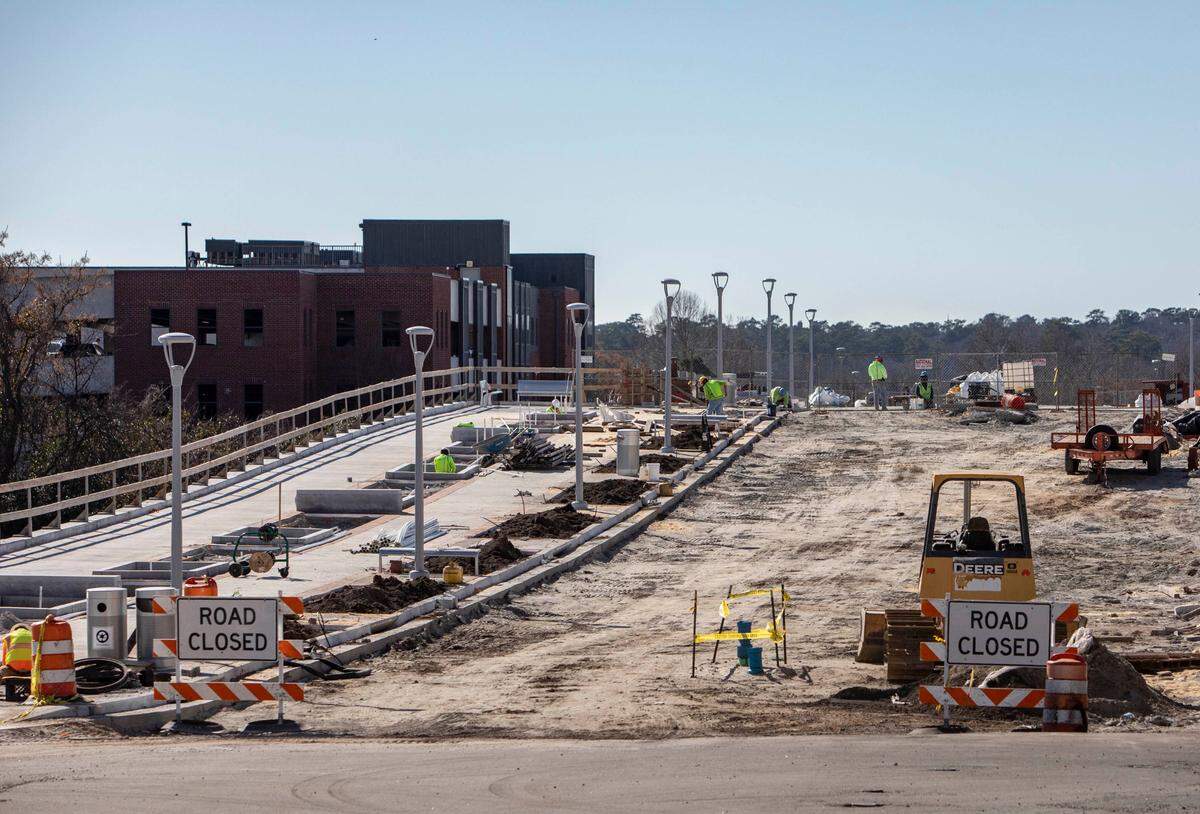
It’s been 30 years since those initial talks, and 15 years since the completion of a master plan outlining the broad vision. Finally, the Greene Street bridge is nearly finished. Motorists should be able to travel from the east end of Greene Street all the way to Huger Street by late June, according to the Richland County project manager overseeing the work, Allison Steele.
It’s taken 30 years to get here because for about 20 of those years, there was no clear way to fund the Greene Street expansion. Then, in 2012, Richland County voters adopted a penny tax program that added one additional cent to the county’s sales and use tax to pay for infrastructure projects county-wide.
Voters set aside $50 million for three projects, including the Greene Street bridge, meant to open up river access, according to Steele.
The first phase saw Greene Street between Assembly and Gadsden streets condensed to a three-lane, more pedestrian-friendly road and the addition of bike lanes along with the beginnings of a “foundation square” at the intersection of Greene and Lincoln streets. That work cost just under $18 million.
The Greene Street bridge construction is estimated to cost about $23 million once complete, but it aims to be a vital connection to the river.
“Making those public access connections in there is a great thing,” Dawson said of the ongoing road work. “That sort of says, ‘OK, we’re building this.’”
A necessary cleanup
At about the same time the new Greene Street bridge is expected to open, crews should be starting to remove toxic coal tar from the stretch of the Congaree River where a park would eventually be built. That’s the next step to opening up the riverfront, but the work will take between three and five years, according to Dominion Energy, which is responsible for the cleanup.
“(Dominion’s timeline) is a serious impetus to get on with the park work,” said Charles Thompson, who co-owns and manages the bulk of the property the park would be built on. He is a descendant of the famous Guingard family and manages their properties, which include the vital riverfront parcels eyed for development.
In the meantime, Dominion’s crews will need to use the property for their cleanup efforts, which will include building a series of temporary coffer dams.
The cleanup has also lingered for years. In 2010, a kayaker stumbled into a thick sludge that made his skin burn. That sludge was eventually identified as toxic coal tar drained into the river by a manufactured gas plant that operated on Huger Street between 1900 and 1950.
Dominion Energy, which purchased the former S.C. Electric & Gas Co. three years ago, is responsible for the cleanup because SCE&G owned the land where the former gas plant was located. After years of back and forth, the company in February got long-awaited permits from the U.S. Army Corps of Engineers allowing the cleanup to begin in May.
Once the cleanup is complete, plans for a park can begin in earnest, explained Thompson.
“You can’t really get on with life and development as long as that project is hanging out there and could rear its ugly head at any point in the future,” Thompson said. “At least now, they have a permit and a timeline.”
Thompson’s property was foundational to USC’s early westward expansion plans, which included the dream for the riverfront park. He agreed with planners that the area should promote a mix of investment but rely heavily on private development, both as a tax base and to provide the quality-of-life amenities associated with riverfront hubs elsewhere in the U.S.
What couldn’t be commercially developed should be a lavish public park, Thompson said.
“We’re not looking at the park necessarily as an amenity that drives (monetary) value,” Thompson said. “I think the real impulse here is to provide public access and to make sure the greenway system that’s been envisioned is completed.”
One more pricey hurdle
While the final pieces are falling into place, residents shouldn’t count on being able to walk to a grand waterfront district for many years.
Riverfront development can’t truly happen until Williams Street is connected between Blossom and Senate streets. Located west of Huger Street, Williams ends just before the Blossom Street bridge and picks up again at Senate Street.
The $50 million approved by Richland County voters in 2012 had originally included the Williams Street connection, but after paying for the two Greene Street construction phases, there isn’t enough money for the final leg.
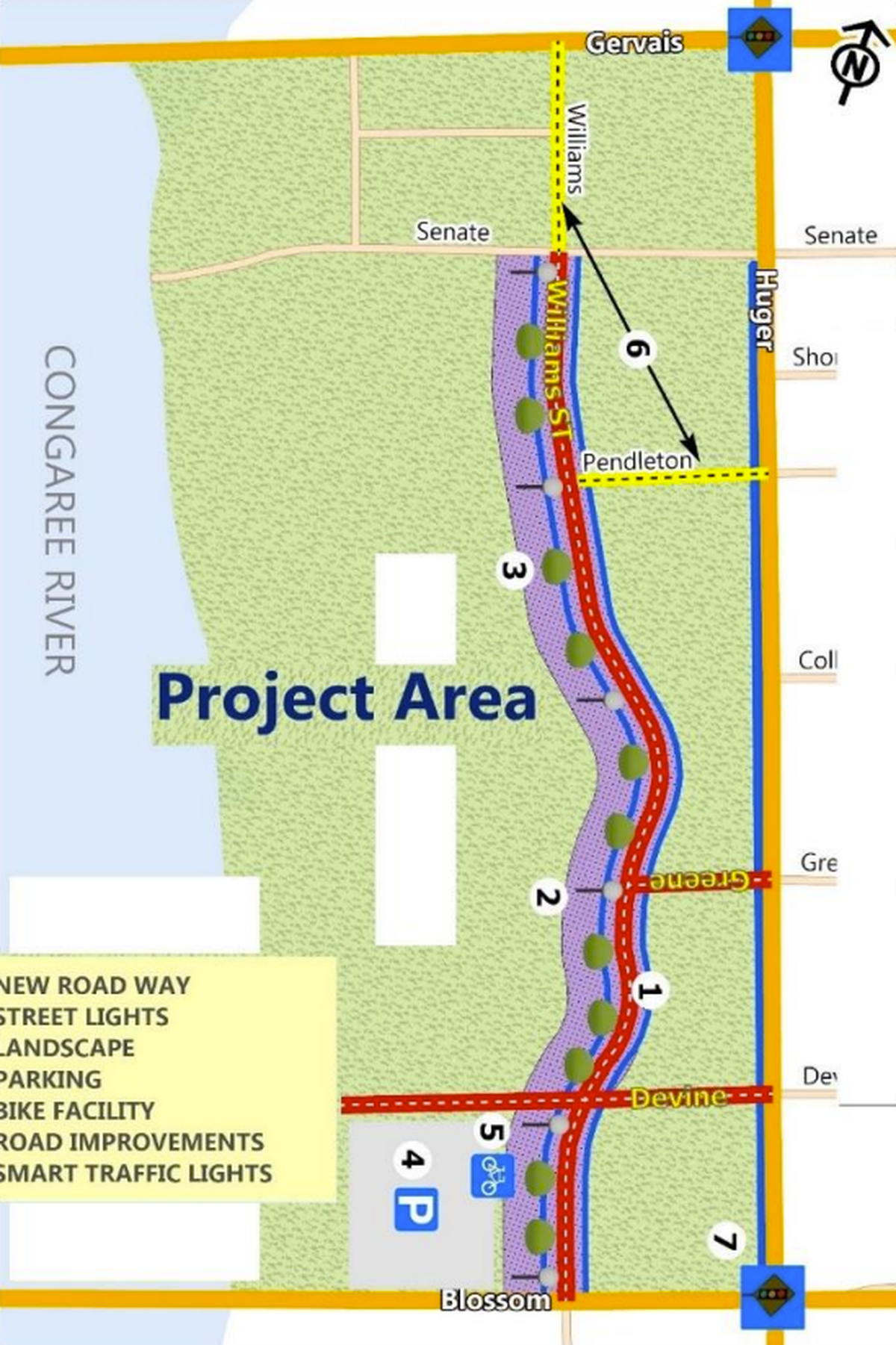
The city of Columbia in April will, for the third time, apply for a federal grant to cover the Williams Street project. The city hopes to get just over $18 million for the roughly $23 million project, Assistant City Manager Missy Gentry said.
The federal grant requires at least a 20% match. Richland County has committed at least $4 million from the remaining penny tax allotment for that match, but Gentry said there are ongoing discussions to raise that amount.
“We think it’s a rock-solid project and transformational to Columbia,” Gentry said.
In addition to finally allowing developers access to the river, the Williams Street connection would alleviate traffic congestion on Huger and create another north-south passage through the city’s west side.
The city plans to keep improving the grant application until it gets accepted, but other funding sources — such as from private investors — are also on the table.
As for the eventual “crown jewel” park, Thomspon said he’s still committed, adding that he’s “probably one of the most patient property owners in Columbia,” referencing his family’s centuries-long hold on the riverfront land. The shape the park eventually takes will come down to money.
“The problem is when you start to envision these bigger gestures, the price tag goes up,” not just for construction, but for maintenance, Thompson said.
In 2007, designers projected spending $48 million on the park and amenities like boat landings, an amphitheater, fountains and greenway connections.
Thompson said he doesn’t know if the park would be municipal or led by private money, but he doesn’t want to wait another decade before the park is built. He hopes to use Dominion’s three- to five-year timeline to start scoping out park plans, with a goal to start construction once Dominion’s work is finished.
“There’s new energy,” Thompson said. “Hopefully now is the time.”
This story was originally published March 28, 2022 at 5:00 AM.