
70% of Lexington County roads could be in ‘fair’ or worse condition by end of the decade
Road conditions in Lexington County are expected to noticeably worsen by the end of the decade, even in the best-case scenarios.
Lexington County Council reviewed a report Wednesday that raises red flags about the future of the county’s roadways, and paints a dire picture of how the county can maintain them at current funding levels. The report has county officials once again discussing ways to raise money, including through a user fee and a sales tax hike.
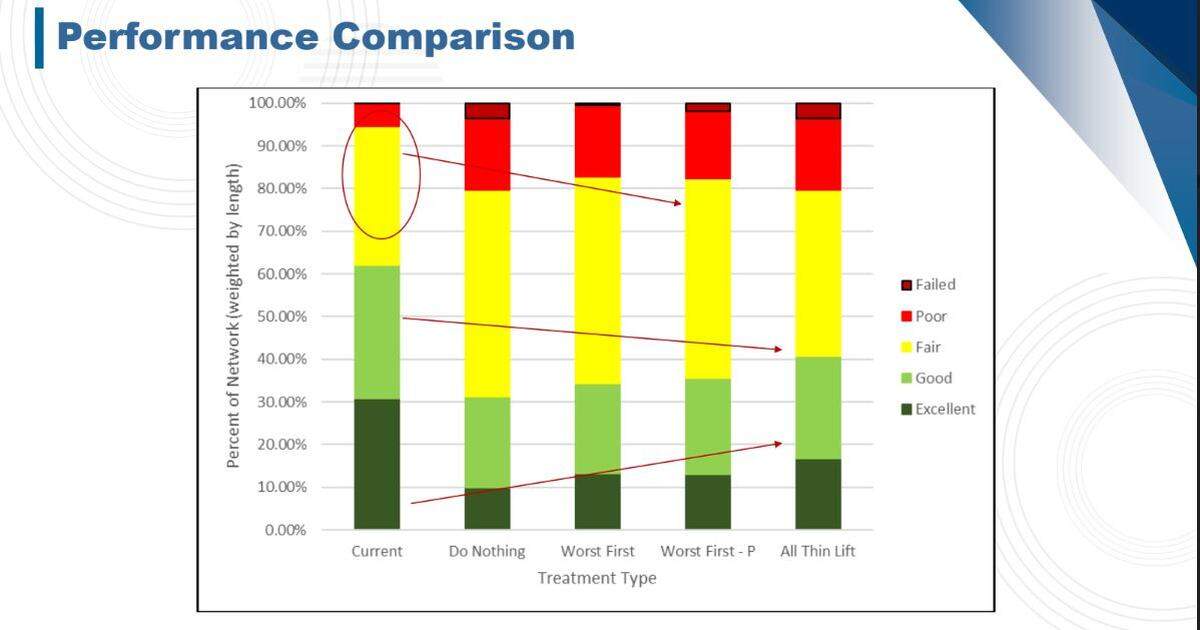
A consultant says 38% of roads in Lexington County are currently classed as “fair” or “poor,” and 12 county-owned roads have even “failed.” Within seven years, the number of roads in that category is expected to rise as high as 70%, and even aggressive countermeasures may only slow the rise, according to an analysis by Infrastructure Consulting and Engineering.
Consultant Jay Thompson warned council members Wednesday they didn’t have enough funding to halt the deterioration of the county’s roads, and said flatly “you’re going to have more” poorly-rated roads going forward.
This year, Lexington County received $6.25 million in “C” Funds from the S.C. Department of Transportation for the improvement of roadways in the county. About $2.5 million is budgeted for paved road maintenance, according to the County Transportation Plan.
The study noted two clusters of failing roads within the county, in the Irmo/Seven Oaks area between the Saluda River and the Richland County line, and in the West Columbia area stretching west toward Lexington.
Council members noted projections are based on current traffic levels, which are expected to grow over the decade.
Thompson recommended a regional approach that would still target the worst affected roads, but also repair surrounding roads at the same time.
But a major concern is funding. If the county’s roads department spent $2 million a year, only 73 out of 171 poor or failed roads would be repaired. The number of poor or failed roads could even grow to 460 by the end of the seven-year study period. Thompson noted that at such a rate, it would take 194 years to complete repair work on the county’s entire road system.
“Two million dollars is a used Band-Aid,” Councilman Todd Cullum said.
Thompson said among the half-dozen counties he’s worked with, Lexington’s are above average. “They must be in really bad shape,” Chairwoman Beth Carrigg said of the other counties.
But he warned that Lexington County’s road spending is below average, as are his predictions of the roadways’ future condition.
The county has long sought a stable funding source to deal with road issues, including a road user fee on all registered vehicles in the county that council discussed earlier this year. But Councilman Darrell Hudson said he wanted to revive the proposal that would raise the most money.
“I’m going to keep going back to the penny tax until the day we die,” Hudson said.
Last year, county officials drew up a list of 400 projects, priced at around $500 million, that would have been paid for by a new 1% penny sales tax, if voters approved the plan in a referendum. But county voters rejected that idea last November, by a 55% to 45% margin, leaving the county without an obvious alternative to raising the funds needed to fix its crumbling roads.
Cullum said the county couldn’t count on a proposal voters have already rejected. “We’ve got an immediate way (to address this) right now, and it’s not a penny tax,” he said, referring to the road user fee
Vehicle owners would pay the road user fee when they register their vehicles with the county. Lexington County officials have not proposed a dollar amount, but similar fees in other counties cost anywhere from $10 to $50.
But council members, including Cullum, acknowledged the two options aren’t mutually exclusive. Placing the burden on vehicle owners could even spur support for a wider penny tax.
“We can put a mechanism in place, and if the public doesn’t like it — and I don’t like it either — then we can spread it out,” Cullum said.
This story was originally published November 3, 2023 at 9:59 AM.
.jpg)