
Aging Midlands hotel could become transitional home for ‘hidden homeless’ families
When local nonprofit Homeless No More started work in Lexington County two years ago, it offered families struggling with housing the option of moving into the family shelter and transitional housing units it operates in neighboring Richland County.
But 60% of families declined that option. Lila Anna Sauls, president and CEO of the Columbia-based nonprofit, wasn’t surprised.
“They weren’t coming over here because even though they were homeless, their schools were over there,” Sauls said. “Their churches were over there. Families were over there. If they had a part-time job, it was over there. There’s no quick, reliable public transportation to get you across the river.”
Because of this, she continued, many of the families were choosing to double and triple up in one residence rather than take advantage of Homeless No More’s accommodations and programs a county over.
“Or, as I call it — vanish,” Sauls said.
With two transitional housing communities already open and operating in Richland County and five more in development there, Homeless No More is pushing to open a transitional shelter in Lexington County in a former hotel that would be the first of its kind in the Midlands.
The Midlands Area Consortium of the Homeless listed a verified homeless population of 45 in Lexington County, compared with 831 in Richland County, but Sauls emphasized that “hidden homeless” families are hard to identify due to the fact that they often matriculate through residences that aren’t their own and don’t end up on the street.
The nonprofit reports seeing evidence that the numbers and needs of homeless families are on the rise in Lexington, citing a 288% increase in the number of calls for shelter, housing and services there between 2021 and 2022, and a 744% increase between 2021 and 2023.
New use for an old hotel
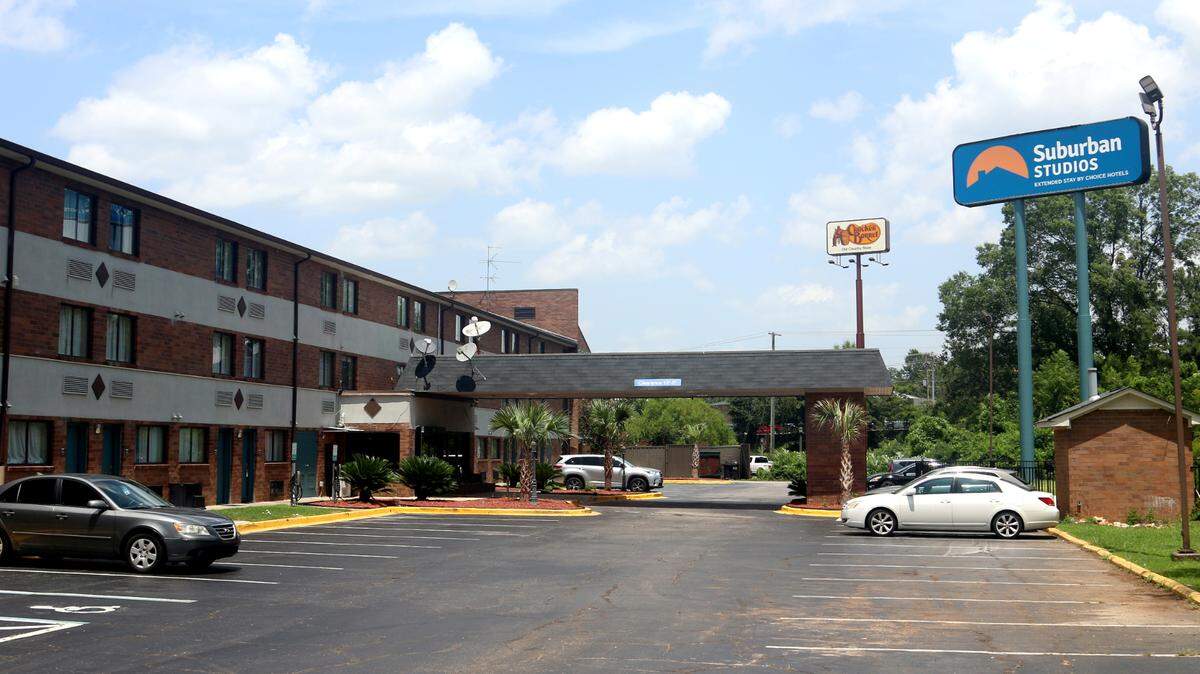
Homeless No More has set its sights on the Suburban Studios extended-stay hotel on Bush River Road off Interstate 20 as the location for St. Andrews Village. The project would include 31 transitional and permanent supportive units for at-risk and homeless families with children, along with an accredited childcare facility for ages 0-4 and a small grocery store to service both residents and the surrounding area.
The closest grocery store is nearly two miles away, which is prohibitive for residents facing transportation challenges.
Part of the pitch here — getting rid of an aging former Quality Inn and Travelodge built in 1985 with a concreted-over swimming pool and replacing it with something new and useful for the community — is nothing new for Homeless No More. Last year, the nonprofit announced plans to transform the derelict Grand Hotel on Two Notch Road in Columbia into a gated, mixed-rent community aimed at helping families find affordable housing.

But in Richland County, Homeless No More’s family shelter, transitional housing and support services, meant to stair-step families into their own housing away from the nonprofit, are housed separately. The Lexington County operation will look to accomplish that mission under one roof.
“With a project like Lexington, a big piece of it is what we call the wraparound services,” Sauls said, referring to elements like bringing in accredited childcare and education programs, which keep the kids on track and keep them occupied while parents take the steps necessary to get the family back on a firmer foundation.
At St. Andrews Village, that will all happen in the same place where the families live. Sauls said New York and New Jersey have seen success with similar projects taking over old hotels.
The hope will be to limit families’ stays to six months, but Sauls said there will be flexibility to grant more time if families are showing progress but aren’t yet ready to make it on their own.
If it all works out, 2026 is likely the earliest the facility could be ready, Sauls said.
Not a ‘homeless shelter’
Both Sauls and Lexington County Council Chairwoman Beth Carrigg, who represents the area where the hotel is located, said the project is important and messaging will be key to getting community buy-in.
“I think messaging is very important and especially important when people have a fear of projects that maybe they’re unfamiliar with, but the situation itself is uncomfortable,” Carrigg said. “I have had a number of people from my district reach out to me, and we have walked through this process and I believe that by the time we hung up the phone, they felt like this was a good option and a good project because it was for family, because it was transitional, because we are devoting our time energy effort and money to family. So I think they feel good about that.”
Sauls said “homeless shelter” isn’t the right term for the operation, emphasizing that St. Andrews Village’s residents won’t have the issues that many people typically associate with a shelter.
“What we find is homeless families with children tend not to suffer from extreme mental illnesses and addiction,” she said. “You may find one family in an encampment, but for the most part, we call them the hidden homeless. They’re in a car in a parking lot under a street light, or they’re double, triple up with families.
“Or the mothers with teenagers are splitting them up,” Sauls added, explaining that often the families are split up among different residences with free rooms or couches. “We call it couch surfing.”
Homeless No More is still working to pull all the money together for the Lexington County project.
The total cost for the project is estimated to be $8 million, with the acquisition cost for the hotel estimated to be $4.5 million. Lexington County kicked in $3 million in American Rescue Plan funding to purchase the property with another $800,000 in federal funds coming from the U.S. Department of Housing and Urban Development to pay for necessary rehab to the building, the cost of which Sauls noted could change once they get into the building.
Should the building prove viable for the project after due diligence is complete, Sauls said two other federal sources have been lined up to front the rest of the acquisition cost. Then the process would commence to figure out how much remodeling the building would cost and lining up funds to pay for it.
Should the Suburban Studios hotel not work out, Sauls said she isn’t sure what the next move would be. Homeless No More had previously looked at a trashed and abandoned Motel 6 along St. Andrews Road at an interchange with Interstate 26, but that building was demolished after the body of a deceased man was found in one of the rooms.
There aren’t many other suitable sites in the area around Interstates 20 and 26, and pushing further into more rural areas of Lexington County would come with significant challenges.
“If you move rural, then you’re going to be missing the infrastructure a family needs: transportation, employment, childcare,” Sauls said.
Carrigg said that beyond helping families in need, the project could strengthen the local community.
“I believe that this is going to be a great transition for young families to get them back on their feet and transition to hopefully home ownership in Lexington County,” she said. “And they will become contributing members of our society in Lexington County, and their children will benefit from this project.”
This story was originally published August 9, 2024 at 4:55 AM.
.jpg)