
Longtime Columbia civil rights leader and Confederate flag foe Lonnie Randolph dies
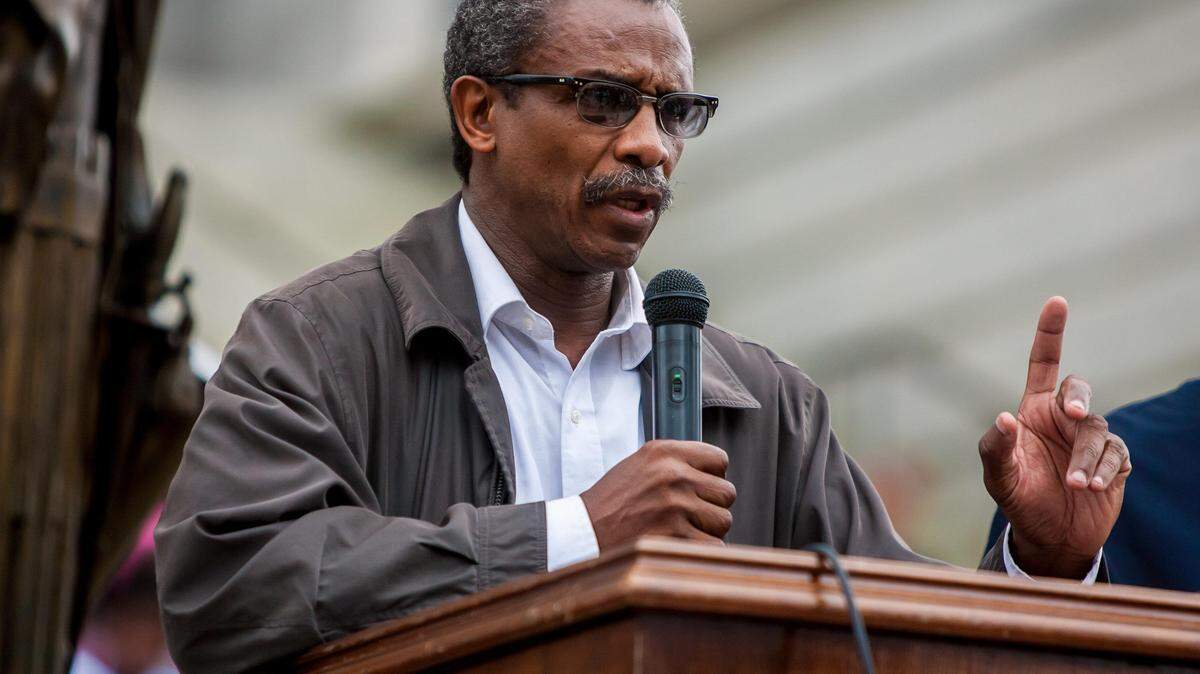
Lonnie Randolph, longtime South Carolina civil rights leader and NAACP state president who for years fought to rid the State House grounds of the Confederate flag, has died after a lingering illness, friends said.
Randolph, who was raised in Columbia and was among the first Black students to integrate Dreher High School in the mid-1960s, was motivated throughout his life by racial injustices he saw and experienced daily while growing up in a segregated society where whites set the rules and made minorities second-class citizens.
For example, even as an adult, Randolph did not like to go into the main branch of the Richland County Public Library on Assembly Street. It reminded him too much of the indignities of the time when African-Americans were denied admittance to Columbia’s whites-only public libraries and made to go to a dismal shoebox of a dilapidated facility on Gervais Street away from downtown, he told a State newspaper reporter once.
Randolph was known for his passionate, blunt talk about racism and refusal to compromise his principles.
“Lonnie was a visionary. He was not fearful of anything,” recalled Columbia attorney I.S. Leevy-Johnson, who in 1970 was one of the first African Americans elected to the Legislature in the 20th century.
J.T. McLawhorn Jr., president and CEO of the Columbia Urban League, said, “Lonnie will be greatly missed. He had great perceptions about racism, whether it was camouflaged, or out in the open.... He was a civil rights icon, a courageous leader, and he inspired many people to get involved. He did not let anything block him from addressing racial discrimination. He didn’t stand in the back, he got to the front of the line. He was a leader. ”
For years Randolph spoke out against the Confederate flags inside the State House and on top of the dome of the State House, describing them as relics of, first, a slave-holding, pre-Civil War society and, secondly, of the white supremacist Jim Crow era of segregation when South Carolina Blacks were denied rights that whites took for granted. Those rights include eating in many public restaurants, access to jobs and hotels and public beaches and going to good, tax-supported public schools.
At the same time, pro-flag whites insisted the flag was only a benign symbol of Southern heritage and Confederate soldiers’ bravery.
The Confederate flag was first raised atop the State House in 1961 by the all-white General Assembly, when Randolph was in public school in Columbia. It was a time of protests and legal actions against segregation, and raising the flag was regarded as an act of defiance to liberals like then-President John F. Kennedy.
Over the years, the flags continued to bedeck the State House, inside and out, and stir high passions. It is hard these days to realize how heated the controversy was over the flag’s state-sanctioned visibility.
In 1998, then-Gov. David Beasley lost a bid for re-election after he suggested the Confederate flag could be brought down from the dome and placed elsewhere on the State House grounds.
Beasley “infuriated fellow Republicans when, amid threats of boycotts and lawsuits and protests, he went on statewide television, saying he had reversed his position on whether the flag should remain atop the dome after praying about it,” wrote Associated Press reporter Meg Kinnard.
Only in 2000, after a massive protest that drew 50,000 people to the State House and after years of sometimes angry legislative debate, did lawmakers agree to a compromise. They voted to remove the flags inside the State House and to take down the flag atop the dome and fly it on a 30-foot flag pole in front of the State House on Gervais Street.
At the same time, lawmakers approved an African American monument, which was ultimately erected on State House grounds outside Senate chambers.
Randolph — as well as numerous others and groups such as the Urban League — had been key movers in the compromise.
Bringing the flag down only to place it in a highly prominent public position in front of the State House did not go far enough for Randolph, who became president of the S.C. NAACP. He then led a boycott, for years urging national groups to stay away from the state and asking tourists not to come either.
By that time, many people, Blacks and whites, regarded the compromise of moving the flag and building an African American monument as the most achievable arrangement that could be forged.
Randolph did not agree.
“The flying of the Confederate flag sends the wrong message,” Randolph told a State newspaper reporter in 2010. “This was to promote slavery. Us flying the flag on State House grounds says we want to bring those days back. Those days ain’t coming back.”
In 2015, a tragedy finally brought the flag down. After white supremacist Dylann Roof — who worshiped the Confederate flag — massacred nine African Americans at a Charleston church, it was no longer possible for most whites to deny the flag’s poisonous symbolism. The Legislature finally voted by a narrow margin to move the flag to a museum.
Randolph was a longtime optometrist in Columbia. He also provided care to inmates in the S.C. Department of Corrections and the S.C. Department of Juvenile Justice, according to the South Carolina African-American History Calendar. Randolph earned his undergraduate degree in biology from Benedict College before obtaining his Doctor of Optometry from the Southern College of Optometry.
“He also played a key role in organizing the first King Day at the Dome march in Columbia and served as president of the South Carolina Conference of the NAACP and its Columbia chapter for over a decade,” the calendar said.
Richland County Sheriff Leon Lott said he and Randolph first met playing in a softball league more than 40 years ago. They hit it off and remained close friends. “People were always surprised that a Southern sheriff and a Black civil rights leader could be good friends,” Lott said.
Randolph worked to help Lott set up a citizens advisory board to deal with sensitive issues, Lott said.
Bob Coble, former mayor of Columbia, said that during his 20 years in office, “Lonnie was a tireless advocate for justice and fairness. He made a lasting impact on our community.”
Joe McCulloch, a Columbia attorney and longtime friend, was two years behind Randolph at Dreher High when Randolph was one of several Black students who broke the school’s color barrier.
They ran together on the school track team. “He was very good. He ran 200s and 400s. He didn’t like long distance, and he had a beautiful stride on the backstretch,” McCulloch said.
Over the next 50-plus years, they remained friends. McCulloch became his lawyer and represented the S.C. NAACP. He also marched with him for years at King Day at the Dome.
“Lonnie was no shrinking violet,” McCulloch said. “But he was prepared to talk and not create a fight. He always believed problems get solved through conversation, discussion.”
After Martin Luther King was assassinated in 1968 by a white racist, riots erupted across the nation. But “the students at Dreher did not riot because of Lonnie’s and others’ leadership,” McCulloch said.
State Sen. Darrell Jackson, D-Richland, said, “Although we did not always agree on the strategy, we always agreed on the purpose — the mission. Lonnie was one of the key players not just in the removal of the Confederate flag from the top of the State House, but also in the building of the African American monument. He never wavered. He was the conscience.”
Leevy-Johnson said, “Lonnie could identify problems and proposed solutions. I have over the years seen people who identified problems but who were not vocal. Lonnie was never silent.”
Funeral plans are incomplete.
This story was originally published October 22, 2024 at 5:30 AM.