Lexington park expansion cost nearly $2 million more than initially reported
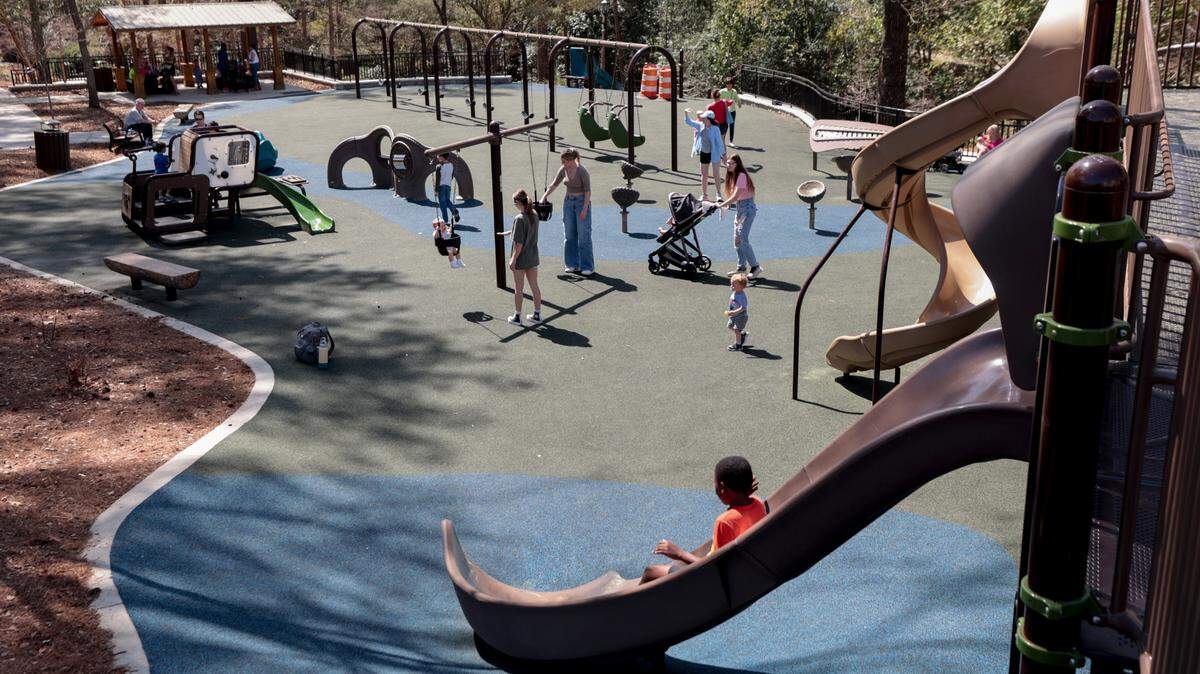
On a warm day in May 2024, Lexington town officials stood proud at the ribbon cutting for Virginia Hylton Park, nearly two years after closing the downtown park for a major overhaul.
In the year since it reopened, visits to the park nearly tripled, according to foot traffic data provided by the town. Staff can now hear the splooshes from the added splash pads from their offices in the adjoining town Municipal Complex, as children play below. The renovations more than doubled the size of the park and also added a new playground with all new equipment, walking trails, and a performance pavilion.
When officials broke ground on the project in the fall of 2022, multiple news outlets — including The State — reported the cost was anticipated to be $7 million. When the park opened, the cost was reported to be $8 million. But documents from the town show the project actually came in just shy of $10 million. So why was it reported to be less?
“The $8 million, which was reported, was the construction contract price, which is one piece of the puzzle. That number didn’t include engineering and planning of the project, the playground equipment (which was purchased outside the contract to avoid a general contractor markup), utility relocation, and safety features, including call boxes, cameras, and installation of fiber,” town spokesperson Laurin Barnes said in an email.
How much did the park cost?
The expansion of the park, which was initially opened in 1991 and is located in the heart of Lexington, added 8.25 acres. It was a project years in the making when the town temporarily closed it for reconstruction in September 2022 with a purported $7 million price tag.
By the time the final invoice was paid in January 2025, the town had paid $9.9 million for the project, according to documents provided by the town to The State. That increase in cost comes after town officials told news outlets that the cost had jumped to $8 million when the town cut the ribbon on the project in May of last year, only accounting for the construction costs.
“I think if you talk to nearly any resident, they’ll tell you just how much they love Virginia Hylton Park ... but setting aside how much people love the parks, I think it’s also inherent upon us to meticulously plan when it comes to how we are spending taxpayer dollars and working to ensure that we’re sharing accurate cost projections with citizens of the community,” Town Councilman Gavin Smith, who was not on council when the park was being planned, told The State.
In the earliest planning stages of the project, town officials set aside $3 million for the renovations. But after Lexington officials saw an overwhelming desire by residents, through surveys, to make sure that the existing trees in the park weren’t torn down, they went back to the drawing board with the design firm and came back with a potential budget more than three times that at $9.7 million, with $8.4 million planned in construction costs.
In 2021, the final budget was drilled down to a little over $7 million for construction costs and an unspecified amount for additional costs such as the park’s design. Those costs were estimated at $768,000 in the 2020 budget, but not included anywhere in the 2021 budget. The town was unable to provide that information to The State.
“The No. 1 thing to come out of [the survey] was ‘Save the trees, protect the trees,’” Mayor Hazel Livingston told The State. “When that comes out of it, the price goes up because you can’t go in there and just clear the land and make it easy. You’ve got to protect the roots, you’ve got to make sure they’re not dying a year later.”
Livingston was the lead person at the town pushing the project forward, according to her online bio.
The initial increase in the budget — a proposed $9.7 million number that was presented to the town council during a November 2020 council retreat — is relatively inline with the final cost of the project at $9.9 million. But it differs from the cut-down version of the budget in 2021 and from the number town officials told media outlets throughout the process.
The main factors in that increase were that the town needed to preserve the trees while also making trails and playgrounds handicap accessible, Livingston told The State. COVID-19-related inflation also played a role in increasing costs, Barnes, the town spokesperson, said.
“God’s making all of us smarter and we’re making all kinds of things, but one thing we can never do is make more land so we’ve got to protect some of it. And protecting 16 acres right downtown is a big deal,” the mayor said.
In the spring of 2022, the town chose Randolph & Son Builders, a Charlotte-based construction company to complete the project at a price tag of $7.95 million. But after a number of change orders from the construction company, the town paid the construction company, in total, $8.5 million for the work. Town Councilman Ron Williams, who was on council while the project was being planned, said the park renovation went out to bid “during a high-inflationary time,” but that council did everything they could to circumvent that.
The other $1.4 million came from things such as the design plan, security cameras and playground equipment. Lexington opted to purchase its own playground equipment, as opposed to doing so through the construction company, which Barnes said saved money. The town budgeted for a $650,000 playground equipment allowance in 2021, but only spent $577,000.
Where did the money come from?
The initial plan was to pay for most of the renovations to Virginia Hylton Park with bonds. But as the scope of the project became more defined in late 2020 and early 2021 and the budget increased, the town found itself in the same lucky position as other municipalities across the country – it had access to American Rescue Plan Act (ARPA) funds.
ARPA money, the federal funding meant to aid with recovery from the COVID-19 pandemic, gave towns like Lexington access to money they wouldn’t have otherwise seen, so most of the funding for Virginia Hylton Park didn’t come from local taxpayer pools, but rather ARPA funds, as well as impact fees paid by developers bringing projects to the town.
“Because of those ARPA funds ... we only borrowed about $1 million. In light of that, I will say this, I’m not a huge parks person, but there is a lot of benefit to folks with developmental disabilities, physical disabilities. There are parks benefits and features that we’ve never had,” Town Councilman Todd Lyle, who was on council during the planning of the park, told The State.
The town spent around $8.1 million in ARPA funds, $1.1 million in general obligation bonds and $389,000 in impact fees on the project. The additional quarter of a million dollars came from the Lexington Beautification Foundation and donations.
“The reason we chose to use ARPA funds for the park was because it was shovel ready and we knew we could be in compliance with all the regulations and get it done in a timely fashion. The money that would’ve gone to the park now was going to get to go to other stuff,” Barnes told The State.
Smith said he believed the town has made efforts to be more transparent about its spending, with Lexington posting monthly financial spending reports, which began in the spring of last year. He noted in the future that he’d like to see the town put out more routine information about larger capital projects.
“It’s very hard for the average citizen to track ... it’s very hard to figure out, ‘Well, what was this supposed to cost?’ If there was just a report that says, ‘Here’s the budget for the park,’ and it’s updated maybe every quarter or every six months, that’s very easy to follow,” Smith said.
Lyle said that the town was “not where we should’ve been” in terms of transparency when the park was being planned, but that the town had made strides in the right direction since then and that he didn’t believe the lack of transparency on cost was done intentionally.
“I can tell you that in the last year it’s been a high priority of council to switch over to software, or to use means, that are more readily searchable and available to be seen,” Lyle said.
Barnes said during the yearslong process of sorting out what the park would look like and how much it would cost, council members routinely discussed costs, timeline and ways to save money. She pointed to 2016 meeting minutes during which a resident said that the park “used to be the crown jewel of downtown and it’s no longer that.”
“Council went back and forth. It wasn’t just like, ‘Oh, let’s just do it,’” she said. “Some people on council were like, ‘We don’t need this … cut it back.’ And then it’s like, well the community is saying otherwise,” Barnes said.
This story was originally published May 15, 2025 at 5:30 AM.