
After butting heads with county, Lexington tightens rules on new housing
The town of Lexington is pushing to tighten its rules for how many houses can go into new developments, part of an ongoing effort to align the town’s rules with the surrounding county.
The town council took the first step Monday to limit residential growth in Lexington by setting a maximum of four houses per acre in new subdivisions. That’s down from five per acre and syncs the town up with Lexington County’s density limit.
“This initiative reflects an effort to promote development consistently and thoughtful growth management, collaboration with Lexington County as consider a central overlay district,” Councilman Todd Carnes said at Monday’s meeting. The proposal will go to the town’s planning commission for consideration at its Aug. 20 meeting.
The move would implement one of the proposed changes the two sides have considered to standardize development rules for the area in and around Lexington. Town and county leaders tussled last year over sometimes conflicting development goals after Lexington County canceled its road maintenance agreement with the municipalities within its borders, pushing back on new developments that didn’t comply with county rules.
But the county later backed down and earlier this year reinstated the agreement, leading to a renewed push for collaboration between Lexington County and its namesake town. The county is looking at a central zoning area that would run along Interstate 20, the Saluda River, the south coast of Lake Murray and Calks Ferry Road in the west.
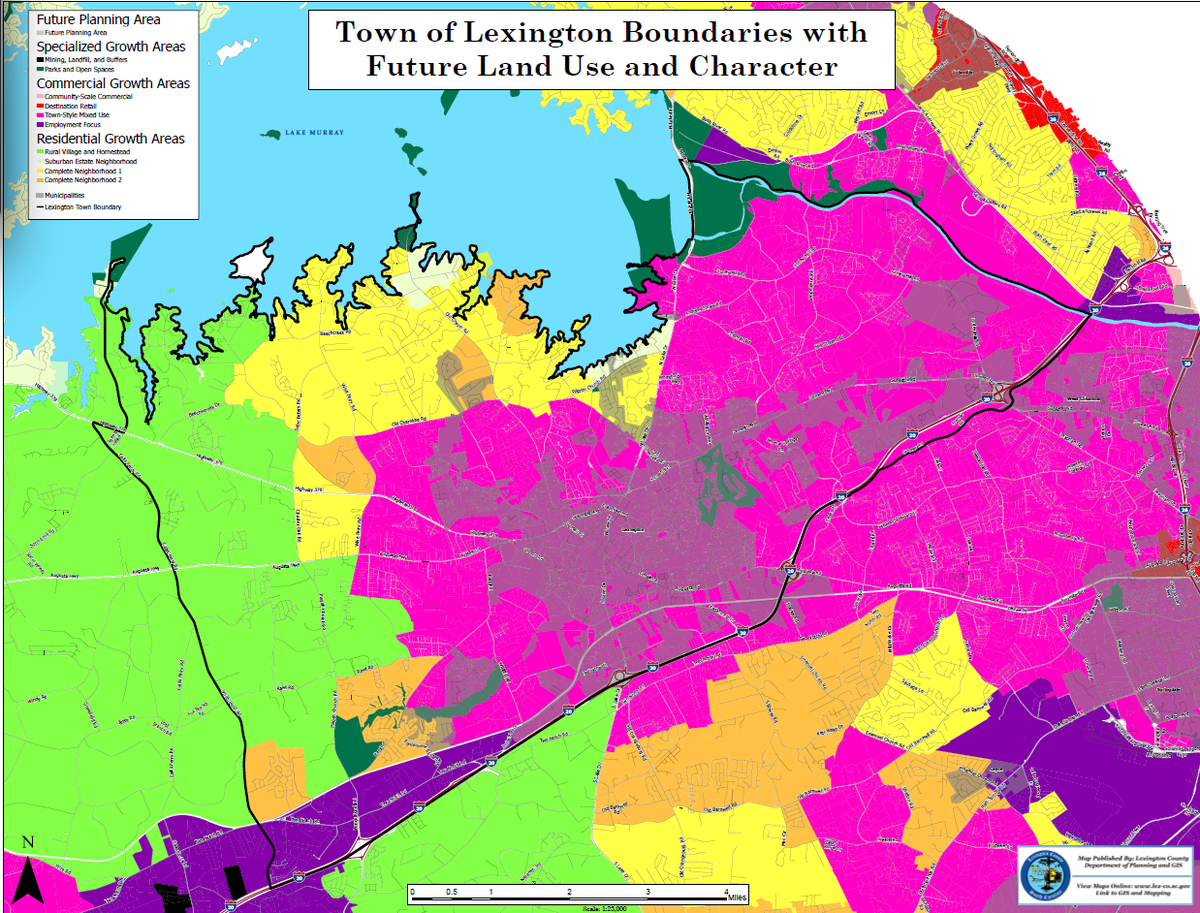
Under a proposal presented to Lexington County Council earlier this year, houses around Lexington could be no more than 35 feet tall, or approximately three stories. The town will also follow the open space requirements that the county already follows in the county’s Lake Murray overlay district, which covers the northern edges of the town.
“There are all kinds of properties immediately adjacent or almost adjacent to the town, and historically we haven’t had uniformity in how to handle those properties,” Carnes said Monday. “We’re trying to come to a long-term agreement so we have uniform standards in what that development will look like.”
Other concessions are being made on the county’s end. The county will now follow the town’s requirement that developments of 150 houses or more must have at least two exits to a main road, stricter than the county’s requirement of 200 houses. Developments with 300 houses must have at least three exits, with additional exits required as more houses are added.
The town of Lexington will look to follow design standards akin to what the county requires in its eastern overlay district, while the county will adopt the town’s rules for traffic impact studies on new developments.
“They will be adopting some of our [transportation improvement program] and requiring that if a neighborhood causes an impact that they would need to make some road improvements,” Mayor Hazel Livingston said. “So it would take it all the way into the county for the improvements we make. It’s a positive all around.”
Councilman Gavin Smith said he was glad to see the two councils working together more collaboratively and hoped the new agreement sets the tone for future dialogue.
“To councils of the future, take note, government can work together,” Smith said.
.jpg)