When SC charter school expanded to new campus, local district didn’t get a say
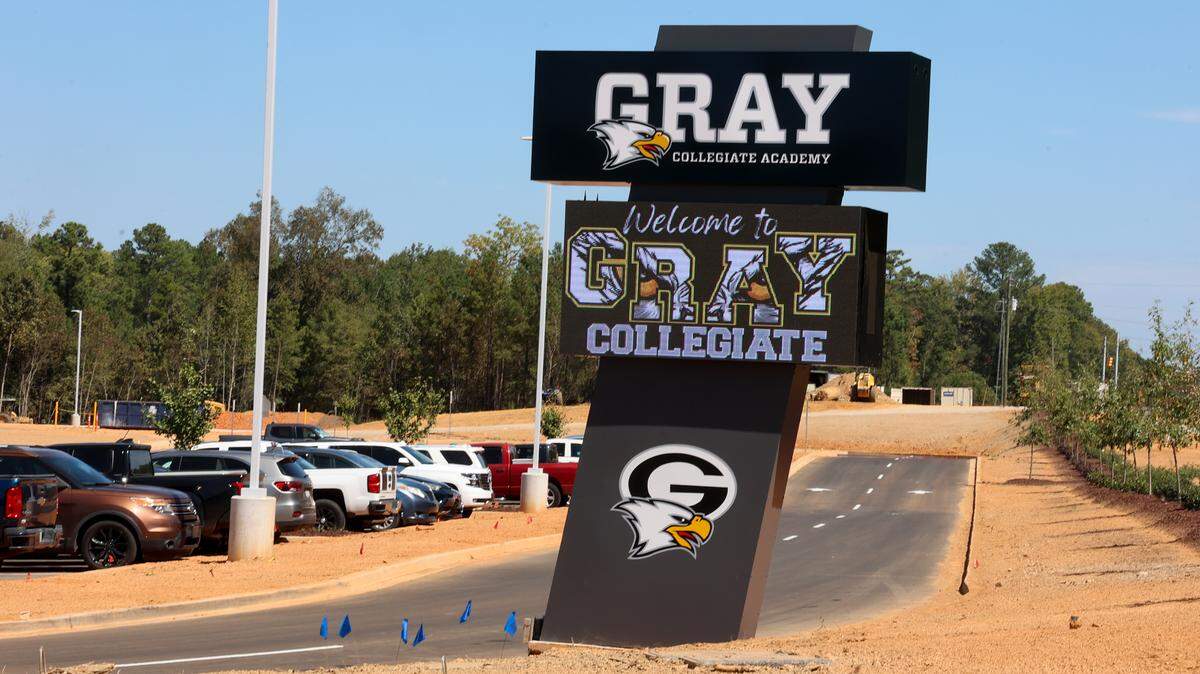
The leaders of a West Columbia charter school opened a new campus this fall, but did not qualify it as a new school despite the fact the campus sits in a completely different school district zone.
That decision, which the state’s education department signed off on, allowed Gray Collegiate Academy to bypass a lengthier application process that would’ve made the local school district aware of its new campus in Irmo earlier. It’s raised questions about the legality of so-called “satellite” campuses from a charter school expert.
“Every time a charter school or authorizer does something that people say ‘Hey, that doesn’t seem right,’ they’ll say, ‘Well there’s nothing that says we can’t do it.’ And that is not how government agents or government contracts work,” said Derek Black, a University of South Carolina law professor who has written extensively about charter schools. “The absence of a statute speaking to it says, to me, you can’t do it.”
What does the law say about new charter schools?
Under state law, charter schools are typically overseen by authorizers, usually an institution of higher education or the South Carolina Public Charter School District.
In Gray’s case, the Charter Institute at Erskine is its authorizer. The Charter Institute, which came under legislative scrutiny in 2024 after reporting by The State Media Co. raised questions about its spending, operations and ability to provide objective oversight of the schools it regulates, is the state’s largest authorizer of charter schools. It oversees 28 schools across South Carolina.
State law governs the process through which charter schools must undergo to open a new school, including laying out the typical application process. The law does allow for the replication of successful charter schools and those replications undergo the typical application process.
Planning to open a new charter school usually formally starts nearly two years before classes at the new campus would begin. A school hoping to open in the fall of 2027, for example, would need to submit a letter of intent by Oct. 31, 2025 and a formal application to an authorizer, with the education department copied, by Jan. 30, 2026.
From there, the authorizer would have to rule on whether to approve plans for the charter school in a public hearing within 90 days. The local school district that the school would open in has the option to appeal the decision.
But the Charter Institute didn’t qualify Gray as a new school, but rather an extension, no different from adding portable classrooms or a new wing.
“The school’s authorizer has indicated Gray Collegiate Academy continues to operate one school and has performed an expansion of an existing school. As such, the authorizer has stated this action does not constitute a replication,” South Carolina Department of Education spokesperson Jason Raven said in an email to The State.
Gray wasn’t required to inform local district
In January 2025, school leaders announced their plans for a new campus at 617 Koon Road in Irmo. The campus opened months later, in August.
A 15-minute drive up Interstates 20 and 26 from its original West Columbia campus, which the school opened in 2014, school officials planned to place three modular buildings with eight classrooms each on a plot of empty land. The initial plan was to open with a class of around 600 students in grades six to 10, with the goal of eventually attracting 1,000 pupils to a full grade six-to-12 grade school, The State reported at the time.
The new campus sits roughly in between two high schools in the Lexington-Richland 5 school district, four miles from Dutch Fork and six miles from Irmo High. While the new campus sits in the LR5 school district, it draws students from across district lines. Gray pulls students from 18 school districts across the state, spokesperson Ashley Epperson told The State.
The decision to qualify the new campus as merely an extension of the school, expediting the school’s opening, meant that the Charter Institute wasn’t required to inform Lexington Richland 5 of the new campus. It also meant the school district wasn’t able to object to the opening of the school.
“Part of this process is, when you file an application, if the school district says ‘Hey, I don’t think this is a good idea.’ They can object. With the position [the Charter Institute] is taking, there’s no more objections,” Black said.
When asked whether leaders for Gray had informed LR5 of the upcoming campus, Vamshi Rudrapati, the Charter Institute’s Chief Operating Officer, told The State that it wasn’t required, but that Gray’s Principal Brian Newsome was friends with people in the district and may have informed them.
The State reached out to Newsome for this story and did not receive a response.
The State reached out to a spokeswoman with the LR5 school district to ask when the district was made aware of the new campus. She declined to answer questions. Multiple attempts to reach the school district’s superintendent were unsuccessful.
The school district, which covers the Chapin and Irmo area, was staring down a drop in state funding, The State reported in August, after the district saw a sharp decline in its student body.
The dip of at least 627 students since classes began this fall compared to the same period last year raised concerns for LR5 because the amount of funding it receives from the state is tied to its overall enrollment. School board members had expressed concerns earlier in the spring, before Gray opened, about how a potential drop in enrollment could impact the district’s budget.
“There’s a good chance we’re going to lose kids,” school board member Catherine Huddle said at an April budget workshop. “Even if the state doesn’t know about it, we know about it.”
After The State reported about the board’s discussion on the impact of Gray’s opening in the spring, Newsome posted to the school’s Facebook page that Gray expects to enroll 600 students at its Irmo campus next year, and Lexington-Richland 5, which has around 17,000 students, would not be negatively affected.
Why Gray chose a different process
Rudrapati pointed to land availability as one of the key issues a new charter school faces. When plans for one Charter Institute-sponsored school, Ascent Classical Academy, fell through after failing to get the go-ahead from the town of Irmo, the Charter Institute and Gray saw an opportunity.
Ascent had planned to hold classes in St. Andrews Presbyterian Church, holding kindergarten through eighth grade classes in the church’s education building until the school could move into a more permanent location. The school’s opening was delayed a year over a permitting dispute with the town.
The land that was pitched as Ascent’s long-term home, “just became available,” Rudrapati told The State.
“We work very closely with the schools and when opportunities come through … we work with them and make it happen.”
With an empty spot of land and a lengthy waitlist, Rudrapati said the school opted to open a satellite campus as opposed to adding more portable classrooms. The charter school opened in 2014 and has added more than 500 students to its 6-12 grade campus in West Columbia over the last decade.
Despite the West Columbia campus having larger classes of 11th and 12th graders, compared to its 6-10 grade levels, the Irmo campus initially opened to serve sixth through 10th graders, with plans to eventually expand to 12th grade.
Rudrapati said Gray’s board had been having conversations about expanding into other parts of the state when the land in Irmo became available. Multiple attempts by The State to reach Gray’s Board Chair Pennie Peagler with questions were unsuccessful.
The Charter Institute approved the school board’s request to amend its enrollment, upping it in anticipation of the opening of its new Irmo campus, in July, just a month before the school opened its new campus.
The request for SCDE property acquisition approval for the project was submitted to the Office of School Facilities — responsible for reviewing construction plans, issuing building permits and conducting inspections — in October 2024. The first set of plans for the project were shared with that office on January 24, 2025, a day after school leaders publicly announced plans.
The Charter Institute maintains that since the school serves a similar community, has the same leadership and shares facilities among students that the Irmo campus and the West Columbia campus are the same school.
“For Erskine, we thought through this, we looked at other states, we looked at general authorizing practices … it’s one school, one leadership,” Rudrapati said. “If it was in Sumter, if [Gray] said they were going to Sumter, we would not have allowed it. That is beyond, that is not the same community and we’re not going to do that. This is 15 minutes [away], they found the dirt and they said ‘This is going to be one school.’”
Satellite campuses are relatively rare, legally murky
There are a handful of instances in which charter schools in South Carolina operate multiple campuses in different locations. Legacy Charter in Greenville has four campuses — a preschool, an elementary school, a middle school and a gym — all within a mile of each other and within the same school district enrollment zone.
East Point Academy in West Columbia has both an elementary campus and a middle campus about two miles apart.
But there are a handful of distinct differences between these examples and Gray Collegiate. Where the other school extensions are simply campuses that serve different grade levels, Gray’s Irmo satellite campus serves similar grade levels as its West Columbia campus. The Irmo campus of Gray is located 12 miles from its West Columbia campus and in an entirely different school district enrollment zone.
The school has two separate student applications on its website — one for its Irmo campus and one for its West Columbia campus. Epperson, a spokesperson for the Charter Institute at Erskine, said that since the schools share facilities, many students go back and forth.
In a “Frequently Asked Questions” document, which has since been removed from Gray’s website, the school posited that students would be given the option to transfer to the Irmo campus “based on the availability of courses” and that students accepted to the Irmo campus could be added to a waitlist for the West Columbia campus. It noted that students could take courses at both campuses “if a student is able to provide transportation and the scheduling allows.”
Satellite campuses of existing charter schools aren’t explicitly regulated in state law. Charter schools are largely governed by their authorizers and most changes to contracts or enrollment agreements happen between the two.
“At this point, where the law is today, there [are] no regulations. It is an authorizer’s decision,” Rudrapati told The State.
The South Carolina Department of Education has faced scrutiny from federal regulators over its lax oversight of the state’s charter schools. The U.S. Department of Education threatened to withhold grant funding for charter schools if the state didn’t up its oversight in November of last year. The federal department dropped the requirement, imposed by the Biden administration, after Donald Trump took office.
In 2020 guidance for grant applications, the state’s education department said it wouldn’t award grants for charter replications or expansions. Its reason was that “the state does not have statutory provisions or processes for replication charter schools in the current charter school law.”
That guidance said “each entity must go through the new charter school process to obtain a charter from an authorizer and must meet all of the benchmark requirements and opening conditions for a new charter school.”
When asked about that guidance, Raven, the education department’s spokesperson, maintained that state law did allow for the replication of charter schools and pointed to a statute that requires new charter schools to identify “any involvement with the replication of existing successful public charter schools” in their application.
Raven also reiterated that because the Charter Institute did not identify Gray’s new campus as a replication, but rather a “satellite,” it was not required to go through the typical application process.
This story was originally published November 17, 2025 at 5:30 AM.