
Shooting raises old issues for North Charleston residents (+ video)
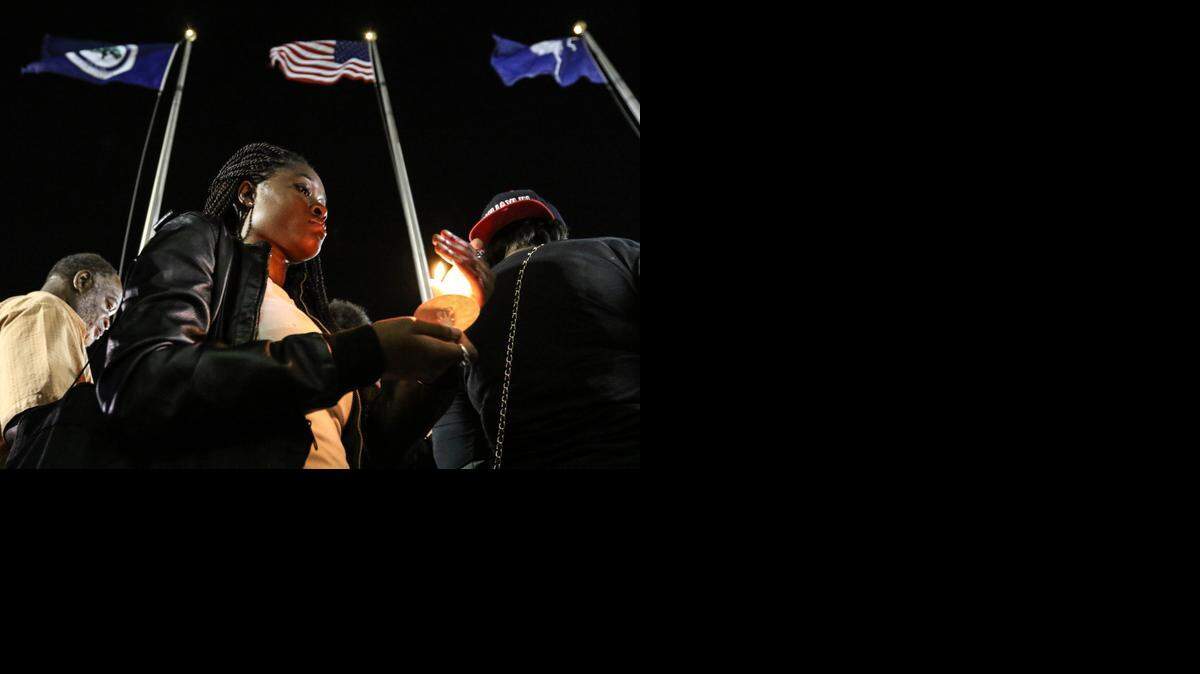
Many in this community have gone to Craig Road in the past two days to see the makeshift memorial where, just days before, Walter Scott lay dying.
Thursday morning, Wanda McNeil, a student at Trident Community College, sat in her car as a light breeze rustled flowers that hung in the lattice of a fence.
“Once I got here, I felt this peace and this calm,” McNeil said. “I don’t have class until 11:30, so I figured I could just sit here and take in the sight.”
There’s been no violence, but some say personal peace has been difficult to come by in this community that’s just north of the historic port of Charleston in the two days following the release of a video showing the fatal shooting of Scott, an unarmed African-American man, by a white North Charleston police officer.
Residents of the state’s third-largest city long have had a tense relationship with the police force. Race is part of that. While nearly half the residents of North Charleston are black, the majority of the city’s police force is white. Gunfire isn’t uncommon, nor are large swaths of poverty. And North Charleston for the past few years has been listed among the nation’s most dangerous cities.
On Saturday morning, Patrolman 1st Class Michael Slager, 33, shot at Scott, 50, eight times as Scott fled. A passerby took out his cellphone and recorded the incident. Although Slager said in a report that Scott attempted to take his Taser, the video shows Scott tried to run from Slager before being shot in the back.
“If it wasn’t for the video, I think the officer would have gotten away with what he did,” McNeil said. “There are some good cops, but then there are the bad cops. I have seen their attitudes toward some of the situations they have responded to out here and, unfortunately, it’s been more bad than good.”
Michael Harris came out to the scene to get his own perspective on what so far he has only seen in the media.
“It’s hard to believe,” Harris said. “I can’t even believe that it really happened. It’s surreal. Why would somebody shoot somebody like that?”
Harris said he lives in a part of North Charleston where both drug and violent crimes are prevalent, but he has never had a bad run-in with the police. Rather, Harris said the police normally are very responsive and professional when he has called them. Now unemployed, Harris said he used to own an auto-parts store just a few blocks away from where Scott was killed.
“I have never had any bad issues with them,” Harris said. “They were always there to support my business. They are very fast to be on the scene to help.”
But Harris said Slager’s actions Saturday morning were inexcusable.
“The gentleman was only 20 feet away from the officer before he starts shooting,” Harris said, referring to the video. “Where was he going to go anyway? He was all fenced in. He’s basically shooting a cornered animal. It seems so primitive.”
For Arthur Downard, the cut-through next to where Scott was killed is a path to get to and from work at Dixie Furniture Co., where he works as a warehouse technician.
“I passed here Saturday morning, and we saw the news media,” said Downard, a Long Island transplant to North Charleston. “It seemed like he was going to get away with it until the video. Eight shots? I mean, come on. The guy was unloading his gun, and the other guy was unarmed.”
Downard said normally when he encounters North Charleston police, “they all have attitudes.”
“The ladies are nice, and the black guys are awesome,” Downard said. “But the white go-getters, they aren’t piss and vinegar, they are piss and gasoline.”
Downard said when he walked by the day after the shooting, he grabbed a small piece of crime scene tape “just for memorabilia.”
“I knew this was going to be big, and five days later I was right,” Downard said.
Thursday afternoon, members of the Charleston County NAACP held a rally outside of their main office on Columbus Street in Charleston. The Rev. Joe Darby and other organization leaders urged the U.S. Department of Justice to review not just Saturday’s shooting but other North Charleston cases in which black men were killed by officers.
Darby, a well-known minister at Morris AME who moved here from Columbia, said the relationship between the residents of North Charleston and the police department was bad to begin with. Scott’s death “made it worse,” he added.
“I think that, hopefully, this will be a sobering experience for our friends in the law-enforcement community,” said Darby. “We have to look at how to change the law enforcement culture.”
Darby commended North Charleston city and police officials for swiftly firing and charging Slager with murder after the video surfaced. But, Darby said, if the video had not been released, Scott’s death would have been just “another routine police shooting.”
“(Slager) shoots the guy, and (Scott) is face-down in the grass, and (Slager) tells him to ‘put your hands behind your back,’” Darby said. “Too often in these cases, police beat the living daylights out of someone or shoot someone and start saying, ‘Put your hands behind your back’ or ‘Stop resisting.’ You need to look at them as a human beings and not suspects.”
Others have said the same.
Most recently, police became more assertive after a string of shootings in 2006 and 2007. That led to some residents saying the police weren’t assertive but aggressive and were inappropriately using force.
In 2007, North Charleston was ranked the country’s seventh-most-dangerous city in the annual listing by “City Crime Rankings: Crime in Metropolitan America.”
Over the next four years, 120 complaints were lodged against the city’s police force, the majority of them by African-Americans, according to media reports.
Of the North Charleston Police Department’s 324 officers, 60 – or about 18 percent – are black, according to statistics provided by that department. The department has 256 white officers, accounting for about 79 percent of the force. Eight Hispanic officers account for the remaining 3 percent. By comparison, U.S. Census statistics from 2010 show about 47 percent of the city’s 98,000 residents are black.
Census numbers also show that North Charleston saw its black population go from 25.5 percent in 1980 to 49.4 percent in 2000. Whether that’s from gentrification in downtown Charleston, as some assert, doesn’t matter, Darby and other have said.
More on-point conversations are needed, they say. And cops need to be cops.
North Charleston police need to stop doing the “nice things, like participating in smoke-alarm giveaways and Big Brother programs, and start talking to the community about how they plan to enforce,” Darby said.
The Associated Press contributed to this article.
DEVELOPMENTS THURSDAY
▪ AFRAID FOR HIS SAFETY. The bystander who shot the video of Walter Scott’s death said he’s afraid for his safety. Feidin Santana, 23, hired Columbia attorney and state Rep. Todd Rutherford and talked to a dozen or more media outlets Thursday.
Santana also said that as he shot the video, he thought Scott ran from officer Michael Slager because he didn’t want to be Tased.
▪ EARLY DOUBTS. State Law Enforcement Division agents had doubts about the shooting incident from the day it happened, the agency said in a Thursday-night news release. For one thing, said SLED chief Mark Keel, the multiple gunshots wounds in Walter Scott’s back raised questions. There were other inconsistencies, too, he said, without elaborating.
Santana’s cellphone video confirmed their suspicions, Keel said. Agents have not yet interviewed Santana but are eager to, Keel said. He appreciates that Santana “was worried about his safety and whether he could trust the police,” he said.
▪ DASHCAM VIDEO RELEASED. The dashcam video released by SLED shows Scott running from the traffic stop when Slager returns to his patrol car. The video does not make clear why Scott began to run, although his family said he had been in jail briefly twice for missing child support payments and didn’t want to go back.
▪ FUNERAL SERVICE. The funeral service for Scott will be held 11 a.m. Saturday at W.O.R.D. Ministries Christian Center, 301 Crosscreek Drive in Summerville, according to a news release. The funeral is open to the public. North Charleston Mayor Keith Summey said Scott’s funeral will have a police escort.
This story was originally published April 9, 2015 at 11:48 PM.