
Federal judge dismisses former USC basketball player’s Adidas racketeering lawsuit
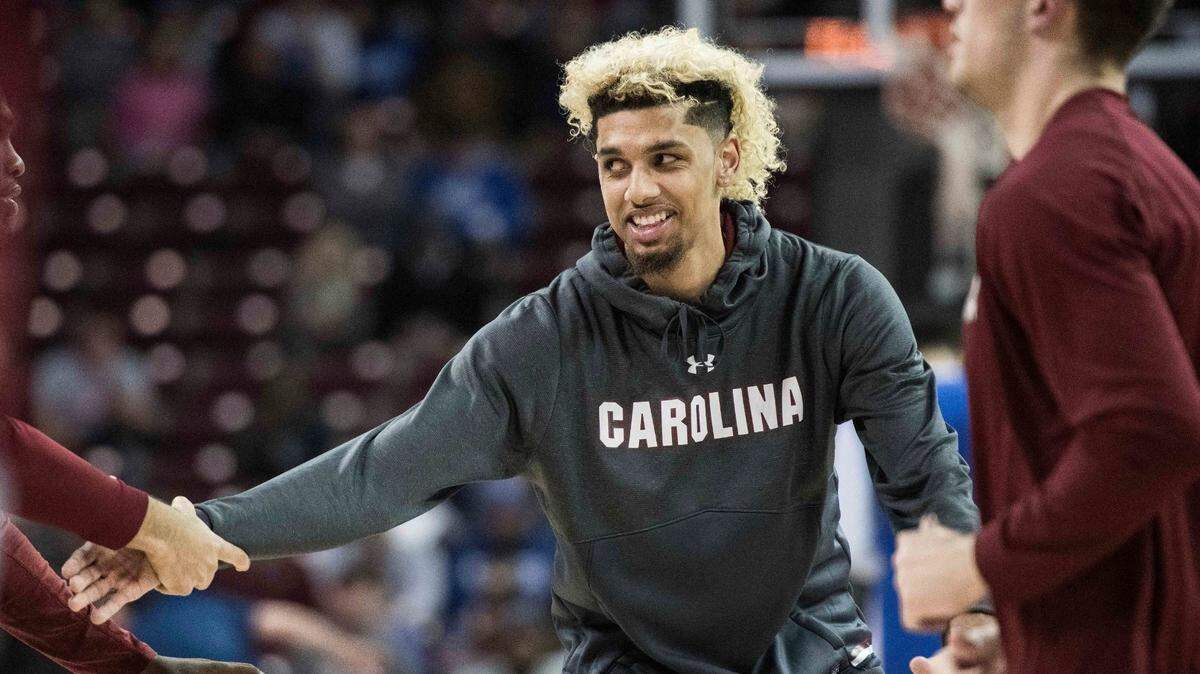
A federal judge on Wednesday dismissed a lawsuit against the giant athletic shoe maker Adidas America brought by Brian Bowen, a former University of South Carolina basketball player, who also played for Louisville.
“Plaintiff’s claims are dismissed, with prejudice, in their entirety,” U.S. District Judge Joe Anderson wrote in an order filed Wednesday morning.
Anderson’s order could still be appealed.
In his order, Anderson wrote that he was dismissing Bowen’s lawsuit for numerous reasons, including that the evidence developed so far was not strong enough to meet the high hurdle demanded for its seeking of triple damages under the federal Racketeer Influenced and Corrupt Organizations Act, which covers organized crime activities such as bribery and money laundering.
The lawsuit alleged a wide-ranging scheme involving numerous people and under-the-table payments from Adidas to families of young basketball prospects.
For the lawsuit to go forward, Bowen would have needed enough evidence to show that there was an organized plot by a group of Adidas officials working in concert to unduly influence numerous star basketball prospects and get them to play for certain colleges that wore Adidas gear.
In recent months, filings made as part of the lawsuit attracted national attention about NBA basketball star Zion Williamson, who played in Spartanburg in his high school years and played at Duke University. The news about Williamson was reported first by The Raleigh News & Observer and The Athletic, then picked up by The New York Times.
The Williamson-related court filing in Bowen’s lawsuit said that a former Adidas employee “may have transferred $3,000 per month to the Williamson family for an unspecified period of time” while Williamson was in high school and before he entered Duke University. Williamson played one year for Duke and is now with the New Orleans Pelicans.
In Wednesday’s dismissal order, Anderson wrote that he “does not doubt that Bowen Jr.’s life was upended by the revelation of payments to his father and the University of Louisville’s decision to withhold him from NCAA competition. Nor does the Court ignore the (FBI) prosecution of certain individuals involved in making those payments to Bowen Jr.’s father.
“But while Plaintiff devotes most of his arguments to these undisputed facts, they are not relevant to the Racketeer Influenced and Corrupt Organizations Act’s (“RICO”) statutory standing requirements. That a fraud has been committed, and that Plaintiff has been negatively impacted by that fraud, does not suffice to confer standing to seek treble damages under civil RICO.”
Anderson also wrote, that Bowen Jr. “was a small spoke in a much larger wheel of the broader recruitment scandals and challenges currently facing college basketball.”
Bowen Jr.’s lawsuit was filed in 2018 by the Charleston law firm McLeod Group on behalf of former Louisville and South Carolina basketball recruit Brian Bowen against Adidas sports shoe company, alleging “violations of the Racketeer Influenced and Corrupt Organizations (RICO) Act.”
Attorney Mullins McLeod was not immediately available for comment.
Bowen spent most of the 2017-18 academic year in Columbia with Frank Martin’s team, but he was not yet eligible to play in games. He left for a professional opportunity when it became clear he would not become eligible to play college ball. He was at the center of the FBI probe after his father reportedly accepted $100,000 for him to play at Louisville.
Bowen’s lawsuit contained blunt allegations.
“This action arises from a criminal bribery and fraud scheme spearheaded by Adidas America, its employees and consultants, numerous AAU and NCAA Division I men’s basketball coaches, and certain financial intermediaries that exists to infiltrate amateur athletics by preying upon the families of top-ranked high school student-athletes in order to get their children to play basketball at Adidas-sponsored universities,” said an amended version of the original lawsuit.
“This criminal enterprise has but a single motive: profit. Profit for Adidas by annually poaching the country’s top high school basketball recruits and chaining them to the Adidas-brand through increased market share in the ultra-competitive $25 billion athletic shoe market,” the lawsuit said.
“All of this profit comes at the expense of Plaintiff Brian Bowen and other student-athlete victims who, by virtue of the criminal scheme directed by Adidas and its lieutenants, lost their eligibility to play college basketball, lost their eligibility to receive financial aid necessary to continue their education, and lost the singular opportunity to develop physically and athletically into NBA draft picks at a NCAA Division I men’s basketball program,” the lawsuit said.
In an answer to that lawsuit, Adidas denied the allegations that the company was part of an orchestrated scheme and put much of the blame on Bowen’s father, Brian Bowen Sr.
“Throughout Brian Bowen Jr.’s high school career, his father, Brian Bowen Sr., solicited and accepted money in return for promising that his son would play basketball for specific schools and programs. In each instance that Bowen Sr. took money for his son’s services, Bowen Jr. in fact played or committed to play for a particular team,” Adidas said.
“Some of the funds Bowen Sr. received were misappropriated from Adidas America, as part of a larger scheme. In this scheme, former Adidas employees and other individuals misappropriated funds to pay families of high school athletes, like Bowen Jr., in exchange for those athletes committing to play for certain schools and programs,” Adidas’ answer said.
“The participants in this scheme did not act on behalf of Adidas or for its interests. To the contrary, the participants worked together to submit, and cause to be submitted, fraudulent invoices to obtain funds from Adidas. In order to evade Adidas’s internal controls, the fraudulent invoices contained false descriptions of how the funds would be used. For example, an invoice submitted for purported ‘travel expenses’ generated funds used to pay a player’s family,” Adidas said.
“Adidas was unaware of this scheme and never would have approved the invoices had it known the funds’ intended use,” the company’s answer said.
Defendants in Bowen’s lawsuit also included former Adidas executive James “Jim” Gatto, former Adidas consultant Merl Code, Christian Dawkins, Munish Sood, former Adidas executive Thomas Gassnola and former Adidas executive Christopher Rivers, all figures in an FBI corruption probe that occurred around 2017 into under-the-table payments in college basketball.
In 2018, a federal jury found Gatto, Code and Dawkins guilty in a basketball corruption trial in the Southern District of New York, which includes New York City. Among the charges: they had participated in a scheme to defraud Louisville by funneling $100,000 of Adidas money to the family of top basketball prospect Bowen so he would commit to playing for the Cardinals. All received short prison sentences of less than a year, but the sentences are being held in abeyance pending their appeals.
Sood, a financier who allegedly funneled Adidas money in the company’s basketball schemes, and Gassnola, a former Adidas consultant, were government witnesses in the trial. Sood received a $25,000 fine; Gassnola received two months home detention.
Dawkins had directed an Adidas-sponsored AAU youth basketball team that Bowen had played on, according to the lawsuit.
Bowen had been a standout high school basketball player. In 2017, he was 6-7, a McDonald’s All-American high school basketball player, widely ranked as a five-star recruit, and was one of the most sought-after college basketball prospects in the United States, according to his lawsuit.
Bowen’s lawsuit, and the FBI’s criminal case, grew out of a 2017 FBI investigation involving alleged widespread fraud in the college basketball world in which federal officials said they would expose the “dark underbelly of college basketball.”
Since Bowen’s civil lawsuit was filed in U.S. District Court in Columbia, more than 20 lawyers have gotten involved on various sides of the matter. The court record has more than 260 separate filings, including the 106-page lawsuit and a 60-page answer to the allegations by Adidas America.
Columbia attorney Debbie Barbier, who represented Gatto in Bowen’s civil lawsuit, said Wednesday, “We are very pleased with the Order dismissing the lawsuit against Jim Gatto. The Court’s decision is legally solid and we are confident it will be affirmed if appealed.”
This story was originally published May 26, 2021 at 11:06 AM.