
Prosecution, defense give closing arguments in trial of Cayce doctor accused in shooting
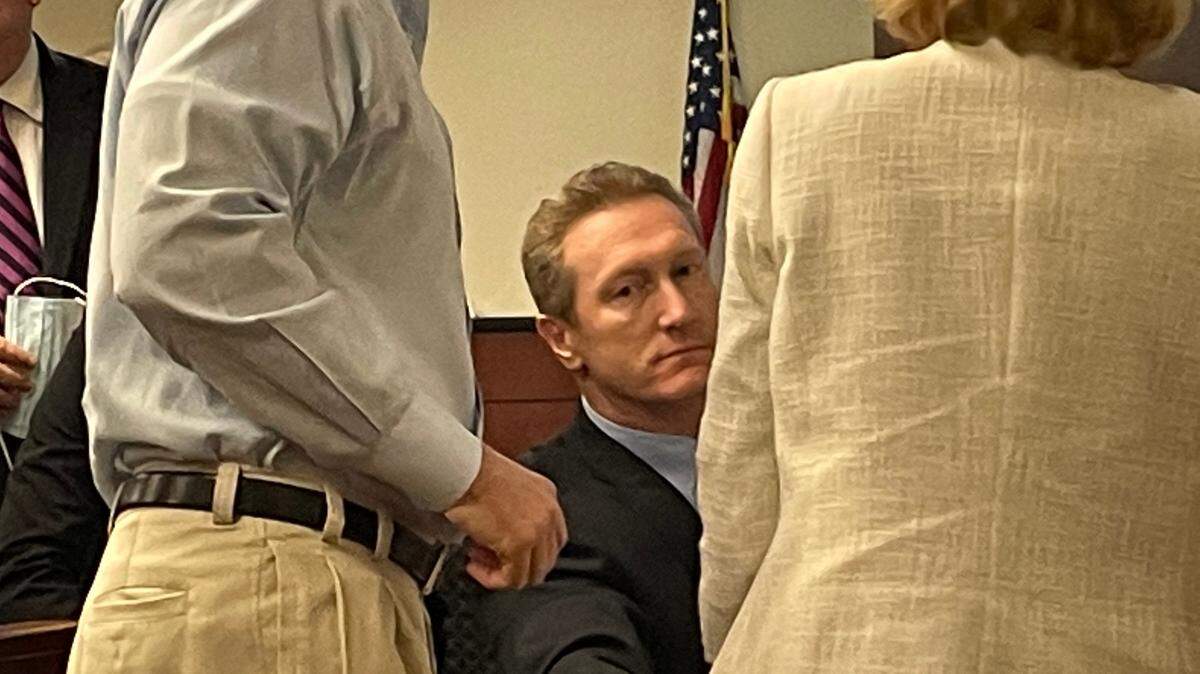
Prosecutors and defense attorneys in the trial of a Cayce doctor accused of a fatal shooting tried to sway the jury for a final time Thursday.
Prosecutors Shawn Graham and Luke Pincelli of the 11th Circuit Solicitor’s Office gave their closing arguments followed by defense attorneys Greg Harris, Jack Swerling and Alissa Wilson in the trial of Adam Lazzarini, a former Lexington Medical Center surgeon charged with involuntary manslaughter in the shooting of 30-year-old William Player Holland in October 2017.
The events leading up to Holland’s shooting had been established in testimony. Lazzarini and Holland spent Oct. 9, 2017, together in Columbia and Cayce after a trip to Georgia to see a new medical operation. The operation was canceled, and the pair returned to Columbia. Between 7 and 8 p.m., the two were at Lazzarini’s house looking at some of his handguns in an upstairs bedroom. Those were the last moments of Holland’s life.
The defense didn’t expend much energy pursuing testimony that Lazzarini didn’t shoot Holland. Instead, they argued that the shooting was a “horrible accident” and the gun could have gone off in Lazzarini’s hand.
The trial lasted nine days, including one day for jury selection. Friends and family of both Holland and Lazzarini spent every day in the court room.
The jury was deliberating a verdict just after 1:30 p.m.
Prosecutors’ closing argument
Graham presented the prosecution’s argument to the jury.
“Each and every thing that Adam Lazzarini did that night you have to say, was it reckless?” Graham told the jury. “Doctors are supposed to do no harm. He sure did harm that night.”
Graham emphasized that the case was not about whether Lazzarini meant to kill Holland. He said he wasn’t arguing that Lazzarini intended to kill. Instead, the jury should convict Lazzarini because he was criminally negligent and reckless.
Graham argued that Lazzarini was trained in gun safety and chose to ignore those safety rules on the night Holland died. Lazzarini was drinking that night and should have known that Holland, who had twice the legal limit of alcohol in his system, was drunk and shouldn’t have handled guns with him, Graham told the jury.
Known malfunctions in the gun that killed Holland still required physical force with the gun, loading the gun and pulling the trigger, Graham said. The gunshot was an inch away from Holland’s chest, and Graham demonstrated how the gun would have been held when Holland was shot. Graham did this to try to persuade the jury that Lazzarini pointed the gun at Holland and pulled the trigger.
Lazzarini told three different versions of the shooting, Graham reminded the jury. In one, he was out of the room when Holland shot himself. In another, he was in the room and his back was turned when Holland shot himself. Finally, he told at least one person that he was facing Holland and exchanging the gun when it went off.
Lazzarini changed his story to investigators about whether his daughter was in the room and lied about other parts of that night, Graham said.
Graham reminded the jury that Lazzarini’s daughter, then 5 years old, told a child forensic interviewer that her dad was holding the gun. “He pushed the trigger,” the daughter said. “They think the boy killed himself but my dad accidentally did it.”
Neighbors and acquaintances testified that Lazzarini said on the night of the shooting that he killed his best friend; later, he said, “I think I shot him,” Graham told the jury.
In the end, Graham reminded the jury of Lazzarini’s words.
“What will I tell his family?” Lazzarini told an investigator about Holland.
Graham said it was now up to the jury to answer that question.
“Adam Lazzarini is, and you will find, guilty of involuntary manslaughter,” Graham said at the end of his closing argument.
Defense’s closing argument
Swerling gave the jury Lazzarini’s final perspective in a sometimes emotionally heated closing argument that lasted two hours and brought in historical trial law of England, John F. Kennedy’s assassination and a mention of the Gamecocks and Clemson.
He began by appealing to jurors’ humanity.
“People are subject to emotion” and feelings that alter their thinking and cause them to say different things at different times, Swerling said. “(Prosecutors are) ignoring normal human emotion.”
He asked the jury to think of people who witnessed the attacks in New York on 9/11. Did the jurors believe those people could have recalled events exactly as they were without changes over time?
“This was a man (Lazzarini) that was distraught,” in shock and had an emotional breakdown, Swerling said.
Swerling took on the prosecution’s argument that Lazzarini pointed the gun and pulled the trigger.
Lazzarini “was not handling the pistol” when Holland died, Swerling argued. There’s not a “scintilla” of evidence Lazzarini was handling the pistol.
Swerling discussed the principals of the legal system, saying that the presumption of innocence was one of the United States’ distinct and highest principals. Jurors should have reasonable doubt about the involuntary manslaughter charge.
“If the evidence or lack of evidence causes you to hesitate,” a juror has to find Lazzarini not guilty, Swerling said.
Swerling admitted that Lazzarini’s changing stories about the shooting and who saw it aren’t consistent. But “they all come down to one thing.”
“He is not guilty beyond a reasonable doubt,” Swerling said.
Convincing jurors that reasonable doubt existed was central to the defense’s arguments.
Lazzarini had told an investigator that he didn’t know that Holland had picked up a loaded handgun, Swerling reminded the jury. Lazzarini didn’t know that he was taking a loaded gun from Holland when it went off.
Swerling told jurors that Lazzarini admitted to drinking about five hours before the shooting. But Swerling argued that Lazzarini was not impaired when the two were looking at guns.
Like the prosecution, Swerling brought up Lazzarini’s knowledge of gun safety and his “meticulous” manner of storing his guns. Swerling argued that “he’s not an individual who just all of a sudden os going to be unsafe.”
Swerling criticized evidence presented by investigators. Investigators didn’t want to consider ballistic evidence that could have proven Lazzarini wasn’t lying about the shooting, Swerling said.
Raising his voice, moving toward and gesturing at prosecutors, Swerling told the jury that Lazzarini agreed to a lie detector test but investigators never administered the test. Swerling said this was because investigators would have gotten results that were contrary to their case.
Lazzarini’s story had variations because he was trying to figure out what happened in the heat of the moment, Swerling argued. But he said investigators also got information wrong in their reports, such as what Lazzarini drank.
To prosecutors, being distraught makes someone look guilty, Swerling said. It doesn’t, but it makes Lazzarini look innocent, Swerling argued.
Using video of Lazzarini’s 5-year-old daughter saying her father shot a man was wrong, Swerling argued.
“Against her father,” Swerling yelled at the jury.
The pathologist relying on the daughter’s recollection, which was faulty, to determine the shooting was a homicide “was inappropriate to rely on,” Swerling said.
Swerling spent about 15 minutes of his closing argument reading parts of interrogations of Lazzarini to attempt to show the jury that he cooperated with investigators and were truthful with them. The attorney reminded jurors that the pistol had a malfunction that could cause it to delay firing.
Swerling told the jury with what he said happened on the night of the shooting.
Swerling said Lazzarini handed Holland an unloaded gun to dry fire and feel the weight. Lazzarini went to the bathroom. While he was out of the room, Holland picked up a loaded gun and put a bullet in the chamber. When Lazzarini returned, Holland handed over the loaded weapon unbeknownst to Lazzarini. That’s when the gun went off.
“Where is the fault here?” Swerling asked the jury.
Lazzarini did not handle the gun that killed Holland, as the indictment says, Swerling argued. Rather, Holland handled the pistol.
“The state has failed in its proof miserably,” Swerling said. “This case is over before it began.”
“Justice in this case requires a verdict of not guilty,” Swerling said.
This story was originally published March 3, 2022 at 3:36 PM.