
Murder brings them together: Dawn Staley, Harpootlian and serial killer Pee Wee
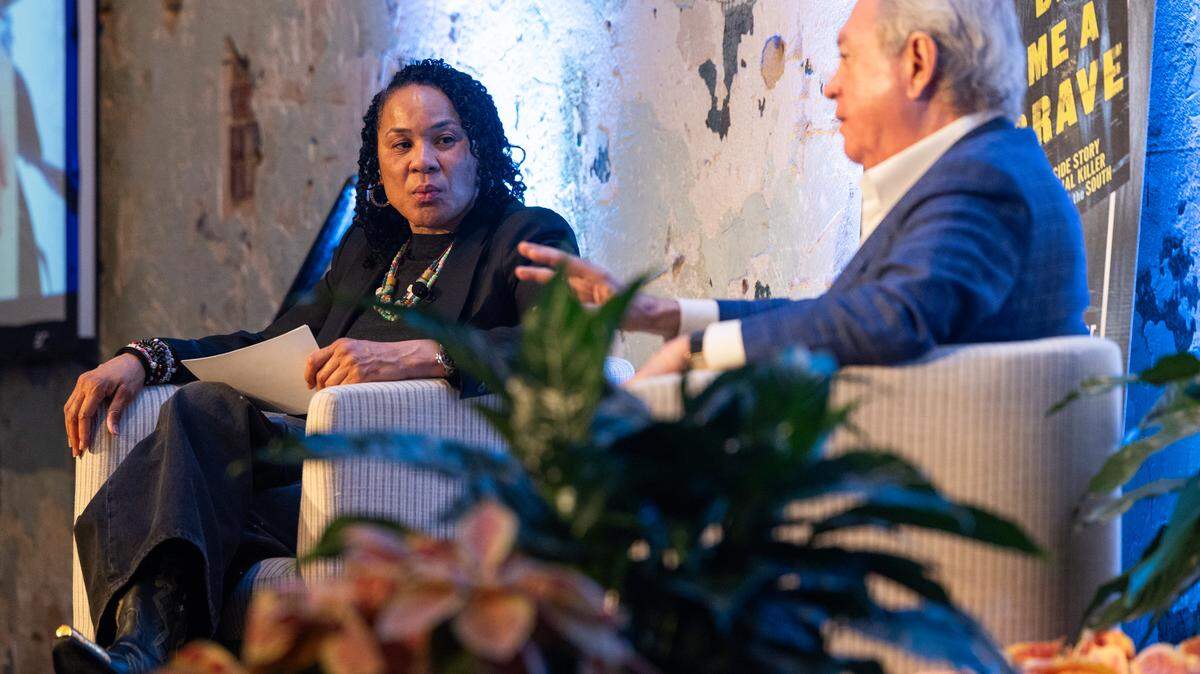
Two of South Carolina’s best-known people from different worlds — famed University of South Carolina women’s basketball Coach Dawn Staley and legal lion Dick Harpootlian of the notorious “Murdaugh Murders” case — teamed up last week to do a kind of talk show before hundreds of people at 701 Whaley Street in the mill village section of Columbia.
They are separated by a generation. Harpootlian is 76; Staley, 55.
But both are fascinated with murder. It was a natural fit.
Though it’s not well known, Staley is a diehard true crime fan.
And Harpootlian has just published a true crime book — “Dig Me a Grave” — about a long ago colorful South Carolina serial killer named Pee Wee Gaskins and his sensational last killing. That’s when Gaskins, who had confessed already to 13 murders and was living on South Carolina’s death row, used plastic explosives in 1982 to assassinate another inmate. The book tells the story of how Gaskins was caught and how Harpootlian, then a Richland County prosecutor, convinced a jury to find him guilty and send him to the electric chair.
The event with Staley was the launch of “Dig Me a Grave,” and some 19,000 copies are said to be arriving in bookstores and ready to be bought at $29 each.
“I assume we all have a fascination with true crime,” Staley said with a sly smile, explaining how she came to share the stage with Harpootlian. “I know I do. I don’t even think they asked me to do this. I think I volunteered.”
Normally, Staley is at home on basketball court sidelines, urging her championship teams on before crowds of thousands and in title games, television audiences in the millions.
But for this event, Harpootlian and Staley were seated on armchairs on an elevated platform before an audience of some 300, a 7-foot or so high, dark gray tombstonelike poster with the words “Dig Me A Grave” between them.
With its 18-foot ceilings and roughed-in inner brick walls, 701 Whaley was the perfect place to talk murder. The two-story structure is in the center of what was a once-bustling former Columbia mill village, and was first built more than 100 years ago.
Noting that she, like Harpootlian, is a first-time author, Staley said, “It’s cool the excitement you get when you write a book, and you are passionate about it.”
Her book “Uncommon Favor,” published earlier this year, is an insightful and inspiring memoir of her journey from a North Philadelphia apartment in the projects to becoming one of the modern era’s most celebrated college basketball coaches.
“I wasn’t into true crime stuff as a child. I think I became interested because in my life now, it’s an escape,” Staley explains in her book. “I get a rise out of it. It feeds something in my morbidly curious soul.”
Trial lawyers are like coaches, assembling teams of experts and witnesses who do battle in the arena of the courtroom, Staley writes. “No one wins a case alone,” she writes. “See, just like basketball!”
The talk show
The format was simple. Staley questioned Harpootlian about the book and his deadly dance with Gaskins, who during his six-week death penalty trial accused Harpootlian of being a killer, too.
“Dick, you know what? You’re a lot like me. You like killing, just like me,” Gaskins taunted Harpootlian.
During the questioning, the legendary Staley — a three-time Olympic gold medalist, a three-time women’s NCAA basketball championship coach whose salary is some $4 million a year, said to be the highest women’s coaching salary in the nation — seemed to enjoy quizzing someone whose battleground is the courtroom where the stakes can be life or death.
Staley opened by saying Harpootlian’s book grabbed her from the beginning. How did he choose the gripping opening pages, “the moment that pulled everybody in,” an account of how Pee Wee drowned a pregnant South Carolina mother in a pond and then beat her half-white, half-Black toddler to death with a hammer?
“We wrestled, wrestled with that,” replied Harpootlian, “we” being his co-writer, Shaun Assael, a nonfiction expert. (Harpootlian is a masterful courtroom orator, but writing a readable nonfiction book is a separate craft, one that Harpootlian realized he needed help with.)
Ultimately, Harpootlian said, he and Assael decided that while the killings were awful, they showed the reader “what kind of monster we’re dealing with here ... I wanted the reader to understand (that) out of the chute.”
“What compelled you to write the Pee Wee Gaskins story, like now? What did you feel was still unresolved?” Staley asked next.
“The Gaskins case haunted me,” explained Harpootlian, explaining that in 2021 when the COVID pandemic was raging, and people were staying home, he finally began putting some ideas down on paper, got an agent and hired a nonfiction writing specialist.
It was more than an average murder case, Harpootlian explained. During the six-week 1983 death penalty trial, Harpootlian had forged an unlikely relationship with the 5’-2’’, 140-pound Gaskins, a chatty and amiable fellow who had killed 13 people, gotten multiple life sentences and was living on death row at the time of his last and most sensational murder.
“I thought it was a unique story. If it’s not unique, there’s something wrong with the world. He killed 13 people — babies, pregnant woman. ... He was a killing machine ... He was killing people left and right. ... he got away with it for five, six, seven years ...,” Harpootlian said.
Harpootlian also said he realized he had two crucial documents that had been given to him with other court records in 1991 after Gaskins was executed: a printed transcript of the entire 1983 trial and a 500-page transcript of a detailed confession of 13 murders (Harpootlian calls them “13 kills” in his book) Gaskins had made to Florence County prosecutor Ken Summerford in return for multiple life sentences.
The documents were crucial in making sure his book is based on fact, Harpootlian said. “There’s no guessing.”
Staley was quite familiar with the details in Harpootlian’s book. While asking him about how Gaskins blew up his last victim, Rudolph Tyner, on death row with explosives, she mentions a detail from the book — that Gaskins had unsuccessfully tried to poison Tyner several times.
“It feels very much like a Hollywood movie,” mused Staley. “It’s a true story. It’s like this really happened. It’s incredible. ... What do you want your readers to understand that goes beyond the headlines?“
Harpootlian explained that his book is not just about Gaskins, it is also about the transformation of a young liberal who was against the death penalty into someone who came to believe that in horrorific cases like Gaskins’ the death penalty is appropriate and necessary to protect society, Harpootlian explained.
“I’m for it in a very limited way,” Harpootlian said.
Where did Harpootlian get the title “Dig Me a Grave” from? Staley asked.
Once Gaskins told an accomplice after a killing to “dig me a grave,” replied Harpootlian. “That stuck with me. ... He was always digging graves or had other people dig graves .... That sort of captured his MO” (MO refers to a latin phrase meaning method of operating.)
With a mischievous smile, Staley asked Harpootlian if the title “had anything to do with altering his stance on the death penalty?”
“Wow,” said Harpootlian after a long pause. “It might have.” Laughter in the audience. Staley grins.
“If there’s one lesson you would hope readers get from ‘Dig Me a Grave,’ what would it be?” asked Staley.
Harpootlian: “There are people out there who don’t believe there ought to be a death penalty ever ... but they have not seen the kind of evil I’ve seen.”
Toward the end of the session, Staley stifled a laugh when Harpootlian was explaining how Gaskins was an adept con man who charmed guards into not knowing what he was up to, a “likeable guy” who called Harpootlian’s home and talked to his mother after he was convicted and awaiting the electric chair.
“So, he wasn’t a serial killer, he was a likeable guy? ” Staley repeated, chuckling in disbelief.
“He sent me Christmas cards,“ Harpootlian said.
“Can you imagine your life without having to prosecute him?” Staley asked.
Harpootlian gave a long answer which added up to: not really.
Staley wanted to know if there might be a sequel to the Gaskins story, perhaps drawing on unpublished material that Harpootlian left out of the book.
“Let’s see what the market is for this,” replied Harpootlian. “Shaping a story and making sure it’s done it a way you’re proud of it is not as easy as it sounds.”
Actually, said Harpootlian, his 2023 Alex Murdaugh murder trial at some point may be a book he and his co-counsel, Jim Griffin, might consider doing. But, “we can’t do it until the (Murdaugh) case is over.”
“If you need me to do any research, I’m willing and able,” Staley said.
At the end, Staley told Harpootlian if she ever gets in trouble, she’ll know what lawyer to call and finished by exhorting people to read “Dig Me a Grave.”
“Go get the book!” she told the crowd.
The preparty
Before the Staley-Harpootlian event, another room at 701 Whaley was the scene of a drop-in of dozens of Harpootlian’s friends and acquaintances who could buy the book and have him autograph it. Harpootlian and his wife, former ambassador to Slovenia Jamie Harpootlian, greeted them all.
Included in that gathering were past U.S. Attorney Bill Nettles and current U.S. Attorney Bryan Stirling, federal judges Joe Anderson and Mary Lewis, former Gov. Jim Hodges, University of South Carolina Rice School of Law dean William Hubbard, aattorney ageneral candidate David Pascoe, former S.C. Supreme Court chief justice Costa Pleicones, Richland County Sheriff Leon Lott and Harpootlian’s opposing lawyer in the Alex Murdaugh case, Creighton Waters.
Most, but not all, bought the book, and some bought multiple copies.
Harpootlian had known many of them for decades, including Judge Anderson, a Harpootlian classmate at Clemson in the late 1960s and early 1970s.
Harpootlian wrote in Anderson’s copy of “Dig Me a Grave”: “Our paths crossed at Clemson. You took the high road — and I didn’t.”
Signed/ Dick Harpootlian.
This story was originally published December 23, 2025 at 5:30 AM.