
Murdaugh appeal: SC justices question prosecution on jury tampering, evidence
Questions about whether jury tampering and improper prosecution evidence spoiled convicted killer Alex Murdaugh’s right to a fair trial dominated an unusually long appeals hearing before a packed courtroom Wednesday at the S.C. Supreme Court.
All five justices peppered attorneys for both sides with dozens of questions in a live-streamed hearing that — with a 20-minute break — stretched nearly three hours.
During the hearing, Chief Justice John Kittredge, a symbol of sober rectitude in South Carolina’s legal establishment, managed to call former Colleton County disgraced clerk of court Becky Hill a “rogue clerk of court” and referred to former lawyer Murdaugh as “a despicable low-life character.”
People came from Georgia, North Carolina and beyond to catch an up-close glimpse of sensational legal history, the Murdaugh double-murder case having been viewed by millions on Court TV during Murdaugh’s 2023 six-week trial. Then, a Colleton County jury found him guilty of the execution-style killings of his wife, Maggie, and son Paul on June 7, 2021, at the family 1,700-acre rural estate.
The case, with its intertwined layers of betrayal, theft, dynasty, privilege, murder, mystery and money, seems likely to be part of America’s crime zeitgeist for years to come.
Although the Murdaugh case has for years played out in documentaries, movies, podcasts and news shows before audiences of millions, Wednesday’s key audience featured just five people — Chief Justice Kittredge and associate justices John Cannon Few, George “Buck” James, Gary Hill and Letitia Verdin.
They and they alone will decide whether the case was improperly tried and whether Murdaugh gets a new trial. They gave no hint Wednesday of how they might rule, or when.
Murdaugh, 57, a once wealthy fourth-generation lawyer in his family law firm in Low Country Hampton County, is serving two life sentences for murder at a maximum security state prison in McCormick County.
He is also serving multi-year state and federal sentences for defrauding hapless clients of millions of dollars. Murdaugh has admitted his financial frauds and plead guilty to them.
But he contends he is innocent of murder and was wrongly convicted of murdering his wife and son. His former law firm, which still exists under a new name, is regarded as a money-making plaintiff’s firm. One of the enduring mysteries of the case bedeviling watchers of his tragic saga is how the privileged Murdaugh, once president of a state trial lawyers’ association, let himself fall into a life of secret crime.
Murdaugh was not in court Wednesday. It would have been highly unusual for a prison inmate in jail garb, slippers, chains and an accompanying security guard escort to appear in the Supreme Court courtroom during an appeal. Also not present were any members of Murdaugh’s family, including his son Buster Murdaugh, the only surviving member of his immediate family. Prison regulations forbidding internet access kept him from watching the court’s live-steam.
Jury tampering
“Nobody wants to do this again,” Murdaugh attorney Dick Harpootlian told the justices when opening the arguments. He referred to the possibility of overturning his client’s two murder guilty verdicts, an action that would necessitate the grueling and expensive task of gearing up for another six-week trial — one of the longest in state history — that featured nearly 90 witnesses.
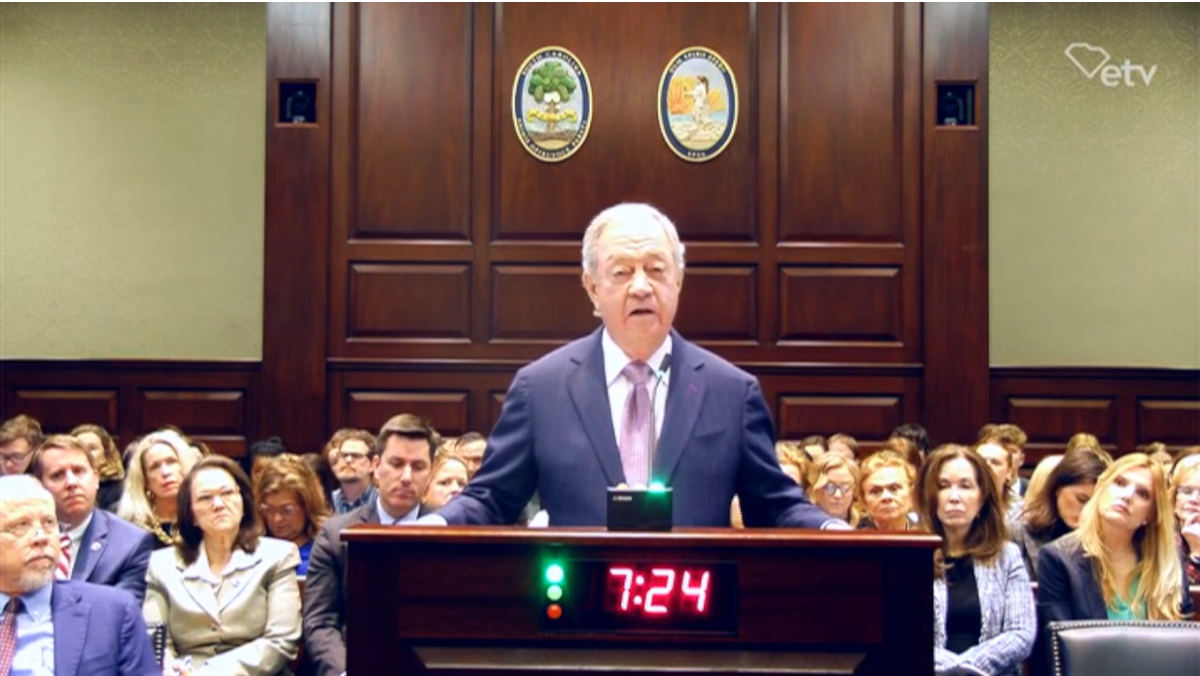
But the inconvenience of a whole new trial is outweighed by a vital constitutional principle that is in play — Murdaugh’s Sixth Amendment right to a fair trial before an impartial jury, Harpootlian told the justices.
That right to a fair trial was undermined by actions and words of former Colleton County Clerk of Court Becky Hill who made improper remarks and insinuations to jury members during the trial, Harpootlian said.
Hill, who as clerk of court was close to jurors during the trial, had told others she wanted to make money by publishing an insider’s book about the event, Harpootlian said. And some jurors and alternates quoted Hill as making prejudicial remarks that could be interpreted as inducing them to vote to convict Murdaugh — a finding that would help Hill sell her book to make money to buy a lake house, Harpootlian told the justices.
“A guilty verdict would be better for her to sell books,” said Harpootlian.
Various statements attributed to Hill by jurors and alternate jurors in sworn statements included: “Watch his body language”, “Looks like the defendant is going to testify ... This is an epic day”, and ”Watch his actions, watch him closely” and “Not to be fooled by evidence presented by Mr. Murdaugh’s lawyers,” Harpootlian told the justices.
One juror understood Hill to be saying that Murdaugh was guilty and another thought Hill was implying that Murdaugh would lie when he took the witness stand, Harpootlian said. At trial, Murdaugh testified over two days and denied that he killed his wife and son, Harpootlian said.
The jury tampering matter puts former S.C. Supreme Court Chief Justice Jean Toal in the midst of the controversy. In early 2024, the retired Toal acted as a trial judge and presided over a hearing in Richland County where former Murdaugh jurors testified about Hill’s conduct.
Toal eventually ruled that Hill’s judgment was corrupted by her desire to be a moneymaking writer, but her comments, while imprudent, did not unduly influence jurors.
“Her (Hill’s) comments were limited in subject and not overt as to opinion,” Toal’s ruling said.
Harpootlian disputed Toal’s ruling. “That statement is wholly unsupported by the record and, I would submit, an abuse of discretion.”
Quoting an 1807 American case concerning treason, Harpootlian reminded justices that a juror’s verdict “must be based upon the evidence developed at the trial; this is true regardless of the heinousness of the crime charged, the apparent guilt of the offender and the station in life which he occupies ... That is what the Sixth Amendment guarantees and that didn’t happen in this case.”
Replying to Harpootlian’s arguments, lead prosecutor Creighton Waters told the justices that Hill’s comments to jurors were just “a few fleeting comments” and inconsequential in affecting the outcome of a trial that went for six weeks and had nearly 90 witnesses with almost 600 exhibits.
Some of Hill’s comments cited by Harpootlian were inconsequential and neutral, such as “this is an epic day,” argued Waters, representing the state attorney general’s office.
Moreover, the jury was told by Judge Clifton Newman some 60 times during the trial to “only rely on the evidence, do not talk about the case, do not have external influence,” Waters said.
Associate Justice Hill asked Waters about the potential outsized influence that a clerk of court like Hill would have on jurors given that the clerk is the key public official who is with jurors constantly and is “the administrative face of the court ... She is their guide, their Sherpa ... Justice is supposed to be blind, but court officials are supposed to be mute.”
After a six-week trial, jurors might become bonded to their clerk of court, Justice Hill told Waters.
Waters downplayed Becky Hill’s sway, saying she didn’t handle jurors on a day-to-day basis and was sick for a while. “ Judge Newman was the Sherpa, not Becky Hill,” Waters said.
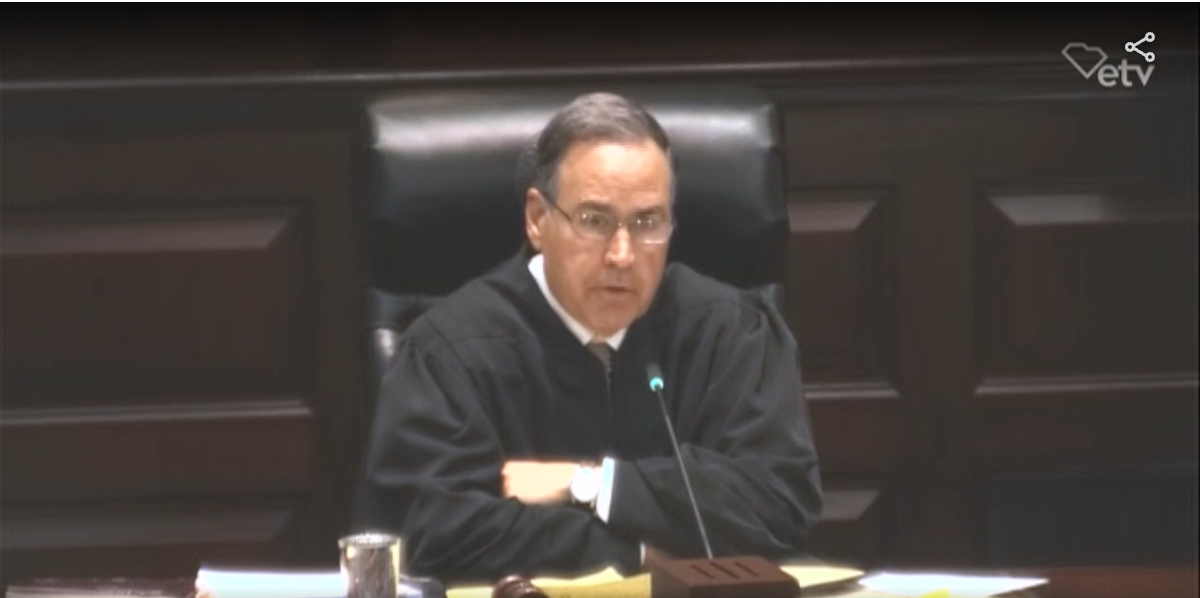
Chief Justice Kittredge, summing up the jury tampering issue, said the Murdaugh trial had an extremely competent team of defense lawyers, an excellent trial judge, a top prosecution and “out in the hallway, we have a rogue clerk of court.”
“Even you acknowledge it (Hill’s actions) was improper,” Kittredge told Waters, “perhaps not improper to the point of reversal, but you acknowledge it was improper.”
“Absolutely,” Waters said, adding that what Kittredge just said about the totality of excellence in trial proceedings proves that Becky Hill’s actions did not warrant granting Murdaugh a new trial.
Alleged improper evidence
The other major issue debated in Wednesday’s hearing involved defense allegations of fundamental errors in presenting evidence that denied Murdaugh a fair trial. These include allegedly bungled evidence concerning cell phones, gunshot residue and firearms, defense lawyer Jim Griffin told the justices.
But the major prejudicial error that prevented Murdaugh from having a fair trial concerned evidence about Murdaugh’s financial crimes that was allowed to go before the jury over a period of six days spanning a time period of six years of fraud, Griffin said.
“None of these” conclusively prove Murdaugh’s guilt, said Griffin, adding that there is no solid evidence such as DNA or eyewitnesses in this case that conclusively prove guilt. And, “the weapons have never been found,” Griffin said.
“This was not an overwhelming evidence case,” Griffin said.
Replying to Griffin, Waters argued that Murdaugh had a compelling motive to kill his wife and son (to cover up his financial troubles), he had the means (using family weapons), he had the opportunity (being at the family estate with no witnesses on the night of June 7, 2021) and after the killings, he committed “multiple acts” of covering up the killings.
“It boils down to motive, means, opportunity, acts of guilty consciousness and the evidence was very strong in all of that,” Waters argued.
Kittredge pushed Waters on whether the financial evidence prosecutors introduced on the pathetic circumstances of some of Murdaugh’s fraud victims unfairly prejudiced jurors against Murdaugh.
After all, testimony before the jury by one of Murdaugh’s fraud victims, Tony Satterfield, revealed that Murdaugh had stolen $3.4 million in inheritance from a disabled young man and the “granular detail” of such harmful information about Murdaugh is “arguably problematic,” Kittredge said.
“That appears to be that not only is he (Murdaugh) is a thief with a motive for murder, he’s a despicable low-life character,” Kittredge said.
Waters replied that prosecutors brought that testimony up was because it involved Murdaugh’s motive for killing his wife and son, not because it illustrated Murdaugh’s character.
Justices must realize that numerous financial pressures, including a looming court hearing where he would be forced to disclose his precarious money situation, were doing a “slow burn” on Murdaugh and that’s why he killed his wife and son, Waters said. Once the murders happened, Murdaugh became an object of sympathy and his financial pressures eased, Waters said.
During the discussion, Associate Justice Few told Waters that prosecutors should have taken no more than two hours to present to jurors how financial pressures on Murdaugh from his frauds contributed to the motives for killing his wife and son. “You took 12 and a half hours to do it.”
Buzz in the courtroom
Two sisters from Augusta arrived at the Supreme Court building at 3:45 am Wednesday so as not to miss the event, since the smallish courtroom, with its elevated bench for the black-robed justices, only has room for about 100 people sitting close together.
The two had been to many Murdaugh events including his 2023 murder trial, the auctioning off of his possessions once he was convicted of murder and even seeing prosecutor Waters play in his rock band.
“This just has so many different layers to it, and our daddy died, he was murdered,” said Carolyn Dickson, 64, with sister Mary Landrum, 68.
“Seeing somebody get justice is gratifying,” Landrum said.
Other spectators included about 15 members of a pre-law group at Clemson University, a retired lawyer from Charlotte and a security guard from Hendersonville, N.C. Three longtime friends of Justice James were in the courtroom, having ridden up from Sumter with James in the morning.
More than 60 percent of the audience appeared to be women of all ages, a not surprising demographic when it comes to true crime events.
Although many of the lawyers’ and justices’ utterances during the hearing involved legalese, the films Fargo and Forrest Gump and were alluded to, at times.
And Justice James spoke in plain English when he said at one point, “Heaven knows, no one wants to try this case again.”
After the hearing, the defense team invited reporters to Harpootlian’s downtown law office, where he and his fellow lawyers happily answered questions.
“You can tell, they (justices) studied everything,” Griffin said.
Harpootlian said he thought jury tampering presented their strongest case, but added no one can predict what the high court will do. “The justices were prepared.”
After the hearing, Attorney General Alan Wilson, with a grim look on his face, brushed by a reporter and kept walking down the sidewalk in front of the Supreme Court. Asked if he had a comment, the attorney general uttered a terse “no.”
Wilson is running for governor. If the Supreme Court were to overturn this case before the June Republican primary, it would likely be campaign fodder for his opponents.
Even if Murdaugh wins a new trial on his murder convictions, and is found not guilty in a subsequent murder trial, he still will have to serve out a 40-year sentence in federal prison for stealing more than $12 million from 27 victims, including his law firm and clients.
At his 2024 sentencing hearing, U.S. Judge Richard Gergel called Murdaugh a “disgrace” who had prowled the “dark side” of the law, using the trust generated by his family name and personal relationships to enrich himself.
“The defendant’s conduct has brought disgrace and disrepute to himself, his law firm, the Hampton County bar, the South Carolina bar, if not the entire court system,” Gergel told Murdaugh before sentencing him to 40 years, an unusually long term for white collar crimes.
Murdaugh will be in his 90s when he’s released from federal prison, if he lives that long.
(Reporter Bristow Marchant contributed.)
This story was originally published February 12, 2026 at 5:30 AM.