
USC Bangladeshi students gather in solidarity for victims of anti-Hindu violence
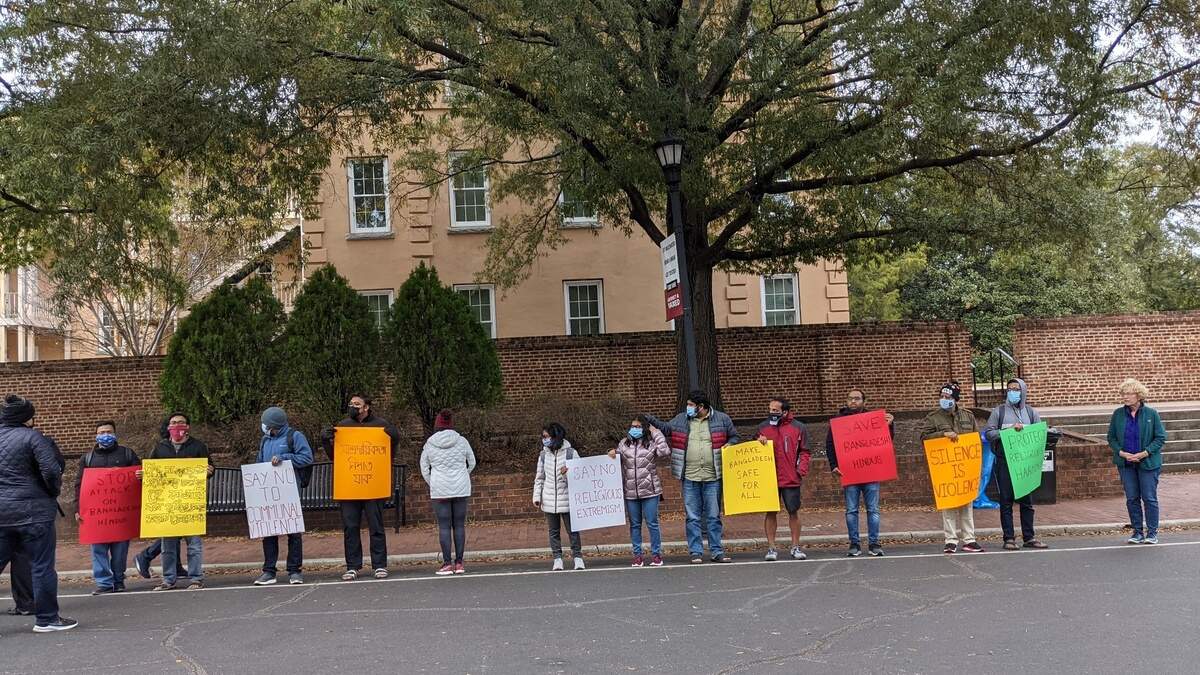
Around 20 University of South Carolina students demonstrated on campus Thursday expressing solidarity with victims of recent anti-Hindu violence in Bangladesh.
The demonstration, held outside Russell House by the Bangladesh Student Association, followed October mob attacks against Hindu temples and homes that were the country’s “worst communal violence in years,” according to the New York Times. The violence erupted following a viral social media post showing a Quran on the knee of a Hindu deity, according to Human Rights Watch.
They carried signs, some in English, saying “Stop Religious Extremism Now,” “Save Bangladesh Hindus,” “Stop Temple Vandalism” and more.
“We are here to show our solidarity,” said Shahirar Iqbal, a PhD student at USC and citizen of Bangladesh. “Minority people are getting tortured and that should not be happening.”
Hindus are a minority in Bangladesh, where 89% of the population is Muslim, according to the CIA World Factbook.
While the overseas flare-up in violence has alarmed observers, sectarian tension in the area is nothing new. Since 2013, there have been 3,600 incidents of violence against Hindus in Bangladesh, according to the Indian Express.
The attack prompted condemnation from the White House and has prompted demonstrations in other U.S. cities, including Detroit, according to media reports.
The United States is often a model for other countries, so it is important for the world to see people in the states standing against the extremism, said Iffath Mizan, a citizen of Bangladesh who attended the protest.
“This is a big issue in our country,” Mizan said.
In recent years, the violence against Hindus is becoming more brazen, said Sudipta Saha, a doctoral student studying mechanical engineering at USC. In the past, it was more common to see extremist violence against Hindus happen in rural areas, but “the audacity to attack a temple in the capital” represented an escalation.
The attacks against a religious minority undermine the secular constitution on which Bangladesh was established in 1971, when the country split from Pakistan, Saha said.
The violence “has shaken the very foundation of our nation,” said Rajat Das Gupta, the president of Bangladesh Student Association.