
If Biden nominates Gamecock alum Childs to Supreme Court, what could it mean for USC?
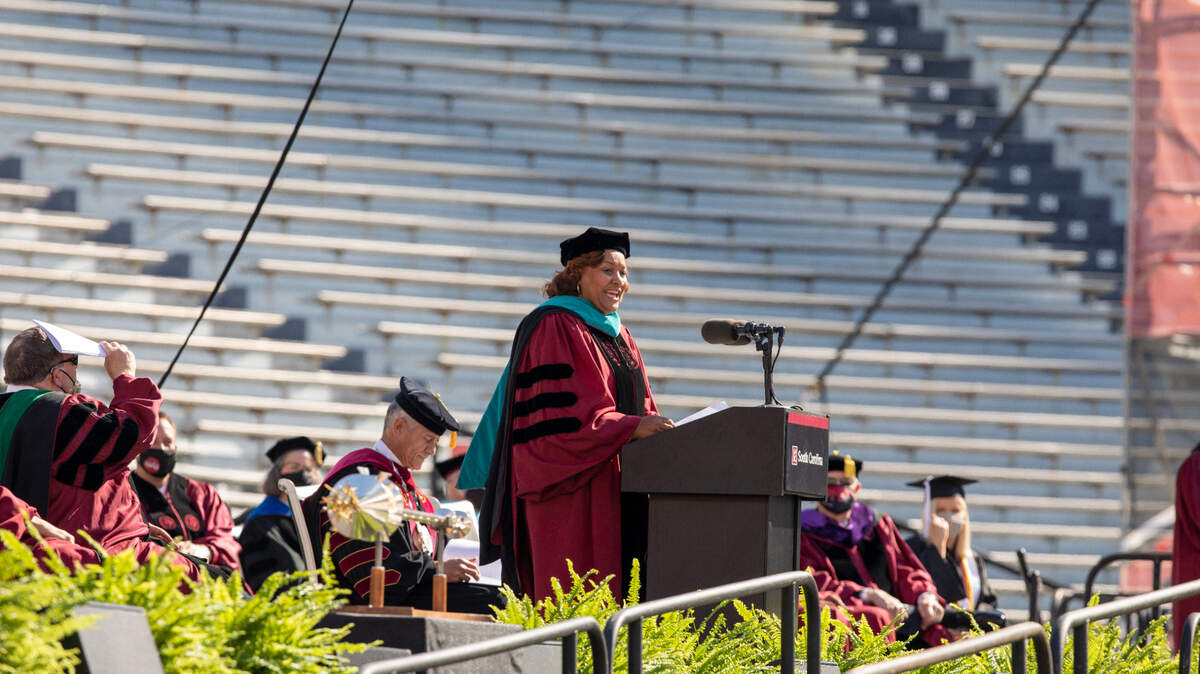
The University of South Carolina could soon have an alumna in the highest court in the land.
If President Joe Biden nominates Judge Michelle Childs for the U.S. Supreme Court, she could be the highest-ranking Gamecock of all time.
If a USC alumna were to plant a flag atop the Mount Everest of the law profession, it could bring increased prestige to USC’s School of Law, which currently ranks No. 96 in U.S. News & World Reports list of best law schools.
“I think it would be validation of the great legal education that we provide to our students here. I’ve watched over many years and decades the success of graduates of this law school and how they have succeeded on a national platform, and it would be further validation of that,” USC School of Law Dean William Hubbard told The State. “This would certainly elevate us in the legal community and the country at large.”
USC’s law school is one of two in the Palmetto State, the other being the Charleston School of Law, that are accredited by the American Bar Association. USC’s law school has alumni in the governor’s mansion, the U.S. Senate and the legal community throughout S.C. USC law school alum David Beasley led the World Food Program in 2020 when the organization won a Nobel Peace Prize.
While USC’s School of Law has alumni in high places, they have yet to break into the most elite distinction, a U.S. Supreme Court justice.
“I think it would be amazing” if Childs was nominated, said James “Ward” Bradley, a Columbia attorney and member of USC’s Law Alumni Council. “I’m not sure there is a word that could express how good that would be for the school of law and South Carolina.”
Should Childs be confirmed to the U.S. Supreme Court, it could also help USC’s law school rankings, Hubbard said.
USC expects to see an increase in rankings in coming years because of factors unrelated to Childs’s candidacy such as improving job placement rates, increased law school admissions test scores and increased applications, Hubbard said. However, 40% of U.S. News & World Report’s law school rankings are based on the subjective evaluation of each school by law school educators and legal professionals, according to the report’s methodology page.
“Where a nomination of Judge Childs would have the most impact would be on the subjective criteria where lawyers and judges evaluate our law school, and other academics evaluate our law school,” Hubbard said.
While Hubbard is optimistic about the future of USC’s School of Law, it’s hard to compare USC to other law schools that recently had alumni named to the highest court. That’s because other schools that have produced recent Supreme Court justices already sit atop the rankings. Even Notre Dame, which is not Ivy League, has always been in the top 30 schools and saw only minimal ranking improvement after Judge Amy Coney Barrett’s confirmation, according to the South Bend Tribune.
U.S. News & World Report did not comment on how a possible nomination of Judge Childs could affect USC’s law school rankings.
The right pick?
Childs was born in Detroit, Michigan, but she moved to Columbia when she was a child and graduated from Columbia High School in the Richland 1 public school district. She received her undergraduate degree from the University of South Florida, and in 1992 graduated from USC’s School of Law.
Childs, whose work as an at-large circuit court judge from 2006-2010 helped propel her to a nomination as a U.S. District Court judge in South Carolina, would also be the first Black woman to serve on the U.S. Supreme Court.
“As a diverse attorney myself, it means a lot,” said Alysja S. Carlisle, the president of USC’s Law Alumni Council.
“This is a historic moment for President Biden to name a Black woman to the Supreme Court. We’re all incredibly proud that her career track really proves that she is well-suited for this position and she has support in a time where there is a lot of divisiveness.”
Carlisle’s only experience with Childs was a chance encounter when Carlisle was on a red-eye flight, Carlisle said. As Carlisle opened her law school homework while on the plane, Childs, who was seated next to her, asked if she was in law school and the two struck up a conversation, Carlisle said.
“She didn’t even say ‘judge.’ She said I’m Michelle Childs,” Carlisle said. “She was just so gracious. She let me ask her a bunch of questions, as a graduate, someone who was successful and she was just so gracious in that moment.”
While Carlisle’s experience with Childs was limited, the judge enjoys a positive reputation throughout South Carolina.
“I can assure though, as the law alumni president, there are many alumni who know her well and she’s held in very high regard (among) our alumni,” Carlisle said. “And everyone just speaks how fair she is as a judge, her track record of getting there, and just her community involvement and her general demeanor.”
Hubbard, the USC law school dean, agreed.
“I think she’d be superb. Her judgment is impeccable. Her work ethic is unsurpassed. She brings energy,” Hubbard said. “I think she’d be a consensus builder on the court. There’s so much, you hear about division...I think she would be welcomed on the court. Just the way she approaches people, I think she would be a leader on the court.”
Public school grad
All but one of the current U.S. Supreme Court Justices received their law degrees from either Harvard University or Yale University. The one exception, Barrett, earned her law degree from Notre Dame University. All currently serving justices received their law degrees from private universities.
Charles Whittaker, a graduate of the University of Missouri-Kansas City School of Law, was the last public law school graduate to be confirmed to the U.S. Supreme Court. Whittaker was nominated by President Dwight Eisenhower and took the judicial oath in 1957, according to the Supreme Court’s website.
“It would also be very good for our state and, in my opinion, it would be a wonderful thing for our nation,” Hubbard said of Childs’ possible appointment.
Students at top law schools are not often from low-income families. The median family income for a Yale University student is $192,000 and the median income of Harvard University families is $168,000, according to a 2017 article from the New York Times. Less than one in 20 Harvard students come from families who made less than $20,000 per year, according to the Times.
Another example: USC School of Law charges $23,722 in annual tuition for in-state students and $55,480 for non-resident students. Harvard charges nearly three times USC’s in-state rate, $67,720, according to each university’s website.
“Students who choose public law schools for a whole host of reasons. They’re place-bound in some cases. There are limitations on how far they can travel. There are financial considerations and I think overall public institutions have a certain accountability to a broader audience,” Hubbard said.
Diversity
While the confirmation of a Black woman and a public law school graduate could boost the diversity on the court, USC’s law school is grappling with its own track record on diversity.
In January, USC School of Law published an audit of the school’s attempts to increase diversity. The audit found USC’s law school, while it may be more attainable than Ivy League schools, has a long way to go in becoming more diverse.
The audit was conducted using focus groups and found “Participants universally described UofSC Law as falling short on diversity,” according to the audit.
The problems with diversity included not having enough students and employees from historically marginalized groups; minority students feeling they are not included with the rest of the university community; a lack of diverse employees at upper faculty and staff levels; and a general lack of social awareness by some students and employees, according to the audit.
One of the reasons for a lack of employee diversity was difficulty hiring and retaining qualified, diverse faculty because USC either had “unnecessary” minimum hiring standards or didn’t provide paths to upward career mobility and/or pay raises, according to the audit.
“Selectivity criteria tend to reduce the pool of qualified candidates substantially, so that even highly qualified candidates are rejected— some of whom end up landing positions at higher-ranked institutions,” according to the audit. “And some of the few minority candidates who receive offers are lost to more competitive offers from other schools.”
In two cases, two women of color who worked for USC’s law school left the university to become deans of other law schools, according to the audit.
Since the audit, USC has made an effort to hire more diverse employees, Hubbard said.
“Out of our last five hires, only one was a white male,” Hubbard said.
One of the reasons for diversity issues at USC and many other universities is long-standing disparities in earlier levels of education, according to the audit.
USC is trying to fix that by partnering with groups such as the state bar and Charleston School of Law to talk to middle school students about going into law as a career, Hubbard said. While some of these outreach programs exist already, prior efforts have been more of a “patchwork” of resources to get young people, especially from diverse communities, interested in law, Hubbard said.
“It’s not enough simply to have a bus load of students come in for one Saturday in February as 8th graders and think that’s going to sustain or create the kind of pipeline we need,” Hubbard said. “It needs to be a sustained effort, over time, with a lot of mentoring and a lot of involvement by many, many stakeholders.”