With 10 more on the chopping block, SC may soon lead the nation in banned books statewide
READ MORE
South Carolina Book Bans
The state now has 22 books banned from all public school classrooms and libraries, becoming the nation’s leader in book bans.
Expand All
South Carolina was on the verge this week of becoming the nation’s leader in the number of books banned statewide from public schools. But last minute action by the state Board of Education paused those efforts.
The board was set to to vote on pulling 10 more books from public schools on Tuesday. If those books had been removed, the Palmetto State would have banned more books — 22 — from public schools statewide than any other state, according to PEN America, a nonprofit organization championing freedom of expression.
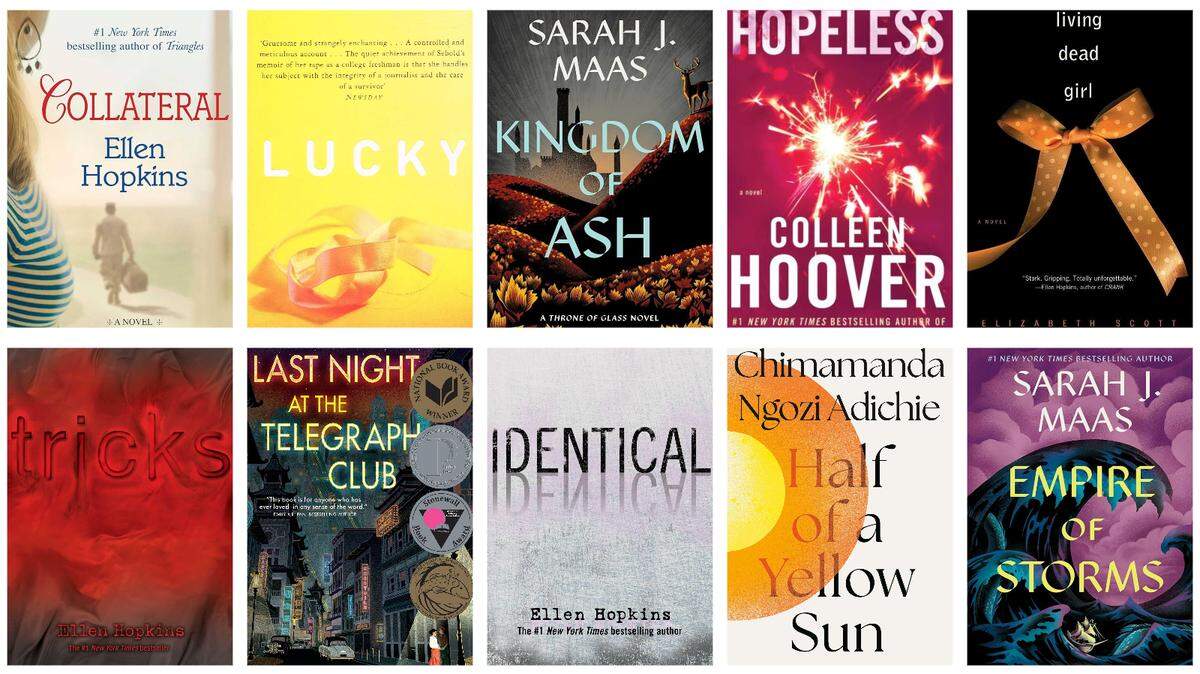
After a motion to table the removal at a meeting Tuesday afternoon, the following books were spared from being removed from libraries:
▪ Collateral by Ellen Hopkins
▪ Empire of Storms by Sarah J. Mass
▪ Half of a Yellow Sun by Chimamanda Ngozi Adichie
▪ Hopeless by Colleen Hoover
▪ Identical by Ellen Hopkins
▪ Kingdom of Ash by Sarah J. Mass
▪ Last Night at the Telegraph Club by Malinda Lo
▪ Living Dead Girl by Elizabeth Scott
▪ Lucky by Alice Sebold
▪ Tricks by Ellen Hopkins
The board’s consideraton is a result of a new regulation that gives the board the authority to ban books statewide.
Proposed by state education Superintendent Ellen Weaver, the regulation was enacted in summer 2024. It gives the state board the authority to govern the selection of materials in schools and school libraries and dictate what is “age and developmentally appropriate” and “educationally suitable” under state law. When a book is removed, it’s removed from every school, regardless of student age or grade level.
Decisions to keep or remove books from library shelves was once in the hands of local school boards. Now, the state board’s decisions are ultimately binding for all school districts in the state.
Supporters of the policy say it respects respect parents’ prerogatives and protects students.
“Parents, educators, administrators, and communities are grappling with questions and concerns about the selection and use of age-appropriate, educationally suitable materials for K-12 students in public schools,” the policy proposal reads. “Increasingly ... disagreements have arisen regarding the appropriateness and suitability of various materials.”
Weaver said at an October 2023 meeting that it was “within the purview and the responsibilities” of the state board to advise on the age-appropriateness.
It’s considered one of the country’s most restrictive policies. Only two other states have mechanisms to ban books statewide, Utah and Tennessee. Utah currently holds the title for most banned books at 17.
While the state education board has already taken steps to ban books statewide, the board expressed new apprehensions about the policy at Tuesday’s meeting.
State board member and former chair David O’Shields said he does not hear about the books the board has elected to eliminate from schools from his community in Laurens County, where he is superintendent of Laurens County School Distict 56. He said that although he found some passages in the books before the board “repugnant,” he had doubts as to whether the policy was being applied correctly. O’Shields said he believed the board should consider written works “as a whole,” rather than the particular pages presented.
“I’m not sure if we’re shooting at the right target,” O’Shields said at the meeting.
The state board has already banned or restricted 12 books from South Carolina schools so far this academic year. The titles include:
▪ All Boys Aren’t Blue by George M. Johnson
▪ A Court of Frost and Starlight by Sarah J. Maas
▪ A Court of Mist and Fury by Sarah J. Maas
▪ A Court of Thorns and Roses by Sarah J. Maas
▪ A Court of Wings and Ruin by Sarah J. Maas
▪ Crank by Ellen Hopkins (Restricted)
▪ Damsel by Elana Arnold
▪ Flamer by Mike Curato
▪ Push by Sapphire
▪ Normal People by Sally Rooney
▪ The Perks of Being a Wallflower by Stephen Chbosky
▪ Ugly Love by Colleen Hoover
Of the books challenged in South Carolina, PEN America pointed out the majority were written by LGBTQ+ and women authors. Many of the books have characters of color and deal with difficult topics like mental health, sexual violence and death.
“By removing students’ access to books about topics like grief, sexual violence, consent, and identity, these bans aren’t protecting young people — they’re doing the opposite,” Madison Markham, coordinator of PEN America’s Freedom to Read program, said in a new release.
Critics have called the book banning policy “censorship” that creates a “chilling effect,” and local librarians say the process is causing confusion and adding to their work load, while violating the constitutional rights of students to receive information.
Paul Bowers, a spokesman for the ACLU of South Carolina, previously told The State that teachers and librarians increasingly second-guess their own judgment as professionals amid a “climate of fear.”
It has led to some “self-censoring” and “guesswork,” librarians previously told The State.
Ayanna Mayes, a librarian at Chapin High School, previously told The State she’s taken the proactive step of removing books herself, before they’re officially banned, to avoid the “unpleasant” process of taking a book from a student.
“The library is a place of voluntary inquiry,” Jamie Gregory, president of the South Carolina Association of School Librarians, previously told The State. “Just because you may not want your child to read something, doesn’t mean it’s pornographic and can be removed from another student, if another student’s parents would want their child to read that.”
This story was originally published April 1, 2025 at 2:33 PM.