USC says new accreditor won’t cost them for now. But it already cost thousands
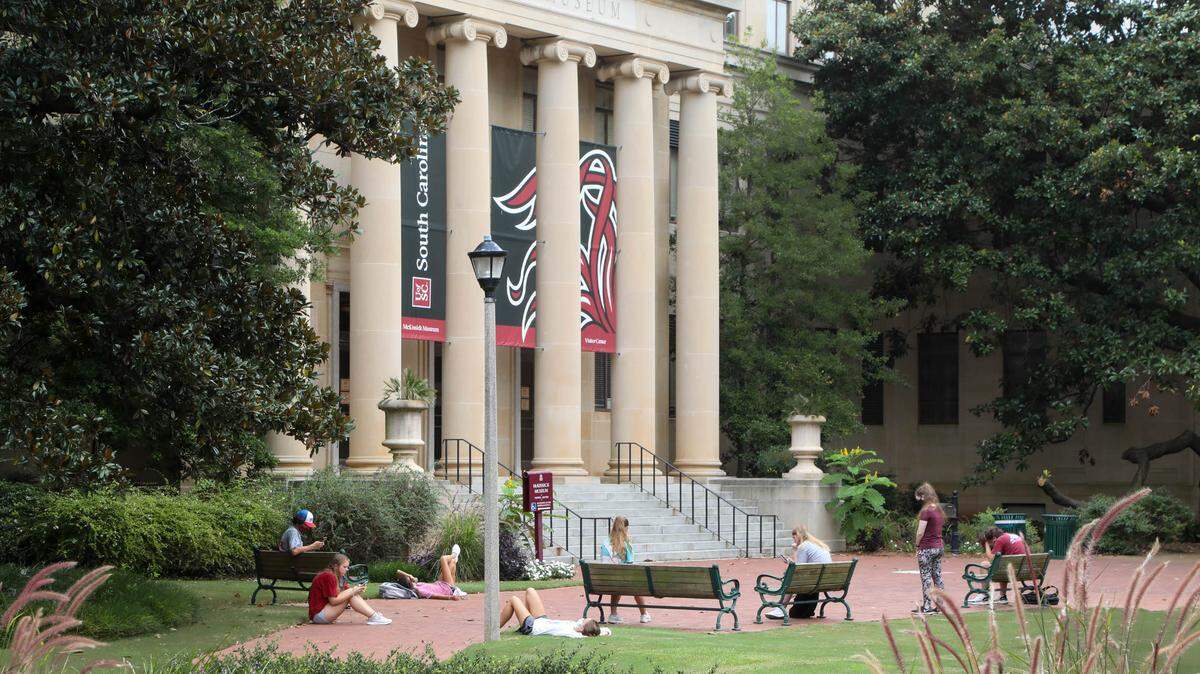
The University of South Carolina is helping establish a university-led accreditor without an initial need for USC funds, board chairman Thad Westbrook told faculty last week. But it’s paying for a staff member to lead the effort.
USC is one of six public university systems that joined together in June to create a new accreditor, called the Commission for Public Higher Education. It’s billed as an alternative to the current “out-of-touch” system and is meant to prioritize student achievement “without ideological capture.”
Cameron Howell, who has served as secretary of the USC board of trustees since 2021, has temporarily stepped away from his responsibilities as secretary to join the Commission for Public Higher Education as a senior advisor. USC continues to finance his $247,000 salary.
University spokesman Jeff Stensland called it an “in-kind contribution” and said the university believed it to be “reasonable and appropriate.”
The decision to join the consortium was not mentioned, nor was it voted on, during any recent public meetings of the USC board of trustees, though the board did vote to appoint interim board secretary Stacey Bradley.
The university also paid more than $16,000 for trips related to the commission, including $403.21 for a trip to Washington D.C. last year and $15,604.13 for a trip to Boca Raton, Florida to attend a press conference in June.
What is the Commission for Public Higher Education?
Accreditation plays a significant role in ensuring an institution’s quality of education. It affects eligibility for federal funding and financial aid opportunities, and can affect students’ future employment and professional licensing. USC is currently accredited by the Southern Association of Colleges and Schools Commission on Colleges, or SACSCOC.
The Commission for Public Higher Education is a nonprofit organized by the Florida Board of Governors, the agency that oversees the state’s public higher education institutions. Initially ensured by a $4 million sum from the Florida legislature, according to the commission’s business plan, it expects the other founding university systems to “dedicate funds, labor or combination of” that is comparable to Florida’s contribution.
The American Enterprise Institute, a conservative think tank, hosted USC representatives, along with stakeholders from several other states, in Washington D.C. last summer to discuss the idea, Westbrook said at a September faculty meeting. It was organized by the University of North Carolina System.
Despite being a founding institution of the Commission for Public Higher Education, USC has not made a decision to change its accreditor. The Commission for Public Higher Education is “currently a concept,” Westbrook said. USC would remain accredited by SACSCOC, though the new commission could be an “opportunity in the future.”
Political motivations?
But faculty fear the move is politically motivated.
Florida Gov. Ron DeSantis, who touted the commission at a press conference in June, said it would “upend the monopoly of the woke accreditation cartels.”
President Donald Trump, who called higher education accreditors “gatekeepers,” signed an executive order in April to resume recognizing new accrediting bodies and to punish those that require diversity, equity and inclusion initiatives.
USC’s accreditor does not have any such requirements.
Overhauling higher education accreditation is a goal of Project 2025, a comprehensive initiative published by the Heritage Foundation, another conservative think tank. Project 2025 claims accreditors have become “de facto government agents” that impose “ideological preferences.” Called a “right-wing wish list” for President Donald Trump’s second term, the initiative shares plans to reshape the federal government, including the U.S. Department of Education, Inside Higher Ed reported. And the U.S. Department of Education approves accreditors.
Gov. Henry McMaster later praised Westbrook and USC President Michael Amiridis for “bringing common sense back” to the college accreditation system.
“The new Commission for Public Higher Education will return focus to academics and learning instead of woke indoctrination,” McMaster wrote on social media.
Impacts to curriculum?
Westbrook spoke at general faculty meeting on Sept. 3 to provide insight into the commission and answer faculty questions. The meeting was standing room only.
Many voiced concerns over how a new accreditor might affect curriculum, others the role of the state legislature in determining what is appropriate to be taught.
The Florida Board of Governors, which is heading the project for now, has reshaped higher education in the Sunshine State and removed courses relating to race and gender, said professor Suzanne Swan, a professor in the psychology and women’s and gender studies departments said.
Kirk Randazzo, a professor of political science, said he was worried about a “chilling effect” so severe that he might have to “completely water down” his classes.
Westbrook tried to quell fears.
“I know there’s been political rhetoric around it, and some politicians that talked about it,” Westbrook said at the meeting. “I would hope there is nothing political related to CPHE.”
The statement was met with laughter.