Columbia is losing its tree canopy as developers hack down forests, USC study finds
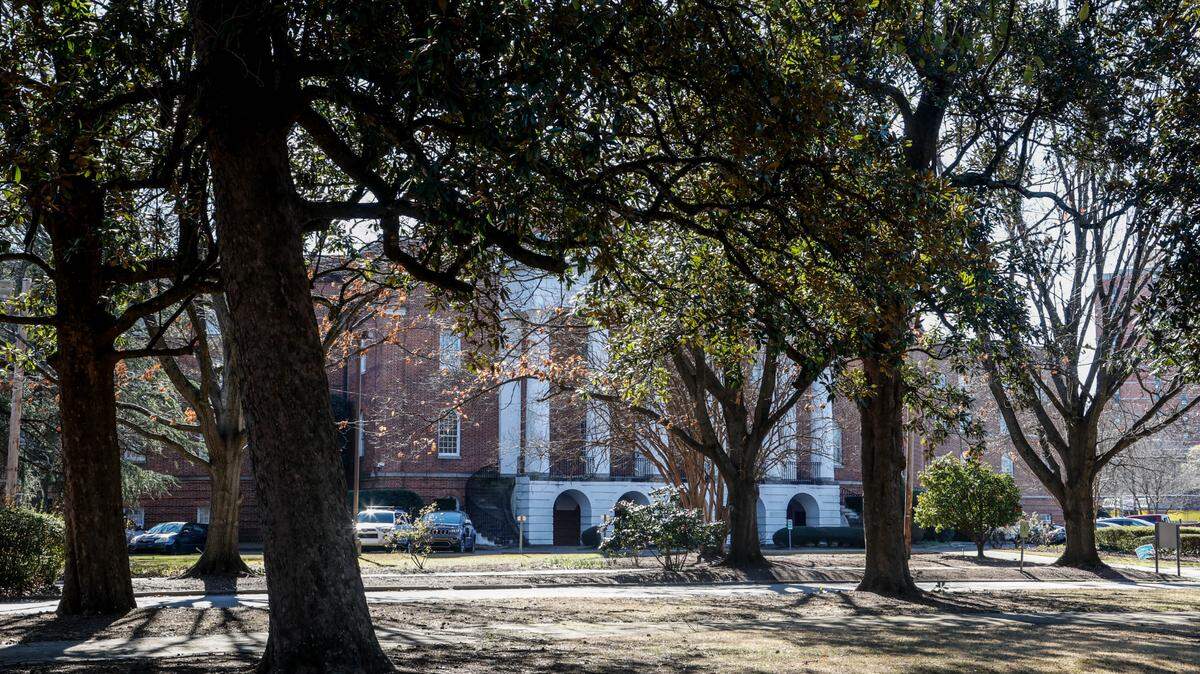
Trees that provide cooling shade in Columbia are falling to the axes of development as the city expands into new areas and remakes existing neighborhoods.
Columbia, notorious for its sweltering summers, lost nearly 22% of its tree canopy from 2005 to 2019, exposing once shaded areas to hotter temperatures, researchers at the University of South Carolina say.
The loss of mature trees is a concern as the city grapples with how to deal with climate change that is sending temperatures higher. Columbia could experience a nearly 600% increase in hot days by the end of the century if something isn’t done to slow the effects of climate change, according to a 2019 forecast made independent of the recent USC research.
USC’s findings about the loss of trees, uncovered by PhD and graduate students, were presented Saturday at a conference that focused on improving Columbia’s response to climate change.
Kirstin Dow, a USC scientist who studies climate, said Columbia should look for ways to protect its tree canopy because forests hold down temperatures, soak up stormwater after heavy rains and improve air quality.
Temperatures in tree groves, for instance, can be 9 degrees cooler than temperatures in open terrain, Dow said. But “heat islands,’’ areas with consistently high temperatures and a lack of vegetation, are found through the Columbia area, she said.
“The heat islands in Columbia are expanding as our city is growing,’’ Dow said.
Blazing Columbia
Columbia, which sits in the center of South Carolina, is widely known for its blazing summer heat. While Charleston has sea breezes and Greenville is near the mountains, hot air often stagnates and chokes Columbia during the peak of the summer. It isn’t unusual to experience temperatures of 100 degrees on the hottest days
Columbia’s loss of trees since 2005 didn’t surprise city officials who attended the climate conference. Development rules haven’t always been strict enough to stop clear-cutting, and sometimes contractors don’t follow the rules, officials said.
“I’d love to say the majority of the time contractors are doing what they are supposed to be doing,’’ but that isn’t always the case, said Scott Holder, a land development planner with the city of Columbia.
Holder said the loss of tree canopy has occurred in developing areas, such as the northeastern part of town.
In some cases, subdivisions have been developed outside the city limit, where county rules are not as strict as in the city on tree protection. Then, developers will seek to annex into the city, he said.
But the city’s rules also had shortcomings that he hopes have been addressed. Holder said Columbia recently passed development rules that have tightened protections for trees. Holder and Dow also noted that many trees have been planted that have not reached maturity, so the tree canopy, should improve in coming years. Holder said the city plants hundreds of trees each year.
Maintaining trees can be a challenge, not only in developing areas, but in poor inner city neighborhoods, one speaker said.
Los Angeles, California, at one time took a dim view of trees in some neighborhoods because the police were afraid urban forests gave crooks places to hide, said Denise Fairchild, who runs a nonprofit organization that helps disadvantaged communities.
Fairchild, in the keynote address at the conference, recalled her time as a resident of Los Angeles.
“We were fighting with this issue of tree canopies and dealing with issues of climate and urban heat islands,’’ said Fairchild, who founded the Emerald Cities Collaborative in Washington, D.C. “We had huge resistance from the police — it would interfere with their ability to track down criminals if they had too many trees.’’
Tree loss was one of multiple topics discussed at the two-day conference at the University of South Carolina’s law school. City officials hope the conference helps the community and local government officials improve the response to climate change on multiple fronts.
Climate fight needs to intensify
A key concern is that Columbia is struggling to meet a series of climate goals by 2036, when the city wants to become 100% dependent on clean and renewable energy.
Mayor Daniel Rickenmann, elected last year after Steve Benjamin chose not to run again, said the city needs to stop depending so much on traditional forms of energy — types that experts say are contributing to global warming. Those forms are fossil fuels, including coal that is burned to make electricity, and gasoline that is used to power cars.
“We have to think differently than we have traditionally and not rely 100% on fossil fuels,’’ Rickenman said. He expressed optimism that change can occur but said “we have to start pushing things.’’
The conference included representatives from other cities, including Portland, Oregon, and Orlando, Florida, outlining what they are doing to address climate change.
Matt Kisner, a USC professor who directed the conference, said he hopes the city walks away from the conference with good ideas. About 15 years ago, the city made a pledge to rely 100% on clean energy sources by 2036.
“When they came up with that pledge, 2036 was 30 years away and it seemed like there was plenty of time,’’ he said. “But now we’re already halfway through that period and not a heck of a lot has happened.’’
The city hasn’t ignored the climate goals, making strides to rely more on solar power and taking many polluting vehicles off the road. But the city had not completed 42 of the 67 climate goals, The State reported in 2020. The city’s challenge in switching to 100% clean and renewable energy is not unique. Many cities have struggled with the effort.
A major issue for Columbia in addressing climate change is designing programs that help the needy, Fairchild said.
She said the United States is in a transition to a green economy, or one with an emphasis on renewable energy. In the past, changes in the economy left out marginalized communities, but that doesn’t have to be the case this time, she said.
The rise of renewable energy, like solar power, provides opportunities to provide jobs for the needy, say advocates for the poor.
Fairchild, the keynote speaker Friday, said disadvantaged people are disproportionately affected by climate change-related impacts, such as heat, but have less ability to deal with the problem than the wealthy.
Many disadvantaged communities already have higher levels of health problems, including high blood pressure, diabetes and chronic heart disease. Problems that come from climate change, such as rising heat and high temperatures, worsen the situation, she said.
“They’re not ready for the kind of climate impacts that we’re looking at in terms of extreme weather,’’ she said.
This story was originally published April 2, 2022 at 2:20 PM.