
Chop down your Bradford pear, win the ‘bounty’ of a new tree at this Lexington event
The state of South Carolina is so done with Bradford pear trees that it will give you a free bounty to chop yours down.
The Clemson Extension Service’s forestry program is offering a bounty on the stinky trees — complete with an Old West-style “wanted” poster — that encourages property owners to chop theirs down by offering a free replacement tree.
Any property owner can register online to get their replacement tree at the Lexington event from 8 a.m. to 11 a.m. Dec. 10 at the Lexington County Public Works Complex, 440 Ball Park Road, Lexington.
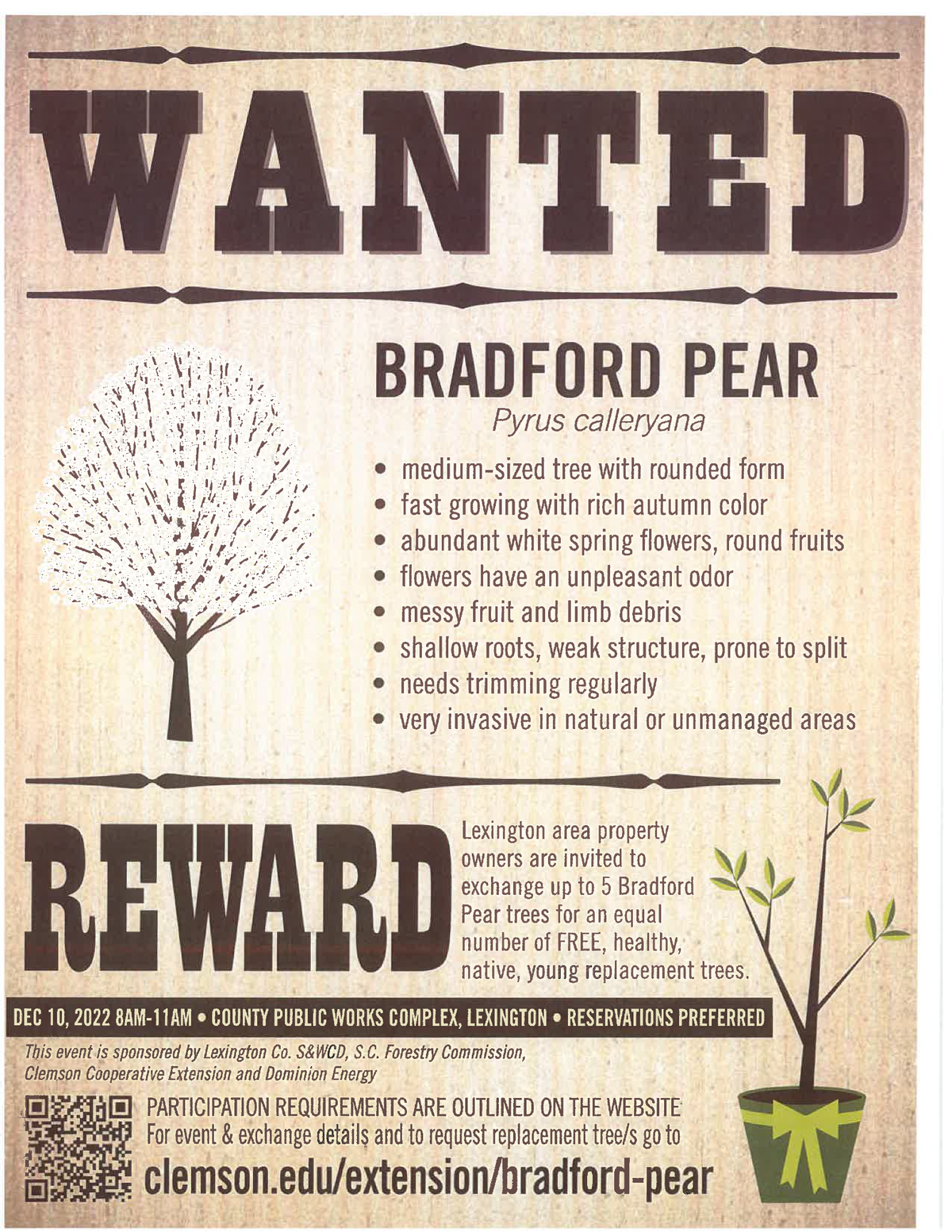
All that’s required is that a South Carolina property owner present evidence they did indeed remove a Bradford pear. A selfie with the downed Bradford will be accepted, the extension service says.
The Palmetto State has a long-time love/hate relationship with Bradford pears. The brittle, spindly pear trees were thought to be sterile when they were introduced to South Carolina. But it turns out that pollen from other species can create viable seeds from Bradford flowers and spread the invasive species across the Southeast.
The trees grow in tight thickets that can crowd out native plants, and they produce thorns so fierce they can puncture a tire. The trees are also fragile enough that high winds can leave streets littered with debris. The trees even smell bad, producing an odor that’s been compared to a dead fish.
In 2019, the S.C. Forestry Commission began asking people with Bradfords growing on their property to chop them down, with some calling them a “Frankenstein” plant that has had as destructive an effect on the region as the kudzu vine.
A variety of alternative tree species are available to replace your old Bradford, but they will be handed out on a first-come, first-served basis, so you can’t reserve your favorite ahead of time. Agents on site will help property owners pick out the tree that will be best for their property, said Janet Steele, the extension service’s Lexington-area forestry agent.
Property owners are also responsible for removing the downed Bradford once it’s out of the ground. Up to five Bradfords at a time can be exchanged for new trees.
The new trees are provided as part of a grant from Dominion Energy, a company with an interest in removing invasive tree species from its right-of-ways, Steele said.
.jpg)