
10 questions with a Blue Angels pilot ahead of Beaufort Air Show (+ video)
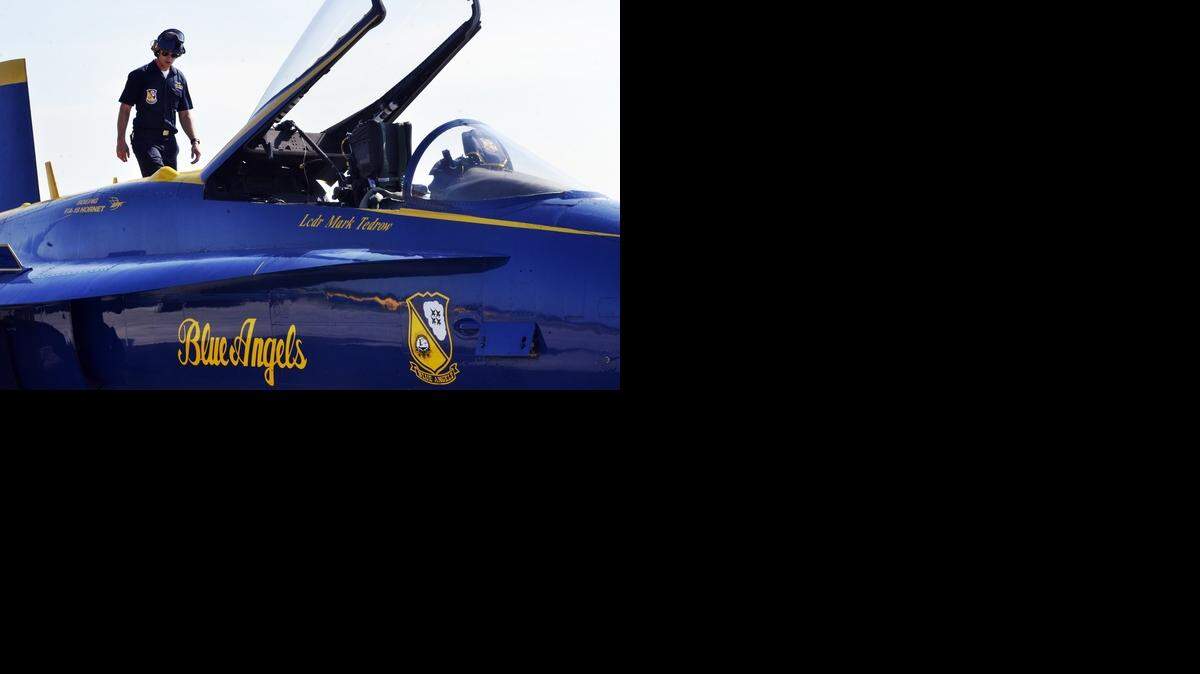
Six pilots in bright blue jumpsuits and aviator sunglasses landed their jets single-file at Marine Corps Air Station Beaufort's Merrit Field on Thursday morning in preparation for this weekend's air show.
The pilots, part of the U.S. Navy's Flight Demonstration Squadron known as the Blue Angels, will anchor the Beaufort Air Show on Saturday and Sunday, roaring above spectators at speeds as fast as 700 mph.
They gracefully unloaded into a flurry of activity and high-fives from maintenance crews dressed in darker blue jumpsuits before answering media questions in front of their jets.
Formed in 1946, the Blue Angels' mission is to showcase the pride and professionalism of the Navy and Marine Corps through their aerobatic flight demonstrations and community outreach. The Angels are back after a sequestration in 2013, once again looping, rolling and turning for millions of people each year. The shows this weekend are expected to draw more than 100,000 people, the biggest in the Air Show's history, according to MCAS Col. Peter Buck.
Before the Blue Angels take their blue and gold F/A-18 Hornets into the air this weekend, we spoke with Commanding Officer Capt. Thomas Frosch, also known as the "Boss," who leads the flight team in Angel No. 1.
Frosch gave us insight into life as a Blue Angel pilot, his favorite maneuver and what the world looks like while flying upside down.
Question: Is there ever a boring day on the job?
Frosch: Never a boring day. It's pretty fast-paced. We train for three months and then our season starts in March and goes to November. It's exciting but it's pretty demanding.
Q: What's your mindset when you're up in the air?
Frosch: Extreme levels of focus and safety. We practice all these maneuvers many, many times, and we're always concerned about safety. We're always seeking perfection. Our main concern is putting on a safe, exciting demonstration.
Q: What does the world look like when you're flying sideways or upside down?
Frosch: It's hard to describe. You don't have time to go, "Oh look at that!" You kind of stay focused on the maneuver and can't get distracted. In those fleeting moments where you do glance around, it's neat to see how many people are down on the ground watching.
Q: Do you guys ever talk about mundane things during practice?
Frosch: In any organization there will be mundane conversations, but you know, everyone on the team realizes it's a real privilege to be a part of this organization. We don't take it lightly. We put these uniforms on knowing we represent people that are doing important things throughout the world.
Q: What maneuver took you the longest to learn?
Frosch: Right after takeoff, the first maneuver we do is called the Diamond 360. It is probably the closest we fly in the whole demonstration, and it requires very precise air work. That's probably the most difficult maneuver to this day. We average around 18 inches from each other.
Q: What's your favorite maneuver?
Frosch: My favorite is the Double Farvel. The Diamond comes down the runway, and No. 1 and No. 4 flip upside down and fly down the runway. For me it's always exciting because as an aviator you think, "Oh I'm down here at 300 feet, I'd never go upside down," and the next thing you know, you're upside down.
Q: What are important skills for a Blue Angel to have?
Frosch: We all bring skills into this team. The main takeaway is teamwork. This team has 130 people on it. Without all their efforts, this show wouldn't happen. Most people think it's just six pilots. They don't see the work that goes into this behind the scenes. A close second is trust. That's the foundation of our team.
Q: The Blue Angels don't wear G-suits, so how do you handle changes in gravitational forces?
Frosch: We have to learn when to tighten our legs and our abdomen. We have to make sure the blood stays up on our head; otherwise, you can gray out or black out, and obviously, that wouldn't be good. We do a lot of anaerobic exercises to make sure we stay fit and strong and help us deal with the G's.
Q: When was the first time you saw the Blue Angels?
Frosch: The first day I saw them was when I was 6 years old up in Michigan at an air show. It was something as a kid that was really special.
Q: What did it feel like when you became a Blue Angel?
Frosch: To finally sit in one and see the blue and yellow paint was surreal. Then after that, the first flight you realize what a humbling and proud moment it is to be a part of the fleet.
IF YOU GO:
Gates open at 9 a.m. on both Saturday and Sunday for the Beaufort Air Show at Marine Corps Air Station Beaufort. Opening ceremonies will begin at approximately 10:45 a.m. The show is expected to end around 4:30 p.m., and gates close at 5:30 p.m. Admission is free. The show will go on rain or shine, so be prepared to dress for the weather. However, if there is lightning within five miles, planes will be grounded for the safety of the performers.