
Black student can’t attend Texas graduation over his long locs, lawsuit says
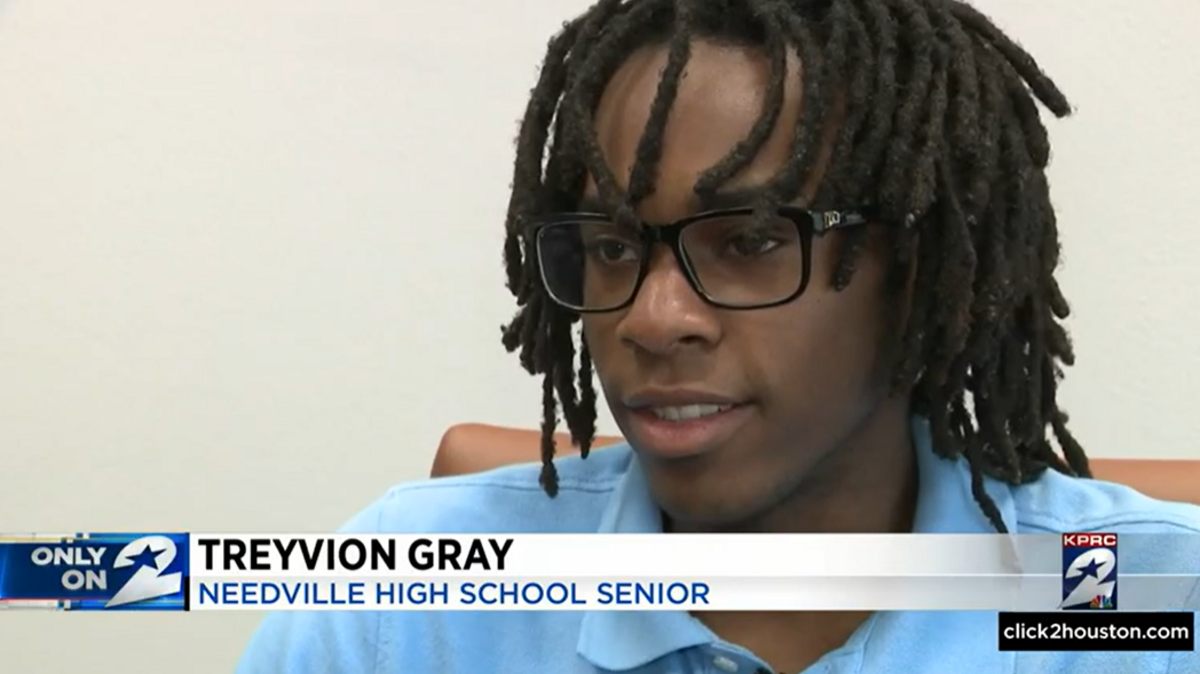
A high school senior in Texas is “eagerly awaiting graduation” — but says he won’t be able to participate in the ceremony as he refuses to cut his locs.
Treyvion Gray, 18, is a Black student who says his locs are an “expression of his Black identity and culture.” He argues the district dress code policy that prohibits boys from growing hair past their ears and eyebrows is both racially and sexually discriminating.
Now Gray is suing Needville Independent School District — alongside its board of trustees, superintendent and high school principal and assistant principal — in federal court.
The lawsuit filed on April 19 says Gray has been “disproportionately targeted and penalized” by a dress and hair policy that profiles, singles out and burdens Black students who wear hair in its natural state.
“The length of locs have no bearing on NISD Black students’ capacity to learn, yet the wholly arbitrary Dress and Hair Policy restricts the mobility of Black students in public and private spaces, deny them equal educational opportunities, and strike at the freedom and dignity of the NISD Black student population,” the lawsuit says.
Needville Independent School District and its attorneys did not immediately respond to a request for comment from McClatchy News.
In a video interview with KPRC, Gray is seen with locs that have grown past his ears, eyebrows and shirt collar. The district dress policy, which “is established to teach hygiene, instill discipline, prevent disruption, avoid safety hazards, and assert authority,” says boys cannot have hair that long.
“It’s part of me,” Gray said of his locs in the video interview. “It’s who I am. My hair is a part of me, my heritage and my culture.”
He began growing his hair as a sophomore in the district to express his Black identify, the lawsuit states, but about three months prior to his graduation, school administration “made it their objective to suppress Gray’s expression of his identity and heritage”
Starting in January, court records say the assistant principal would berate Gray about his hair when he got to school each morning. He continued doing so, demanding that Gray cut his hair. Meanwhile, the lawsuit says male, white students had “similarly long hair,” including mullet hairstyles.
On March 3, Gray’s was placed in school suspension (ISS) “and would remain there until he cut his hair,” his legal team said.
The high school senior tried to compromise by saying he would put his locs in a ponytail, “but that wasn’t good enough ... because among other things male students were not allowed to have ponytails,” according to the lawsuit.
Gray’s mom, Brahna Williams, was notified of the suspension via email that same day, and she asked the principal for an accommodation since graduation was only two months away. She also pleaded that administration “meet her halfway” with an offer to pin her son’s hair up above his eyebrows.
No accommodations were made, according to the lawsuit.
“You’ll cut your hair to the right point,” is the belief of Superintendent Curtis Rhodes, who was previously quoted saying, “We’ve consistently been conservatively dressed, very conservatively disciplined,” according to the lawsuit. “It’s no secret what our policy is: You’ll cut your hair to the right point. You’ll tuck in your shirt. You’ll have a belt.
“How can it be outdated,” he continued at the time. “How many doctors, professionals, lawyers, look at your military branches, look at bankers, how many of them have long hair?”
Those remarks were made regarding a 2008 lawsuit filed on behalf of a Native American kindergarten student who was forbidden from wearing long hair, according to The Washington Post. The federal district court and the appeals court ruled that the policy violated the child’s right to religious freedom.
As a student in ISS, Gray is confined to one room with the expectation of completing homework without any regular teacher instruction, according to the lawsuit. Students in ISS cannot talk with other students and must eat lunch at their desk.
In early April, before the lawsuit was filed, Gray was told he ran out of days he could be in suspension, according to court records. He was told that if he showed up to school without cutting his hair on April 15, he’d be sent to the disciplinary alternative education program (DAEP) and not allowed to attend the commencement ceremony or other extracurricular activities, the lawsuit says.
In April 19, the same day the lawsuit was filed, Gray showed up with his same hairstyle, the lawsuit states. His mom was told that after the standardized test that day, he’d be suspended for the day. She was also told that when Gray got to school on April 20, he’d be placed in DAEP.
“As a result of being targeted, removed from the student population and threatened with not being allowed to participate in senior year activities, including graduation ceremony, Gray’s emotional health has suffered, including stress and depression,” the lawsuit says. “(The district’s) hostile and wrongful actions individually and in the aggregate have made Gray feel unwelcome, ostracized and inferior.”
Gray requests immediate removal from disciplinary programs, the opportunity to attend graduation, a new dress and hair policy that doesn’t discriminate, and compensatory damages.
Needville is about 40 miles southwest of Houston.
This story was originally published April 29, 2022 at 1:07 PM with the headline "Black student can’t attend Texas graduation over his long locs, lawsuit says."