
World’s rarest whale had never been dissected — until now. Here’s what was discovered
This summer, a male spade-toothed whale — the world’s rarest whale species — washed ashore in New Zealand, astonishing scientists and observers.
The animal’s sleek, well-preserved body, which measured about 15 feet long, was spotted on a beach in Otago, located on the country’s south island, in July.
Its discovery posed an incredible opportunity for scientific discovery as very little is known about the species. Only six other specimens have ever been found — and none were in good enough condition to be examined.
So, scientists seized on the moment.
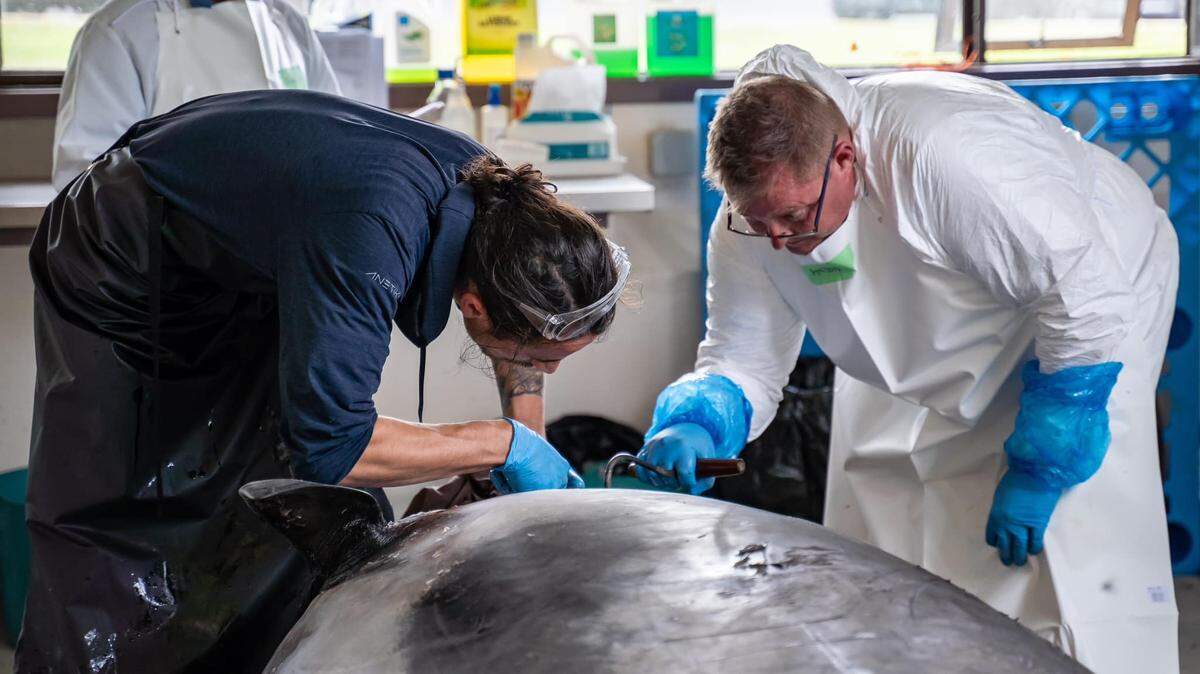
They have now conducted a meticulous dissection of the whale, revealing numerous insights into the mysterious marine species.
First-ever dissection
The dissection, the first to ever be performed on a spade-toothed whale, was undertaken by a team of specialists over the course of one week, according to a Dec. 13 news release from the Department of Conservation.
By cutting open the animal, scientists learned it possessed nine stomach chambers — a feature that had previously been unknown.
Within these chambers, they located evidence of the whale’s diet.
“We found squid beaks and some lenses from the eyes of squid, a few parasitic worms, and maybe some other parts of organisms that we are not quite sure of,” Anton van Helden, who led the dissection, said in the release.
They also discovered the whale’s upper jaw contained small, vestigial teeth.
“These little teeth embedded in the gum tells us something about their evolutionary history,” van Helden said. “It’s remarkable to see this and it’s just another thing that we had no idea about.”
Further, several “interesting structures” linked to sound production and feeding were uncovered.
Throughout the course of the dissection, scientists also ascertained the potential cause of the whale’s death.
Bruising on its neck and head, as well as a broken jaw, indicate it sustained head trauma.
“We don’t know but we suspect there must have been some sort of trauma, but what caused that could be anyone’s guess,” van Helden said.
The carefully documented findings will eventually be published, with more discoveries expected.
“It’s a week I’ll never forget in my life, it’s certainly a highlight and it’s the start of the storytelling around this beautiful animal,” van Helden said.
More on spade-toothed whales
Spade-toothed whales, a type of beaked whale, were first discovered in 1874 after a jaw bone was found in New Zealand’s Chatham Islands.
Since then, just a handful of specimens have been found, and no living individuals have ever been recorded, so much about them remains unknown.
The species is believed to live exclusively in the southern hemisphere, and perhaps only in the South Pacific, according to Whale and Dolphin Conservation, a nonprofit organization.
Their diet is thought to primarily consist of squid, according to the organization.
This story was originally published December 13, 2024 at 3:24 PM with the headline "World’s rarest whale had never been dissected — until now. Here’s what was discovered."