
Rand Paul unveils foreign policy doctrine in South Carolina
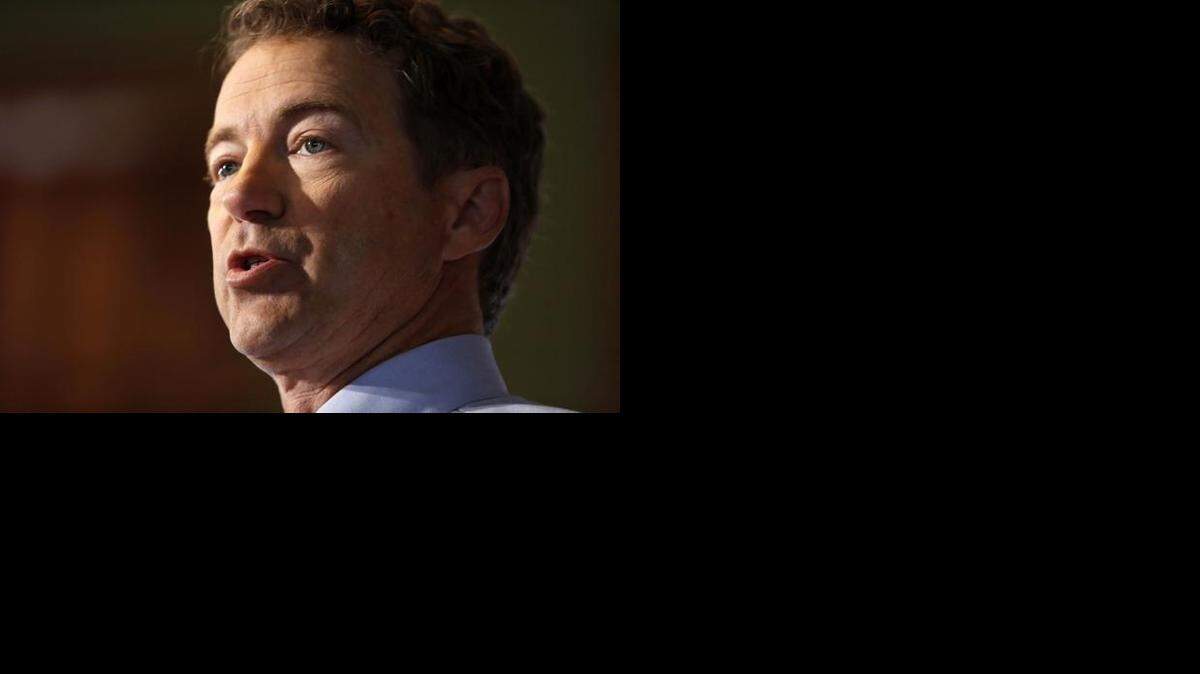
With the formidable U.S.S. Yorktown as a backdrop, Kentucky junior U.S. Sen. Rand Paul declared Thursday that he would "never take the country to war without just cause and without constitutional approval of Congress."
On his second full day as a presidential candidate, having traded the snow of New Hampshire on Wednesday for the humidity of South Carolina, Paul sought to go on offense as Republican critics continued to assail the senator over past remarks about Iran.
Squinting in the sun, Paul tweaked what has become his standard stump speech, beginning his remarks by telling a crowd of supporters and undecided early voters "there's no greater responsibility for any legislator or leader than to determine when we go to war."
"The consequences are potentially ominous," Paul said. "That responsibility should never be given to any individual who frivolously or cavalierly calls for war."
Paul's speech Thursday came as the Foundation for a Secure and Prosperous America, an outside group that has blasted Paul's past comments about Iran, continued to spend money on advertising in the early voting states Paul is visiting this week.
The ad that was set to run Wednesday through Sunday in South Carolina is titled "Dangerous."
"One Republican doesn't get it: Rand Paul," the ad says. "He supports Obama's appeasement of Iran."
The ad quotes Paul, who said in 2007 that "our national security is not threatened by Iran having one nuclear weapon."
The ads and similar criticisms from Republicans have hounded Paul since he launched his presidential campaign in Louisville on Tuesday.
On Thursday, with a visual demonstration of American military might behind him as he spoke, Paul appeared to take aim at the neoconservative wing of the Republican Party, attempting to channel former President Ronald Reagan's doctrine of "peace through strength."
"As commander in chief, the world will know that our objective is peace. But the world will not mistake our desire for peace for passivity," Paul said. "The world should not mistake our reluctance for war for inaction. And if war should prove unavoidable, America will fight with overwhelming force, and we will not relent until victory is ours."
Mentioning students from The Citadel, a military college in neighboring Charleston, Paul said of the next generation of warriors that "we owe them the wisdom to know when war is necessary and when war is not necessary," and he vowed "to judge questions of war with a solemn and profound deliberation."
He talked at length about the "brave and proud warriors" of the now-decommissioned Yorktown, which saw action during World War II and the Korean and Vietnamese wars, telling the crowd "they learned the terrible lesson that war is not a game and should not be used for political advantage."
"Too many lawmakers in Washington haven't learned that lesson," Paul said.
He added: "Is it any wonder that the people who have served in combat are usually more circumspect than those who have never fought?"
Carol Landers, an undecided voter, who said she came to hear what Paul had to say, and dismissed comparisons coming from some establishment Republicans of Paul and his father, former U.S. Rep. Ron Paul. The elder Paul's isolationist-leaning philosophy was consistently a target of criticism from the rest of the GOP field when he ran for president in 2008 and 2012.
Landers said the comparison was "overblown," but she appeared to embrace Rand Paul's war doctrine, especially his call to end foreign aid to "haters of America."
"He's been accused of being an isolationist, and I'm thinking 'Good night, what's wrong with that in this day and time?'" she said. "Let's think about us for a change."
Rob Liszt, another undecided voter, said he was open to hearing what other Republican candidates have to say about foreign policy, with the notable exception of former Florida Gov. Jeb Bush.
Liszt said he wanted to dig a little deeper before deciding on a candidate but he was encouraged by what he heard from Paul.
"Well, you get sound bites today, right?" Liszt said. "So I still have a lot of investigation to do. At least from the commentary that he gave, understanding the onerous nature of war, I was pleased to hear what he had to say."
J.C. Watts, a former congressman who emceed Paul's campaign kick-off event in Louisville, continued that duty in South Carolina. As he warmed up a crowd baking in the sun, Watts acknowledged the attacks on Paul.
"Obviously, we are seeing already in several states that he only announced on Tuesday and they started to attack him on Wednesday," Watts said. "So that reminds me, and I'll remind you, of what my dad used to say to me often: Dogs don't bark at parked cars."
Paul, whose meteoric rise was accelerated in 2013 by his 13-hour filibuster on the use of domestic drones during the debate about the nomination of John Brennan to lead the CIA, didn't miss a beat as irony mixed with the humidity Thursday.
As he delivered a speech containing several lines about his opposition to the National Security Agency's surveillance programs, the crowd looked up and laughed at a drone whirring overhead, presumably capturing footage of the event for a future political ad.
Paul, who has made expanding the GOP tent a mission during the past couple years by reaching out to minority audiences, did not mention in his remarks the high-profile shooting by police of an unarmed black man, Walter Scott, in North Charleston over the weekend.
He did stress that he envisions "an America where criminal justice is applied equally," but it was U.S. Rep. Mark Sanford, whose tenure as governor of South Carolina was mired in scandal, who addressed the shooting death and subsequent public outcry.
Sanford, who welcomed Paul to the Palmetto State but stopped short of endorsing his presidential bid, used the shooting to illustrate the importance of having a president who is committed to protecting civil liberties.
"With the tragic events of Walter Scott and all that's gone on since this weekend, it's a vivid reminder of how important it is, in essence, to have somebody watching even those in authority," Sanford said.
Joe Penny, another undecided voter, said he liked what he heard from Paul even though he thought that when it came to foreign policy, Paul is "behind some of the other candidates, or possible candidates."
"I thought it was a great speech," Penny said. "I'm a little fired up for him now and want to find out a little more about him, to tell you the truth."
Paul was scheduled to continue his kick-off tour with a stop in Iowa on Friday.