
Woodard’s blinding: PBS documentary on far-reaching SC civil rights case to air
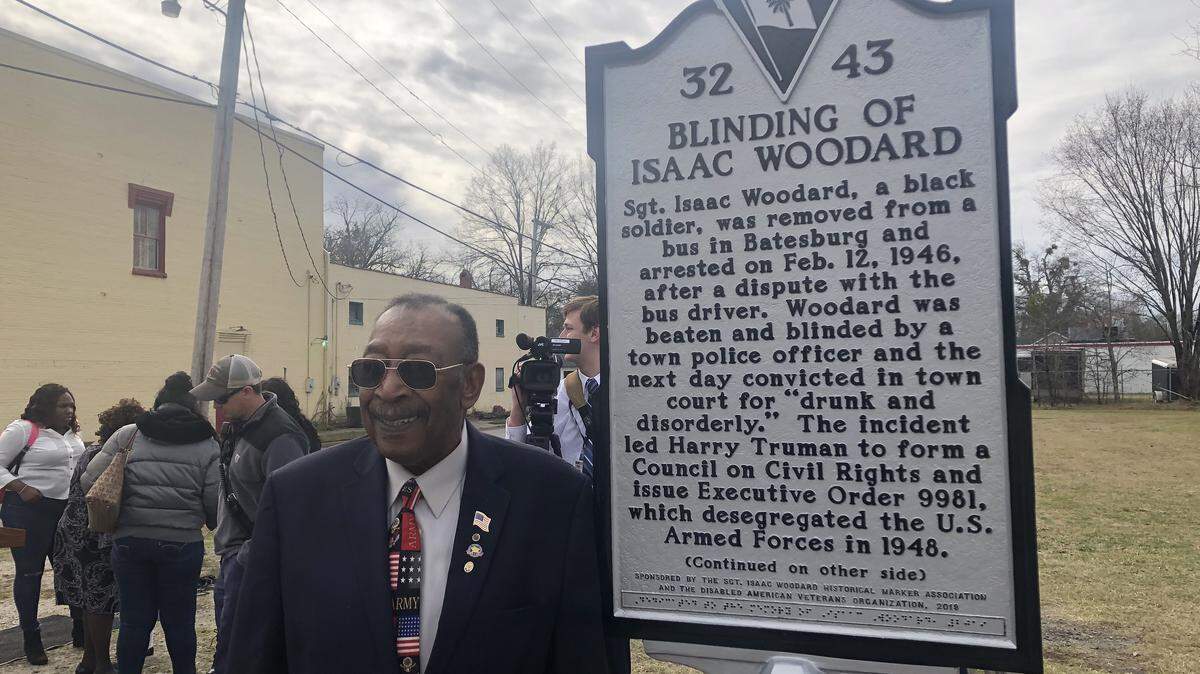
A two-hour television documentary on a little-known South Carolina incident that played a major role in America’s civil rights revolution and caused an obscure federal judge from Charleston to help Black people gain equal rights last century will air on SCETV on Tuesday at 9 pm.
The late federal Judge J. Waties Waring of Charleston is a central figure in the documentary, which is based on the 2019 book, Unexampled Courage, by current U.S. District Judge Richard Gergel, a Columbia native who now lives in Charleston.
Tuesday’s show is called “The Blinding of Isaac Woodard.” It is part of “American Experience,” a widely-watched PBS series in which significant people and events in U.S. history are explored and brought to life by dramatic re-enactments, music, authentic photos and videos and commentary from historians.
Woodard’s blinding happened in February 1946 in Batesburg, a small town in Lexington County, when he was returning home to Fairfield County after seeing combat in the Pacific during World War II. He was in uniform and riding on a Greyhound bus.
When the bus stopped in Batesburg, Woodard descended from the bus and asked if he could use a restroom. For that, he was beaten about the head by the town’s police chief, Lynwood Shull, and knocked unconscious. When he woke, he could not see. He would never see again.
Normally, in that Jim Crow era where Black people were expected to know their second-class status, such an incident would usually have gone unnoticed.
But Orson Welles, a towering public figure in the 1940s, heard about it and mentioned it several times on his weekly nationwide radio show in his trademark dramatic voice. In that pre-television and pre-computer age, radio was a significant way people got their news. Woodard’s incident quickly emerged as a major national news story, writes Gergel in his book.
Because of Welles’ publicity, President Harry Truman became interested in the case and pressured the Department of Justice, which had first ignored the matter, to bring federal criminal charges against Batesburg police chief Shull for violating Woodard’s civil rights.
In September, 1946, seven months after the blinding, Truman’s Justice department in Washington issued charges against Shull.
At the November 1946 trial, held in Columbia, the all-white jury deliberated less than half an hour and — to Waring’s shock — returned a verdict of not guilty.
“The documentary and the book are actually three stories — Isaac Woodard’s story, the impact it had on Judge Waring, and the impact it had on President Truman,” said Gergel, who recently saw the finished documentary.
After Woodard, said Gergel, Waring began to see the injustices of an entrenched system of white supremacy that would allow the brutal beating of a Black man to go unpunished. The judge would go on to write an opinion that became the basis of Brown vs. Board of Education, the landmark 1954 U.S. Supreme Court decision that ruled that excluding Blacks from going to public school with whites was unconstitutional.
After Woodard, Truman established a civil rights commission and issued orders that were to ban segregation in the U.S. military.
“One incident, largely forgotten and unknown, inspired people to act” in two seminal movements of the civil rights era, said Gergel, who spent seven years in his spare time writing his book, researching news accounts, federal and NAACP archives and presidential libraries.
Gergel said his initial goal in researching the book was to find out what made Waring look at race so differently than nearly all other South Carolina whites at that time.
“As people said at the time, ‘What got into him?’ “ Gergel said.
In beginning his research, Gergel said he quickly figured out he had to learn how the Woodard case ever came before Judge Waring in the first place.
“There were no federal cases being brought at the time for injuries caused by a white police officer for injuries to a Black citizen,” Gergel said. “I came to discover it was done because of the personal directive of Harry Truman.”
The major lesson he learned from writing the book?
“I just have a lot of admiration for folks who stood up and did what they thought was right even though every instinct they had about self-preservation would have told them, ‘Don’t do this,’ ” said Gergel. The list of folks to be admired includes not only Waring and Truman, but many Black people who allowed themselves to be plaintiffs in lawsuits that challenged the stiff segregation laws, he said.
In other words, Gergel said, “The many are indebted to the courage of the few.”
Gergel said he has seen the two-hour show and was pleased.
Writers use words, but “a gifted filmmaker” such as the PBS’s producer-director Jamila Ephron used pace, visuals, audio, music, all blended with a narrative, and a lot of historians interviewed, Gergel said.
Gergel’s voice is one of a dozen voices viewers will hear on the show. “Who would have guessed this would be the beginning of the end of Jim Crow in America,” Gergel says on the show.
The film opens with Orson Welles’ audio, talking about Woodard. “It was amazing to hear his voice, a magical radio voice, a great presence — the inflections in his voice, he was maybe the greatest talent of his generation,” Gergel said.
The film closes with a rare television interview of Woodard, filmed in the 1990s, speaking about his life.
Gergel said he said sold the literary rights to his book to PBS but declined to say for how much. “It was modest. PBS is not Hollywood,” Gergel said.
The Woodard case also shows that change can come. In 2019, with the publication of Gergel’s book, the town of Batesburg, now Batesburg-Leesville, unveiled an official historical marker about the incident that gives the facts about what happened.
“In order for healing to happen, these things have to be acknowledged. You can’t sweep things under the carpet and not expect there to be a bump,” said Lancer Shull, mayor of Batesburg-Leesville. The mayor is no relation to Chief Shull.
A trailer for the show can be seen at this link: https://www.pbs.org/wgbh/americanexperience/films/blinding-isaac-woodard/
This story was originally published March 28, 2021 at 5:00 AM.