Millions in COVID relief should go to broadband and SC port, McMaster group says
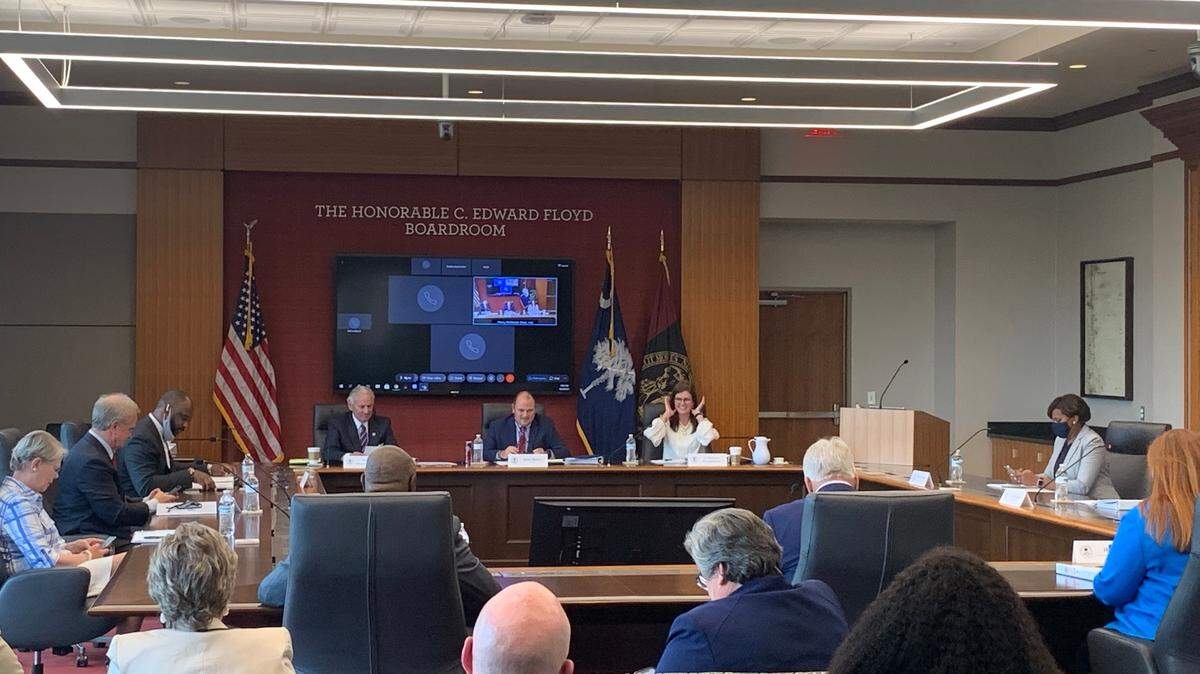
More than a billion dollars of the federal COVID-19 relief money headed to South Carolina should go toward expanding broadband internet in the state, expanding operations at the Port of Charleston, and for improving water and sewer infrastructure, a committee formed by the governor recommended.
AccelerateSC, a committee formed by Gov. Henry McMaster, gave recommendations on Tuesday on how spend about $2.1 billion of the $2.5 billion of American Rescue Plan money available to the state from the federal government.
Ultimately, the COVID-relief money has to go through an appropriations process in the General Assembly. The budget writing committees in the House and Senate have been meeting to consider ways to spend the money.
McMaster said he plans to make his recommendation to the General Assembly early next month.
“We’ve worked very carefully with the General Assembly very closely for a number of years, and as you’ve noticed in our executive budget ... most of those recommendations and ideas are adopted by the General Assembly,” McMaster said.
AccelerateSC recommended using $490 million of the federal money for broadband internet expansion in the state. The need for broadband has been brought to light as more people worked remotely, students learned virtually and doctors relied on telehealth in order to slow the spread of COVID-19.
“We have a digital divide in this state. We have a digital divide in this country. We have an opportunity to build a bridge over that divide,” said James Burns, who chaired AccelerateSC.
The committee also recommended that $350 million go toward the Port of Charleston’s $550 million project to build a multi-modal facility. The state budget that was adopted already allocated $200 million for the port project. If using COVID-relief money for this project is allowed, the state would be able to avoid borrowing money for the project, as has been approved by the state Senate, but not yet by the House.
“That’s been examined. We believe that it does it does qualify,” McMaster said. “There’s some latitude, there’s not a lot of latitude, but there’s there’s some latitude.”
Also being recommended is $400 million for a state matching program for water, sewer and wastewater projects through the Rural Infrastructure Authority.
“This is a once-in-a-lifetime opportunity for our state. (We’ve) never seen anything quite like this where we have this opportunity to put large amount of money into things that can produce results for the state in the future,” McMaster said. “We don’t want to waste this opportunity. ... It’s not an expenditure, it’s an investment on which we can build for the future.”
Among other recommendations are $250 million be set aside for a small business grant program in the future or to replenish the unemployment insurance trust fund if there is a drop in the current trust fund balance, $72 million for cybersecurity for water and sewer systems, $50 million for a nonprofit relief program, $27.3 million for police body cameras, and $47.5 million for tourism recovery and beach nourishment programs.
The committee also recommended money go towards education initiatives including:
▪ $36 million for workforce training programs.
▪ $50 million for a K-12 tutoring services for struggling students. The proposal would be used to reimburse parents whose children attend after school programs, tutoring and summer education programs.
▪ $15 million for schools of innovation.
“We’ve seen that children learning and how they progress has been impacted by COVID-19,” Burns said.
The American Rescue Plan Act does say money can be used for broadband and water and sewer infrastructure projects. Roads and bridges, however, haven’t been listed. The federal law does allow states to use part of their allocation to replace lost revenue because of the pandemic. The state estimates it lost more than $453 million in revenue, including $156 million that would have gone to the S.C. Department of Transportation.
So, the committee also recommended spending $170 million to widen I-26 between Columbia and Charleston, because of the lost revenue.
“An investment of one-time funding towards this vital corridor will jump start the work and provide faster relief to the estimated 26 million travelers that utilize I-26 on an annual basis,” the AccelerateSC report said.