McMaster honors first Black woman lawmaker from Charleston’s death by lowering flags
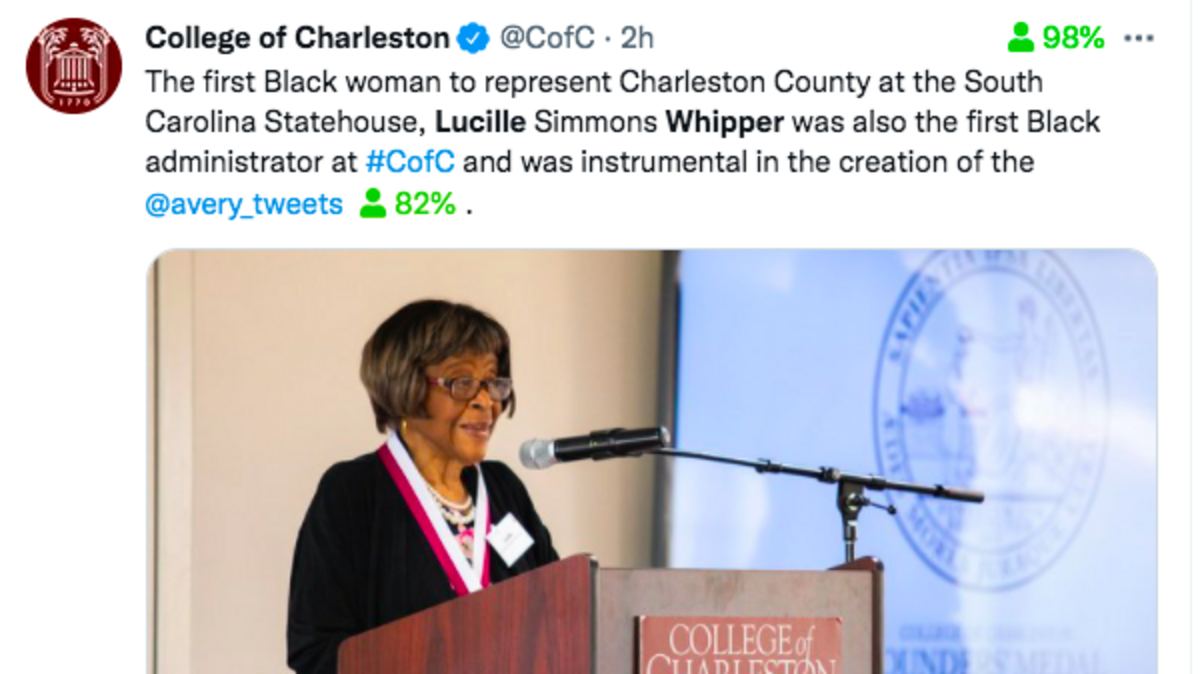
S.C. Gov. Henry McMaster ordered Friday that flags on top of the State House to be flown at half-staff Saturday in honor of Lucille Simmons Whipper, the first Black woman to represent Charleston in the State House, who died last Friday at the age of 93.
Whipper was mourned by officials across the state over the last week, who called her a “trailblazer” and highlighted her legacy as an educator and activist that she left behind.
“Lucille Simmons Whipper was a dedicated public servant, passionate educator, tireless community advocate, and principled leader,” McMaster tweeted Friday. “In honor of her extraordinary legacy and lifetime of service, I am ordering that the flags atop the State Capitol Building be lowered to half-staff.”
Whipper was born June 6, 1928 in Charleston, according to a biography published by The History Makers, the largest U.S. collection of African American oral histories.
She attended the Avery Institute in Charleston and, after graduation, she and her class sought to desegregate the College of Charleston during the 40s, according to an article from the college. Their efforts were unsuccessful, and Whipper went on to attend Talladega College in Alabama, where she earned degrees in economics and sociology.
In college, Whipper did not give up her fight for civil rights. She fought in part of a movement to integrate college student organizations, according to The History Makers.
After graduating from Talladega College, Whipper continued her education and received a master’s degree in political science from the University of Chicago.
When Whipper returned to Charleston, she served as a teacher, guidance counselor and public school administrator at schools across the county, according to the College of Charleston. Whipper worked at Haut Gap Middle School, Bonds-Wison High School and Burke High School.
Whipper was also active in the civil rights movement in Charleston, where she worked “toward greater political empowerment such as voter registration drives,” according to the College of Charleston.
Whipper served as an organizer and director of Operation Catch-Up in the late 60s. Whipper was part of a group that proposed the program, which provided an enrichment program for high school students in the summer and tutored them throughout the school year.
“That program really identified a lot of students and assisted them into college being ready to go into just any school that they wanted to go into,” Whipper said in a 2007 interview. “It was a very enriching experience for them.”
In 1972, Whipper became the first Black administrator at the College of Charleston when she was hired to direct its Head Start program and to develop other diversity programs, according to the College of Charleston. During her time at the school, she helped develop the university’s first affirmative action plan, and in 1990, she played an instrumental role in opening the Avery Research Center for African American History and Culture.
“Lucille Simmons Whipper was someone who seemed to have lived many lifetimes in the span of just one,” said College of Charleston President Andrew Hsu in a letter to the editor published in The Post and Courier. “She was a model for community activism, a model for compassion and a model for turning plans into action.”
While still working at the College of Charleston, Whipper entered the field of politics.
In 1972, she served as the vice chairman of the Democratic Party Convention. She served on the Charleston District 20 Constituent School Board from 1978-1982.
Whipper decided to run for the State House in 1985 after a nearby House district seat became vacant, she said in a 2007 interview. Her family moved into Mount Pleasant and she announced her candidacy.
“It was very interesting because some of the first questions people would ask, ‘What a minister’s wife doing running for a political office?’” Whipper said in the interview. “And I said, ‘What a minister doing,’ because we had many ministers (in office).”
Whipper faced an uphill battle, running against a man who was a long-time activist in the community who’d worked to desegregate a golf club. Her opponent was also supported by Democratic leaders like Sen. Fritz Hollings.
Whipper won her election an went on to serve as the first Black woman to represent Charleston. She spent the next decade at the State House, where she sponsored bills making marital rape a crime and requiring state agencies’ hiring goals for minorities and females to be monitored.
Whipper chose not to run for reelection in 1996.
“Long ago she earned the respect and abiding admiration of all of her colleagues in the General Assembly,” a resolution passed in 1996 in her honor reads. “Her service has been outstanding and dedicated and she has left a lasting mark on the legislative history of this state.”
Whipper’s legacy was honored by several state and local officials upon the news of her passing.
“Lucille Whipper was quite simply one of the finest people I’ve ever known,” Charleston Mayor John Tecklenburg posted on Facebook Sunday. “She loved generously and well, lived her life with fortitude and purpose, and left the world better and kinder than she found it. Known to all for her great intellect and indomitable spirit, Lucille will be much missed, but never forgotten.”
“Saddened to hear about former Rep. Lucille Whipper’s transition,” state Rep. Gilda Cobb Hunter, D-Orangeburg, tweeted. “So very grateful for the memories of serving with that force of nature! #Service #RestInPower #RestInPeace.”
“Lucille Whipper was a trailblazer and a dear friend,” U.S. Rep. Jim Clyburn tweeted. “As an educator and state representative she made a tremendous impact on the lives of countless individuals across this state. My thoughts and prayers are with her family at this time.”
Others recalled her mentorship as they sought political office themselves.
“Dr. Lucille Whipper .... was part of my first campaign cabinet. She guided me as if I were her own son,” S.C. Sen. Marlon Kimpson tweeted. “Her legacy will live on long after her death because of her work. I’m deeply humbled to have had the opportunity to learn from her and will cherish the time spent forever.”