Black women are trying to make SC political history in 2022. Why are they struggling?
In its more than 200 years of existence, South Carolina has never elected a Black woman to statewide office.
Not governor or lieutenant governor. Not secretary of state or superintendent of education. Not treasurer or attorney general, or commissioner of agriculture or comptroller general. And not one Black woman from South Carolina has ever been elected to the U.S. Senate.
But on a warm February morning, while speaking at a supporter’s waterfront home on James Island, South Carolina Democratic state Sen. Mia McLeod was undeterred as she introduced herself to a group of mostly white voters over brunch.
“A change is coming to South Carolina,” McLeod said. “And she looks like me.”
McLeod, who is seeking the Democratic Party’s nomination in the South Carolina governor’s race, is one of seven Black women running for statewide office in the Palmetto State this year.
Most are Democrats. One is a Republican. Another is running as a Green Party candidate. All are chasing history.
Bobby Donaldson, a history professor at the University of South Carolina and a scholar of Southern history and African American culture, said Black women have long played critical roles in helping Black people obtain political power, from grassroots organizers and strategists to get-out-the-vote foot soldiers.
“They worked hard to get African American men elected. Now, as a direct result of their activism and advocacy, African American women are not just in the background. On the contrary, they are leading the way and pursuing offices that few imagined two generations ago,” Donaldson said.
But winning will not come easy.
Because no Black woman has ever won a race for statewide office in South Carolina, McLeod and two other candidates interviewed for this story said they are building a campaign strategy largely from scratch.
On top of that, political analysts and state party officials note Black female candidates historically struggle to raise the money needed to compete in these massive, resource-draining statewide races. As a result, these candidates often face skepticism about their electoral viability while also having to contend with questions about their electability as it relates to their race and gender.
“The simple fact that you’re Black and a woman already puts you behind the eight ball when it comes to the necessities it takes to win,” said Antjuan Seawright, a Democratic strategist and senior adviser to the Democratic Congressional Campaign Committee, who said he would like to see his party make sure Black women candidates have all the tools they need to successfully run for office at every level.
McLeod is the first Black woman to ever run for governor of South Carolina. If she wins her party’s nomination in June and wins the general election in November, McLeod would be the first Black woman ever elected governor in the entire country.
“There’s no template,” McLeod said when asked about the challenges of running a statewide race as a Black woman.
But McLeod also said she is learning there are shared struggles when running for elected office at this level.
The ‘electability’ question
When Democrat Stacey Abrams ran for governor of Georgia in 2018, she had to do more.
Instead of jumping right into the race and making her pitch to voters about why she was the best candidate to win, her campaign also had to dedicate a significant amount of time trying to convince voters that it was possible for a Black woman to win.
According to Kelly Dittmar, the director of research at the Center for American Women and Politics, the dual campaign messaging effort became so prevalent that one of Abrams’ staffers came up with a name for it. She called it the “concurrent campaign of belief.”
“They are having to run two campaigns at once,” Dittmar said. “That is time, energy, resources — legitimate resources — spent on trying to make the case that first of all, you simply can win.”
And even when women do make that case, research shows that they often have to be more likable, raise more money and generally work harder than their male counterparts in order to win.
In interviews and in subtle comments made on the stump, McLeod said she is confident South Carolina is ready for someone like her, in part, because her party’s strategy of nominating moderate, white men has not been successful.
Not only have Republicans accounted for six of the state’s past eight governors, but Democrats have struggled to win any statewide contest here in more than 15 years.
“Why do we keep doing the same thing, year after year, election after election, and losing and losing?” she asked the brunch crowd that February morning on James Island.
“Hello! I’m different,” McLeod said in her speech while flashing a broad smile to the 30 or so attendees, who responded to her observations with polite chuckles and head nods of affirmation.
But another recent election has also threatened to undercut the credibility of Black Democratic women running for statewide office in South Carolina before their campaigns even began. Despite breaking fundraising records in his 2020 challenge against South Carolina Republican U.S. Sen. Lindsey Graham, DNC Chairman Jaime Harrison, a Black man, still lost by a double-digit margin.
If Harrison can’t win, voters point out, how can these women accomplish what he couldn’t?
Angela Geter, a former chairwoman of the Spartanburg County Democratic Party who is one of three Black women hoping to challenge Republican U.S. Sen. Tim Scott for his seat in November, said she feels like she has to contend with three layers of questions.
“(It’s not only) ‘Can I win the race as a Democrat in South Carolina?’ but, ‘Can I win as a woman?’ and then, ‘Can I win as a Black woman?’” she said. “If I win, or if either of the other women in this race win, we would only be the third Black woman to be in the United States Senate. It’s a historic situation, but at the same time it’s a little disheartening.”
The other women in that contest are state Rep. Krystle Matthews, D-Berkeley, and Columbia activist and author Catherine Fleming Bruce.
The dynamics of that particular race are especially interesting since Scott, the lone Black Republican U.S. Senator, is facing an electoral challenge from Black women — a rare moment when white candidates are absent from a political contest in South Carolina.
Geter said she could not afford to sit on the sidelines this election cycle and expressed frustration that lawmakers failed to pass voting rights legislation this year after Democrats were unable to overcome a Republican filibuster and failed to convince two of their own members to vote for the measure.
“We are in a historic moment, and I feel like that moment demanded something of me,” Geter said.
But these political contests also demand something else: Money.
The fundraising disparity
By far, the greatest barrier mentioned by Black women candidates, political operatives and party leaders was fundraising.
Those dollars act as the lifeblood for making a successful campaign go, said Jessica Bright, the executive director of Emerge South Carolina, which is part of a national network to help train and elect Democratic female candidates.
Without that money, she said, candidates can be limited in who they can hire, how they communicate their message and how widely that message can be shared.
“Especially coming out of the gates, men sometimes are able to raise millions of dollars within the first quarter of a statewide race, while a woman in the race that is capable and actually talented and has this full repertoire of why they will be a great candidate just doesn’t get that early fundraising support,” Bright said.
Historically, Black female candidates have struggled to raise the money needed to compete in massive statewide races nationwide. So far, 2022 is proving no different.
Take the South Carolina governor’s race, for example.
Before she can take on Republican Gov. Henry McMaster, McLeod has to make it through a June 14 primary challenge against former U.S. Rep. Joe Cunningham, a moderate, white male Democrat from Charleston.
The disparity in their fundraising totals is stark.
While McLeod has raised about $359,000 for her race, Cunningham has raised more than $1.3 million. And whoever wins the Democratic nomination will face McMaster, an incumbent who has already amassed a war chest of nearly $4.5 million in his reelection bid.
In the U.S. Senate contest, the extremes are even greater.
Scott has raised nearly $38 million since 2017, making him the Republican Party’s strongest fundraiser among Senate candidates running in 2022, according to the filings from the Federal Election Commission.
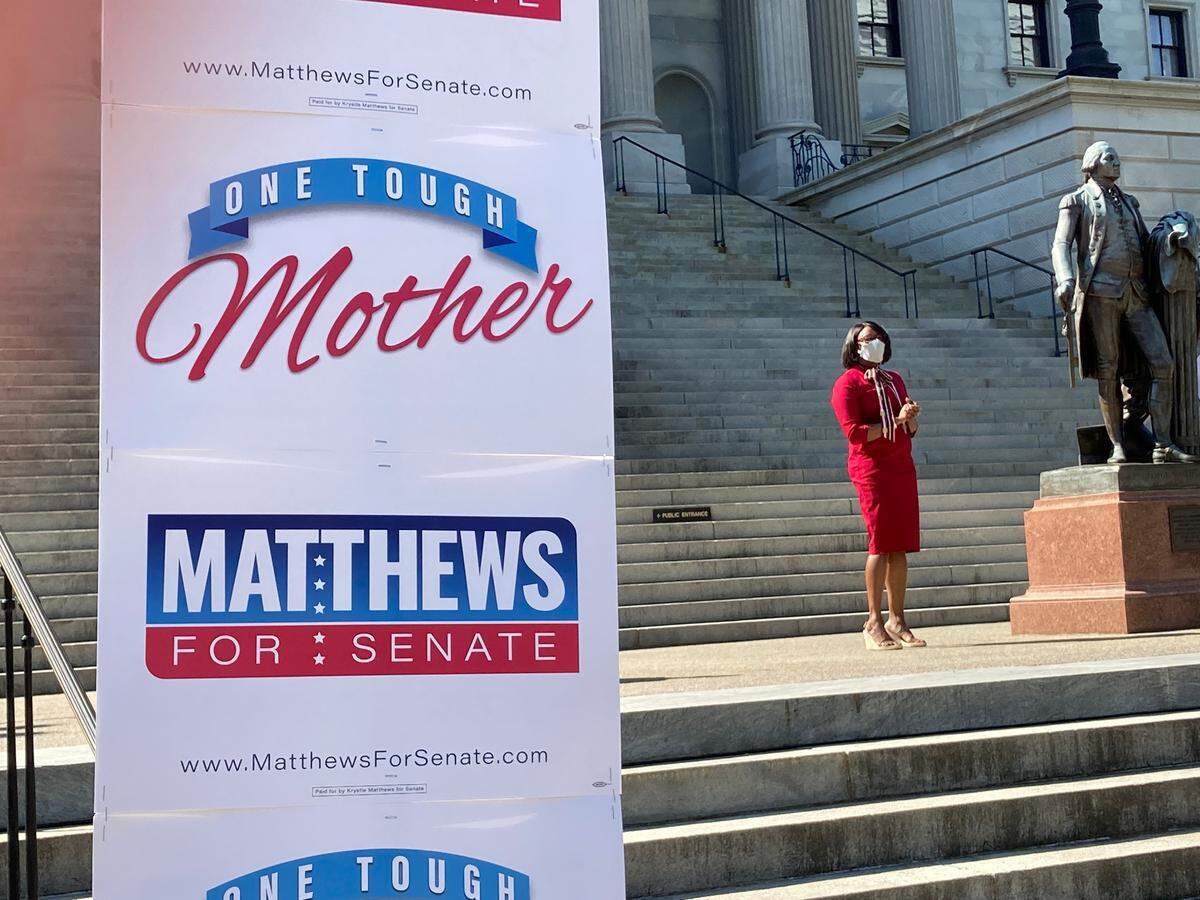
Compare that to the $66,000 haul from Matthews who, along with fellow Democrats Geter and Bruce, is running for the chance to challenge Scott in November.
“We have talented candidates. We have talented female candidates that are very articulate, that are entrenched in their communities, that have done the work and have robust policy positions that they’re getting into. But in order for those messages and the information to get out, sometimes it’s the infrastructure that they have — or the lack of infrastructure — that kind of impedes Black women in South Carolina,” Bright said.
But the most emotionally challenging obstacle is the one that can lurk beneath the surface and bubble up in unexpected ways: Encountering racism and sexism on the campaign trail.
Overcoming racist, sexist perceptions
Matthews said she’s gotten used to making meals out of dry cereal, and peanuts, and any snack that can fit into her purse while she’s on the campaign trail. She’s a single mom, so she’s used to juggling responsibilities and a busy schedule.
What she hasn’t gotten used to is the sexism and racism she still encounters as a candidate running for elected office in 2022 in a state where women make up 52% of registered voters.
“People like to say anecdotally that it’s hard to be a Black woman and run, but it’s another thing to actually be a Black woman and run. When we’re passionate, people read it as aggression. Our tears don’t mean as much, right? They don’t see us in that light,” Matthews said.
She also said she’s faced questions about whether she can represent constituents of all races, which is something she already does as a state lawmaker who represents a district that includes parts of Ladson, Goose Creek and North Charleston.
“My brother is mixed. I have a whole half of a family that’s white. I grew up that way. For me it’s second nature, but for society it’s not necessarily the norm,” Matthews said . “I represent every damn body. I’m not picking and choosing based on that. Everybody wants the same thing: We want what’s best for our families, and we want to thrive.”
McLeod understands how Matthews feels.
In the last year, McLeod said she has reached out to other Black women who are running for governor across the country to seek advice and find some support as they all, respectively, try to make history.
“I have had conversations with Stacey Abrams,” McLeod said. “But some of the things that I talked about with Stacey were much more personal.”
In addition to discussing how Abrams and her network of voting rights activists turned Georgia blue in 2020 after a 2018 gubernatorial loss, McLeod said one of the things they talked about was dealing with the realities of running for office in the South as a vocal Black woman.
“When I’ve been outspoken on issues that are controversial or high-profile,” McLeod said, “some people who don’t look like me, their go-to — even when I did the State of the State response — was ‘Oh, you’re just another angry Black woman.’ I can’t even speak truth to power without being called a name.”
She sighed.
“I have always had to work harder than my white counterparts,” McLeod said. “I’m used to it, but I don’t want to get used to it.”
But there are signs of progress taking root.
Signs of progress
To date, some 19 Black women have held statewide positions in 15 states. This election cycle, six Black women, including McLeod, are running for governor in six states around the country.
In South Carolina, nine women have held statewide office, most notably former Republican S.C. Gov. Nikki Haley, the first woman elected governor in South Carolina and the first Indian-American to hold the office.
But the first woman who won election to statewide office in South Carolina was Nancy Stevenson. Her adopted campaign slogan for lieutenant governor in 1978 was, “Not one of the good old boys!”
It would take another 40 years for South Carolina to elect a second woman, current Lt. Gov. Pamela Evette, to the same post after she ran on a joint ticket with McMaster in 2018.
“Part of why the floor is the ceiling when it comes to Black women in politics here in this state is because very few Black women seem to see themselves as electable, as capable,” said state Rep. Gilda Cobb-Hunter, the longest-serving member of the South Carolina state House and the first person of color to lead a legislative caucus.
“It’s not that Black women aren’t capable and don’t have the capacity; we are and we do. It’s because of cultural norms, and they just don’t step up.”
Cobb-Hunter, D-Orangeburg, said that’s why she hopes this cohort of Black women running for statewide office will inspire more women, and women of color, to run. In the 1980s, Cobb-Hunter started the Women of Color Political Network to create a network of women in politics across the state. While the organization fizzled out over time, she said the spirit of it is very much alive and remains a core personal mission.
“As a Black woman understanding how serious and difficult it is for women, period, to make it in this world and in this state, I can’t afford to stop agitating and advocating,” Cobb-Hunter said.
This story was originally published March 31, 2022 at 5:00 AM.