In coastal South Carolina district, environmental issues recede from campaign trail
When Republicans made winning back one of South Carolina’s coastal U.S. House seats a top priority two years ago, all four GOP candidates went out of their way to tell their party’s primary voters they opposed offshore drilling.
The position was seen as so important that about halfway through a GOP primary debate, one of the candidates not only discussed the issue but zeroed in on its political significance when asked about quality of life in the 1st Congressional District.
“As many people know, we are all against offshore drilling and we believe strongly in protecting our environment — so that’s one of the things the Dems can’t use against us this time,” then-candidate Kathy Landing said, referring to the 2018 contest where Democrat Joe Cunningham used the issue to flip the district from red to blue for the first time in nearly 40 years.
Republican Nancy Mace, now the district’s congresswoman, went further in addressing the issue that cycle. The day before Mace announced her candidacy in 2020, she wrote an op-ed in USA Today where she declared her support for then-President Donald Trump while proclaiming, “We shouldn’t put our shoreline at risk.”
Now, for the first time in two election cycles, one of the defining issues that played a major role in two fiercely competitive races in South Carolina is barely a blip on the campaign trail.
Offshore drilling does not get scribbled down when Republican voters are asked to submit questions at candidate forums and, so far, the issue has not made any appearances in TV campaign ads with about four weeks to go until the June 14 Republican primary.
“I just don’t think this go-round that it’s at the top of anybody’s list. I can tell you it’s not at the top of mine,” said Republican primary voter Kris Smith of Summerville, who cited secure elections and overturning abortion as chief concerns. “There’s so many more critical issues right now than the environment.”
The Biden administration has temporarily put a hold on new leases for offshore drilling in the United States, and in 2020 Trump signed a 10-year ban on offshore drilling that includes the waters off South Carolina’s coast.
But the disappearance of offshore drilling as a central issue in the primary — along with other environmental topics like flooding, sea-level rise and climate change — illustrates a messaging shift in a district with a history of Republicans electing conservatives who also identify as conservationists.
More broadly, it speaks to how nationalized the congressional contest has become, with GOP candidates spending more time talking about the U.S.-Mexico border wall than the sea wall being built around the Charleston peninsula.
“It’s risky, right?” said Matthew Nowlin, a political science professor at the College of Charleston. “But this time it’s not clear what the politics of the issue are now, given the sort of national mood with concerns about rising energy prices, the war in Ukraine and these other economic issues.”
In 2018 and 2020, Nowlin said the “winning position” was clear, with voters largely opposed to offshore drilling off South Carolina’s coastline.
But as a fierce primary fight unfolds, the silence on environmental issues like offshore drilling suggests the subject is either a non-starter for GOP primary voters or reflects a political lesson learned, depending on who’s asked.
A lesson learned
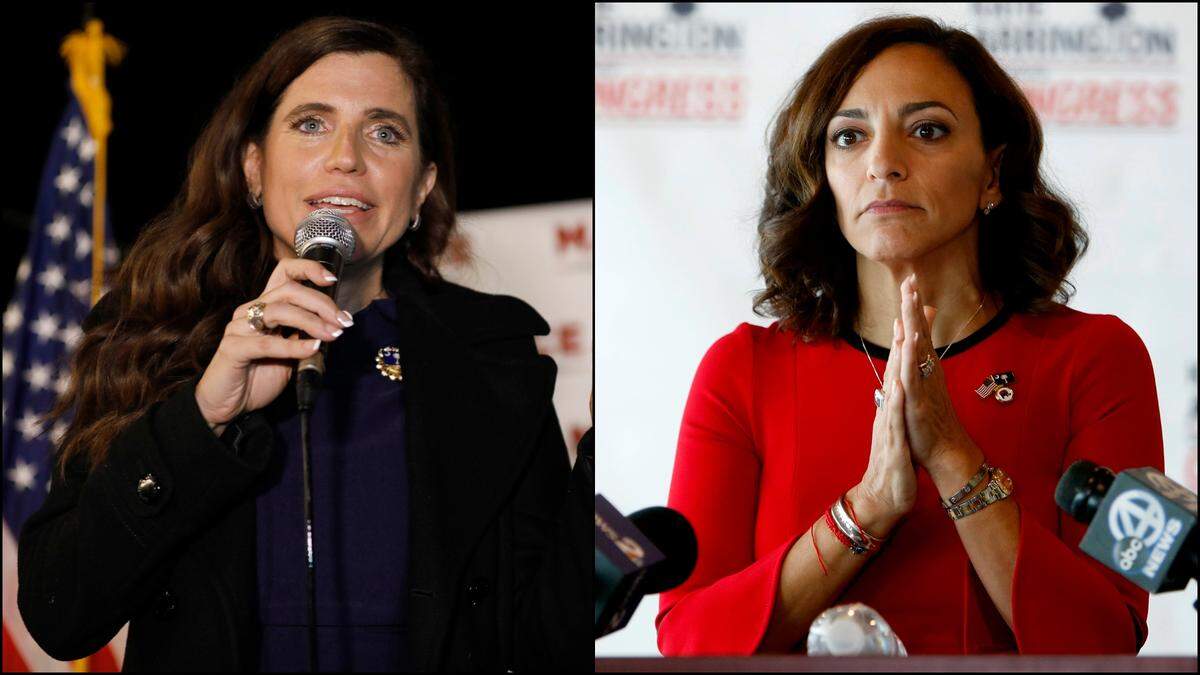
At her campaign kickoff event in Summerville last month, Mace’s chief primary rival Katie Arrington sought to rewrite her own political history when it came to the topic of offshore drilling.
In 2018, Arrington stunned the nation when she defeated U.S. Rep. Mark Sanford in the Republican primary, handing him his first-ever electoral defeat in a race where she made loyalty to Trump a central part of her message.
However, during the primary campaign Arrington also said she supported Trump’s plan to allow drilling, putting her at odds with the majority of voters in a coastal district where the local economy relies heavily on the tourism fueled by its beaches and waters.
Despite repeated attempts to clarify her position in 2018, including a TV ad where she addressed the issue head-on, Cunningham repeatedly cast doubt on Arrington’s pledge to keep offshore drilling away from South Carolina.
He went on to narrowly win the seat, becoming the first Democrat to represent the district in nearly four decades.
“The media, the narrative was all about taking on offshore drilling. No, folks. It was about being where we were in the Trump administration: Energy independent,” Arrington said recently in summarizing what happened in that race.
Asked where she stands on offshore drilling, Arrington said in an interview with The State last week, “I oppose it.”
She further specified that she also would oppose offshore drilling in the Atlantic, saying “there isn’t any oil” there.
Lynz Piper-Loomis, a Republican who is also challenging Mace for the GOP nomination, said she wants to see America become energy independent and would support drilling in Alaska, Texas, Oklahoma and the gulf of Mexico.
Piper-Loomis refused to answer questions about whether she would support or oppose offshore drilling off the coast of South Carolina, reiterating that drilling is “not even a topic of discussion.”
“Have we ever seen any attempt to have offshore drilling off the coast of South Carolina?” Piper-Loomis asked. “If truly there was that opportunity, they would have done it a long time ago. They’re not going to do drilling there.”
Arrington, in a statement, said voters on the campaign trail tell her they are most concerned about inflation and high gas prices.
There are other subtle signs that the issue is no longer in vogue.
A section on offshore drilling has been pushed down to the second page of Mace’s campaign website. Meanwhile, Arrington and Piper-Loomis make no mention of the topic on their respective campaign pages.
Former Upstate Republican congressman Bob Inglis, who now serves as executive director of RepublicEn, a national nonprofit that advocates for conservative solutions to environmental issues, said it appears Arrington has “figured out this is not an issue to raise” after she struggled to overcome it the last time she ran for the same U.S. House seat.
“What I assume is going on is that Katie Arrington has found out ‘there’s no education in the second kick of the mule,’ as Sen. (Fritz) Hollings used to say,” said Inglis, who described the district as more purple than red. “I think she has just learned from the past and she’s not raising it and, therefore, Nancy Mace is not raising it down there.”
But asked if Republicans are missing an opportunity to address environmental issues, Inglis hesitated.
“I just don’t know. I get it both ways in my head,” Inglis said. “If you’re an incumbent and you’re being challenged, you just have to respond to where the challenge is coming from.”
A shift in focus
So far, Mace has not looked to make Arrington’s past comments on offshore drilling a contrast in the intensifying GOP primary.
In an interview, Mace said her stance on offshore drilling is “the same as it’s always been.”
“I’m opposed to offshore drilling off South Carolina’s coast,” Mace said, noting that the first piece of legislation she introduced as a state lawmaker was an anti-drilling measure that Arrington chose not to sign onto at the time.
“I want to be clear I’m running on my record and my opponent’s,” Mace said, referring to Arrington. “And she’s flip-flopped on a lot of issues. This isn’t the only one.”
But Mace also argued the issue no longer has the sense of urgency it once did.
In September 2020, with the stroke of a pen, Trump expanded a ban on new offshore drilling — rendering the topic something of a moot point.
The memorandum sought to prohibit drilling in the waters off both Florida coasts, and off the coasts of Georgia and South Carolina for a period of 10 years — from July 1, 2022, to June 20, 2032.
The abrupt election-year reversal came less than two years after Trump proposed a vast expansion of oil and gas drilling in U.S. continental waters despite opposition from governors and elected officials in coastal states.
And when Trump signed the order, Mace was there, in Florida, sitting on the front row with U.S. Sen. Lindsey Graham, R-S.C., and applauding the decision.
Like Arrington, Mace also said most of the voters she talks to are telling her their No. 1 concern is inflation, along with the economy.
Former 1st District Congressman Sanford, who lost the 2018 GOP primary to Arrington, warned that Republicans should not look the other way on quality of life issues, which includes talking about flooding, drilling and other environmental topics.
“I think it’s a mistake within a Republican primary to cede to Democrats the environmental issues,” Sanford said. “To voters of the 1st District, the environment has much to do with what attracted them to the area in the first place and it’s what has kept them there.”
Jordan Ragusa, a political scientist at the College of Charleston, said South Carolina Republicans also tend to care deeply about the environment in a way that is not seen in other similarly deep red states.
Gov. Henry McMaster, for example, pushed back against Trump’s ban on offshore drilling, along with Attorney General Alan Wilson. Both are Republicans.
But Ragusa argued the nationalization of U.S. House races has taken hold in this particular Republican primary race, where the 1st District race is also once again a test of Trump’s grip on the GOP.
Trump endorsed Arrington in the contest over Mace, the incumbent. The former president further affirmed his support for Arrington when he held a March 12 rally in Florence to boost her candidacy.
And because primaries tend to draw a smaller, but more ideological and more politically active set of voters, Ragusa said that this electoral reality is bound to influence which issues are getting discussed now.
“Given that dynamic, in the primary it’s all about who’s a Republican,” Ragusa said. “And there are transformations going on within the Republican Party right now about what it means to be a Republican.”
Already there are early signs that the Democrat in the race is eager to make her position on the environment an issue in the general election, regardless of which Republican candidate she faces.
Last week, Democratic congressional nominee Annie Andrews shared dramatic footage of a beach house collapsing into the Atlantic Ocean in Rodanthe, a small beach town located on the Outer Banks of North Carolina.
In a tweet, Andrews warned a similar fate could be, “Coming soon to a SC beach town near you if we don’t get serious about addressing climate change.”
In an interview with The State newspaper, Andrews said she opposes offshore drilling but would also push for a permanent ban on offshore drilling if elected to Congress.
Asked about the extent of the ban she would like to see, Andrews said she wants to ban drilling “everywhere” but said the United States should continue to drill where the are current leases and not issue any new ones.
“We cannot be at the whims of whoever is in the White House. Our entire economy depends on the coastline. One oil spill could erase our economy and would be devastating to the 1st Congressional District,” Andrews said.
Andrews also said America needs to break its dependence on foreign and domestic oil and would like discussions to start shifting to renewable energy rather than oil.
But political headwinds can change in an instant.
“The issue agenda is always fluid in an election,” Ragusa said. “We’re heading into hurricane season. If the 1st District is threatened by storms or flooding, it could raise the salience of climate change and environmental issues.”
And with less than four weeks to go until the June 14 primary, there are still opportunities for candidates to discuss their environmental record, should they choose to make it an issue.
The first Republican congressional debate in the race is set for 7 p.m. Monday at Burke High School in Charleston.