Abortion debate highlights divisions among South Carolina Republicans
Abortion — an issue that might be expected to unify South Carolina House Republicans — has instead exposed factions within the party that controls the state Legislature.
In the weeks, days and hours before legislators returned Aug. 30 to debate a proposed ban on nearly all abortions, some Republicans questioned whether their colleagues were moving too fast. Others felt emboldened, believing that their growing coalition could persuade their colleagues not to allow exceptions for rape, incest and fetal anomaly.
Meanwhile, one Republican was receiving widespread attention on television and social media over his emotional remarks at a hearing, a sign that some thought showed Republicans suffering from a case of buyer’s remorse after prioritizing a six-week “heartbeat” ban in 2021, now temporarily blocked by the South Carolina Supreme Court.
In the end, the Republican-controlled House approved House bill 5399, banning abortions but making exceptions for the life and health of the mother and allowing until around 12 weeks to get an abortion if a pregnancy was the result of a crime, with a reporting requirement.
For a rare moment, Democrats thought they had found a strategy to foil the majority party’s plans, by leveraging Republicans’ intraparty factions, which increasingly have dogged the caucus.
“We knew that it was going to be a contentious thing ... and we knew we were all over the place,” House Majority Leader Davey Hiott, R-Pickens, said after the vote. “If I told you it was pleasant in there, I’d be lying to you.”
Now, starting Tuesday, senators will pick up where the House left off.
Already, there are some Republican signals that could derail the bill.
Republicans hold 30 seats in the Senate to Democrats’ 16. At least three Senate Republicans have gone on record to criticize the House bill. Another, Sen. Richard Cash, R-Anderson, has vowed to “fight” to remove rape and incest exceptions from the bill.
“I don’t like it; I just don’t like the bill,” said Sen. Katrina Shealy, a self-described “pro-life” Lexington County Republican and one of five women senators in South Carolina, who said she opposes the bill as written due to invasion of privacy and other concerns. “I don’t think there’s enough votes for it to get out.”
State Sen. Tom Davis, R-Beaufort, echoed Shealy’s displeasure, saying he plans to propose a handful of amendments, daring his colleagues to sit him down.
“I am not going to let what passed the House ... pass the Senate,” Davis said. “That is not going to happen.”
Democrats leverage Republican differences
On June 24, the U.S. Supreme Court ruled that abortion is no longer a right protected under the U.S. Constitution. Even before the S.C. House returned Aug. 30 for a special session in response to that decision, Republicans were not on the same page.
After Kansas voters in early August rejected a proposed state constitutional amendment to make abortion illegal, some South Carolina legislators were unsure whether tackling even more restrictive legislation was necessary.
“If it were up to me (it is not), I would slow the process,” Rep. Bill Taylor, R-Aiken, wrote in a letter to his constituents explaining his position. “Let us see the impact of the Heartbeat law over the next year or two. Let’s examine what happens in other states, some with total abortion bans and others allowing abortions at or beyond full-term.”
The chamber’s most conservative Republicans — most of its membership makes up the Family Caucus and the newly formed Freedom Caucus — was sending signals its members might not support a ban with rape, incest and fetal anomaly exceptions.
In the end, two of those who made the commitment — Reps. Anne Thayer of Anderson and Stewart Jones of Laurens — abstained from voting Aug. 30.
“I look at that (rape and incest exceptions) is being cruel, and I couldn’t support it, I couldn’t vote for it,” Jones said. “There was good in the bill; I’m not saying the bill was bad. I think this issue of when is a person a person, (and) me being a Christian, my faith answers that question.”
State Rep. Neal Collins, R-Pickens, appeared in a widely circulated video, in which he emotionally shared the story at a tense hearing of a woman unable to receive an abortion under the state’s then-active six-week ban.
Any regret, Collins said, wasn’t about the six-week ban itself, but that it wasn’t clear enough to allow the woman to have the procedure. Collins voted Aug. 30 to pass the near-total ban, just as he’s supported previous abortion restrictions, but he joined his Republican colleagues who opposed the version of the bill without rape and incest exceptions.
Collins said his vote against the bill without exceptions could result in a primary challenge in his next run.
“I represent the fourth-most conservative House seat in the state. The fact that if the national narrative is Republicans are concerned about November ... I’m probably going to get a primary opponent because I voted against the bill that had no exceptions, and I think national people would just be shocked I get challenged from the right. I’ve never had a Democratic opponent,” Collins said. “I shouldn’t be the cover boy.”
Democrats found a way to expose all of those differences during the debate with a strategy that surprised even themselves.
“Tuesday exposed a lot more than just one vote on that particular issue,” said Rep. Russell Ott, D-Calhoun, the assistant House minority leader who supported the six-week ban but voted against the near-total ban.
Days before the debate, Republican legislators said they anticipated thousands of proposed amendments to the bill, and Democrats, typically unwieldy in their legislative approach, didn’t dispel the rumors.
“We didn’t represent anything different. It was one of those situations where if everybody’s going to be asking, ‘I heard there’s 10,000 amendments,’ let them go,” Ott said.
On the floor that day, Democrats only proposed two, both of which failed.
But it was another strategy, reminiscent of the 2018 poison pill offered by Sen. Brad Hutto, D-Orangeburg, to kill an abortion bill by proposing to outlaw nearly all abortions in the state, that shocked and, in some cases, angered House Republicans.
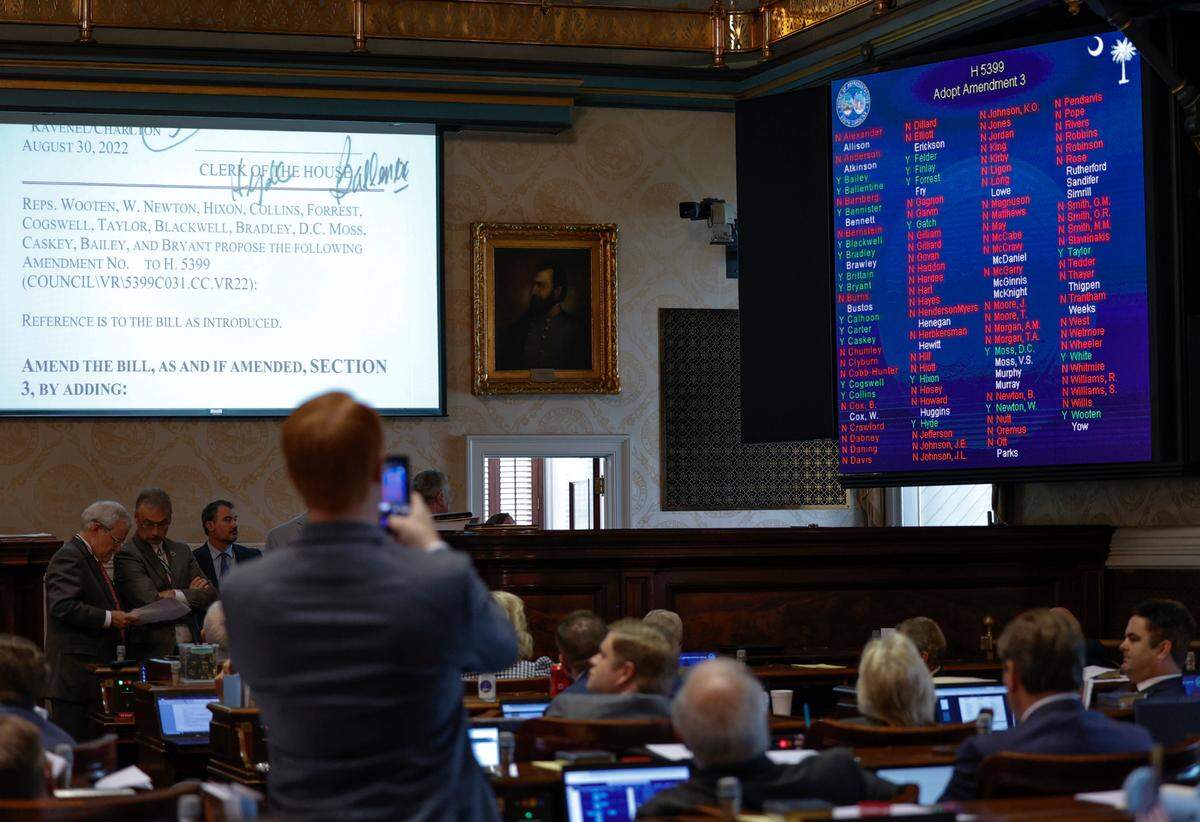
Democrats banded together to join the more conservative wing in opposing any rape, incest and fetal anomaly exceptions, delaying Republican efforts for hours to pass a bill many of them said they could support and one that had a better chance getting out of the Senate. That strategy exposed the problems belaboring Republicans from moving the bill forward.
“Constituents might label them crazy, but the reality is they were being smart,” Rep. Nathan Ballentine, R-Richland, said. “I give them credit. A lot of people don’t do that. They worry about every single vote instead of keeping their eye on the ball.”
Republicans were forced back to the drawing board.
For more than an hour, Republicans met privately to work out a strategy, split into two rooms rather than the usual one because members were unable to agree on a path forward. Party leaders shuttled between the rooms trying to find a compromise, according to multiple people familiar with the proceedings.
“I think this is a giant win for the Freedom Caucus and the more conservative body as a whole,” said Rep. RJ May, R-Lexington. “This is one of the very few and rare times the moderates didn’t control the floor or the caucus, and it only continues with the new members coming in.”
Republicans eventually returned with a new strategy using procedural maneuvers that took Democrats off guard. They first proposed two amendments restoring rape and incest exceptions, then agreed to what’s called cloture, cutting off legislators’ ability to file any more amendments.
In the end, an amendment to add up until 12 weeks for rape and incest exceptions succeeded.
The amendment was adopted by voice vote, a move that lets legislators call out their vote together rather than vote on the board for the public to see.
Democrats, who hours before had the upper hand, lost the final round.
“We heard them, and we moved forward with the bill, ... so obviously they were part of the coalition that was building the final product here, and that’s the way politics works,” House Speaker Murrell Smith, R-Sumter, said of concerned Republicans after the bill passed. “It’s to build the coalition and to compromise and come up with a solution.”