More than TV ads, yard signs. How SC District 26 candidates pitch themselves to voters
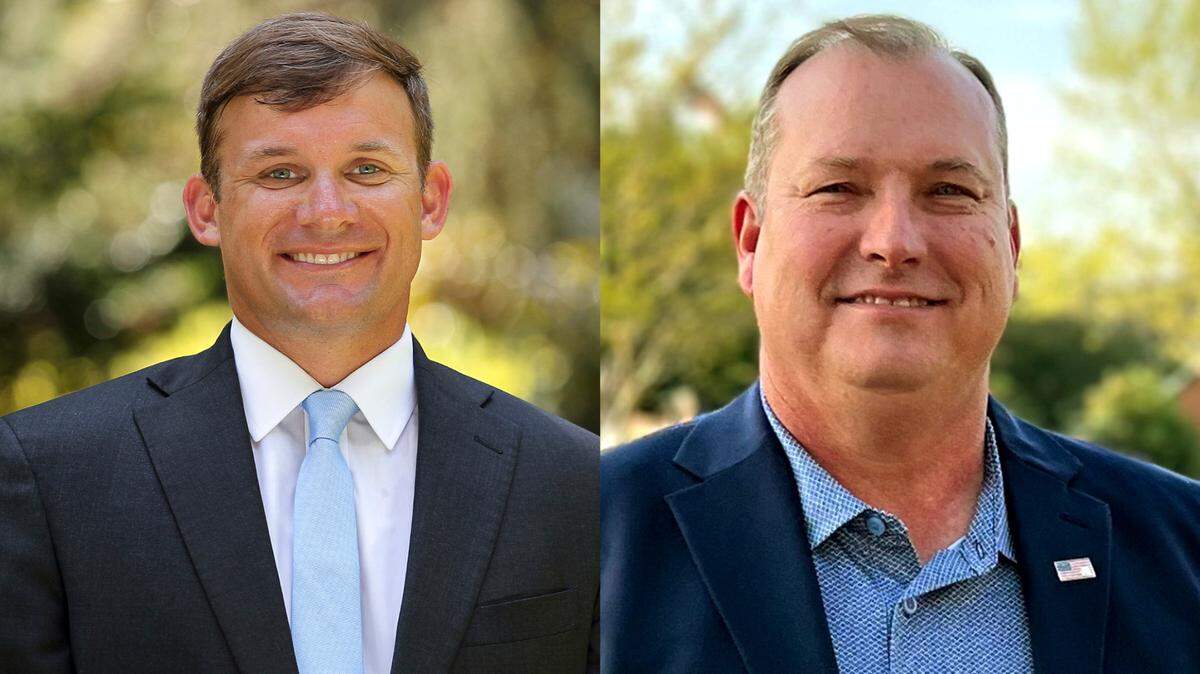
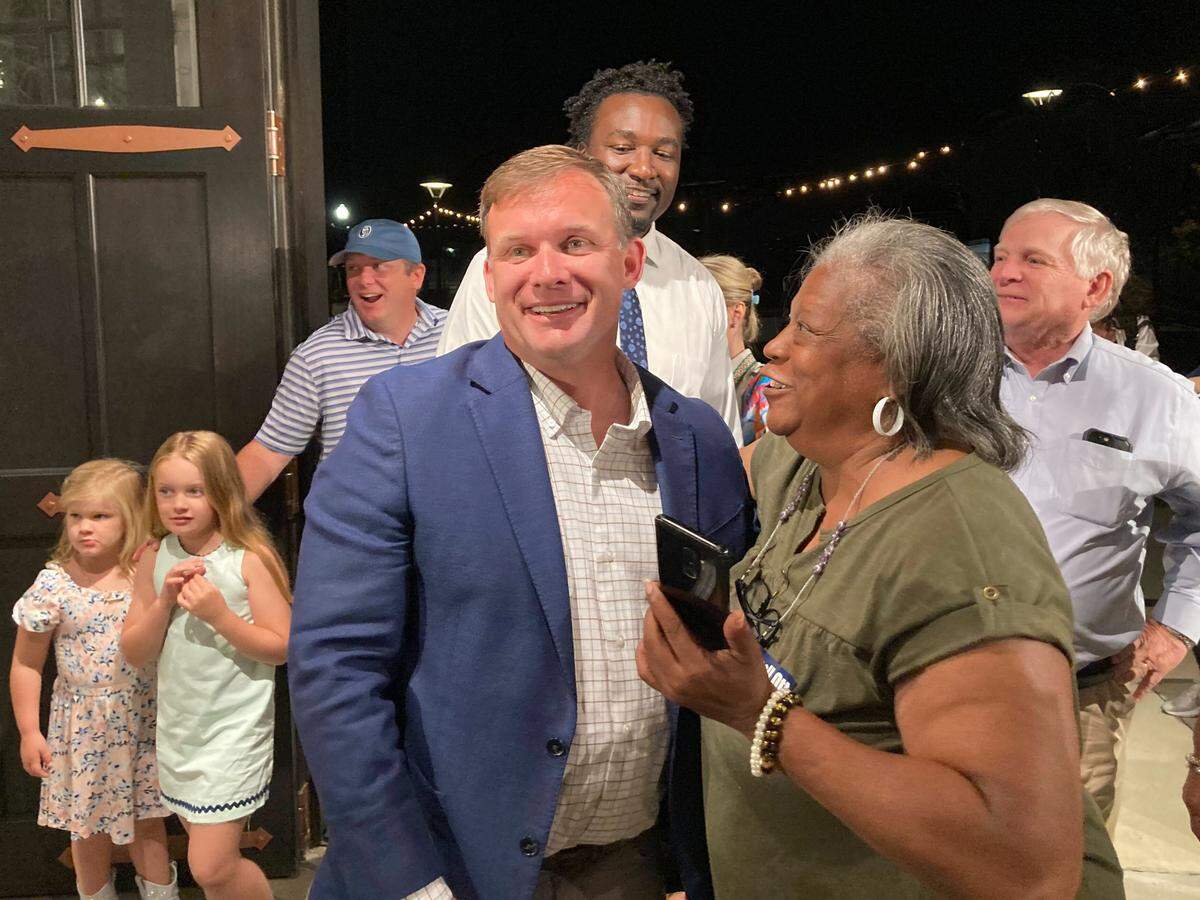
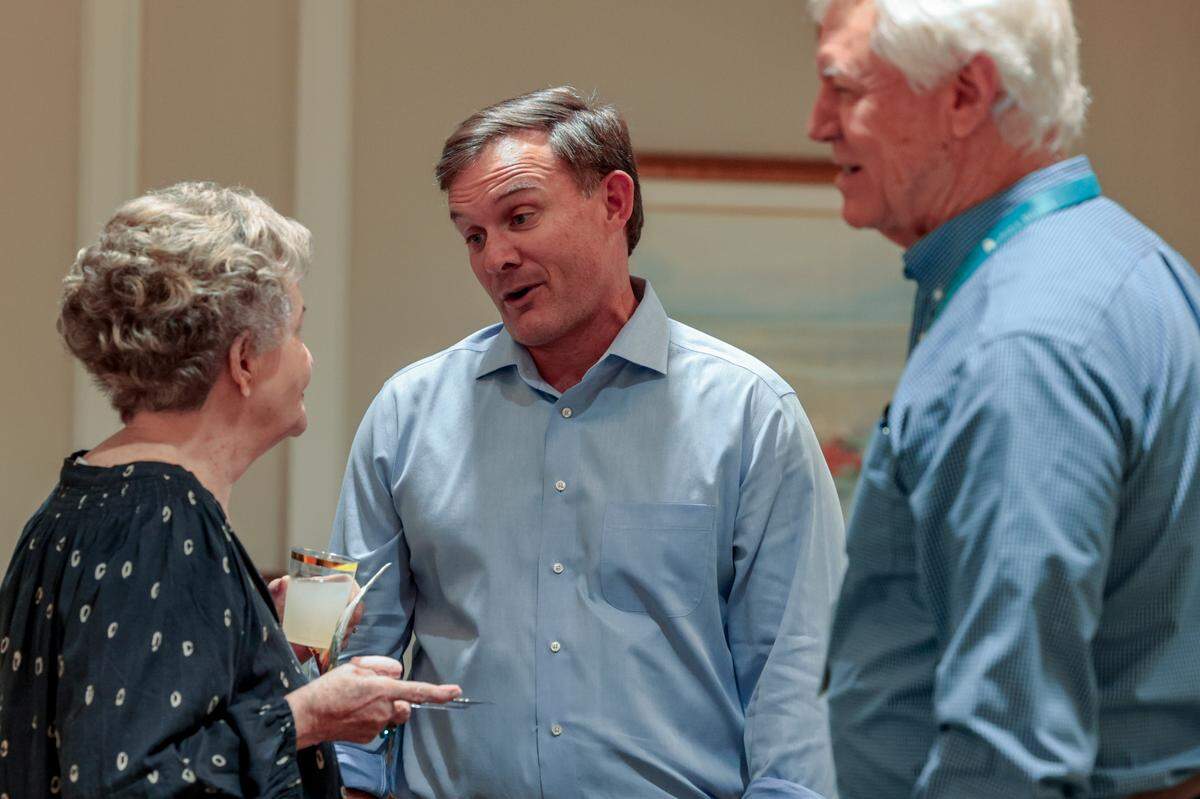
Inside of the Still Hopes senior living retirement community in West Columbia, Linda Dickerson organized a gathering where about 35 to 40 people attended. The center of attention was someone many years from retirement: 46-year-old Russell Ott, a Democratic Calhoun County state representative looking to move up to the state Senate.
“I just love the opportunity to meet new people. I appreciate the opportunity to come and talk about issues that y’all care about,” Ott tells the group of retirees.
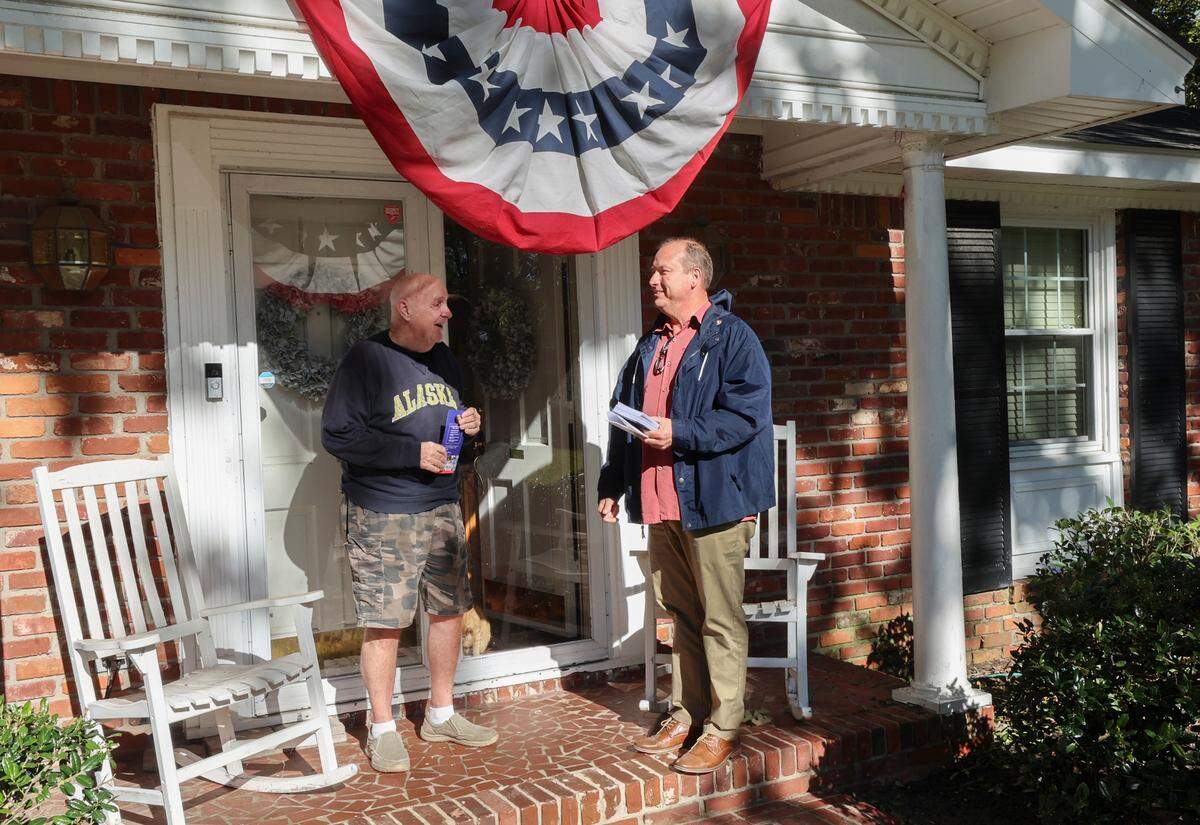
A few days later, state Senate District 26 Republican nominee Jason Guerry is knocking on doors. In the morning he’s walking the Whitehall neighborhood in Lexington County with a list of registered voters and their addresses.
“I’m Jason Guerry, I’m running for state senate. I wanted to introduce myself,” Guerry tells a prospective voter if they answer the door.
If no one answers at the door, Guerry leaves a door hanger.
It’s the closing weeks of the election between Guerry and Ott, who are seeking to succeed state Sen. Nikki Setzler, D-Lexington, who has represented the 26th state Senate district since 1977. Guerry and Ott are trying to reach out to as many voters as possible. In a district of roughly 108,000 people, the Nov. 5 election may have ballots from as many as 47,000 voters in parts of Calhoun, Lexington and Richland counties.
After the most recent redistricting, the district was redrawn to be one of the toss-up districts in the state, with a Democratic lean. President Joe Biden beat former President Donald Trump 52% to 46% in 2020.
So now in the close district, both hopefuls are reaching out to who they think could show up and support them in the voting booth in the Nov. 5 election.
How they’re reaching out to voters is limited to resources they have on hand.
Ott entered the last three weeks of the election with more than $77,800 in the bank.
Guerry had only $9,900 in the bank, after taking out a $36,000 loan for his campaign during the latest reporting period, according to state ethics commission filings.
Money in elections pays for staff, prints signs, door hangers and television air time.
With that cash advantage, Ott had reserved more than $53,000 of air time on local broadcast channels between Oct. 16 and Election Day, according to FCC records.
Guerry only has about $12,000 of air time reserved on broadcast channels through Election Day, and he $4,000 of his airtime cash on four spots to run during the South Carolina at Alabama football game Oct. 12, FCC records show.
But TV ads only go so far, and each of their campaigns have to go out and talk to people in person.
During Guerry’s door-knocking efforts, he has a list of infrequent voters and potential swing voters. He is confident owners of houses with Trump-Vance signs will vote for him, even if they don’t answer the door.
During the course of a day, with the help of volunteers, Guerry knocks on 300 to 350 doors looking for potential voters. He’s left 7,000 door hangers.
“As long as I keep putting them out, I’ll get more of them,” Guerry said.
At one house, which has red, white and blue bunting over the front door, and American and South Carolina flags displayed, Guerry puts a sign in the front yard after speaking to the receptive voter.
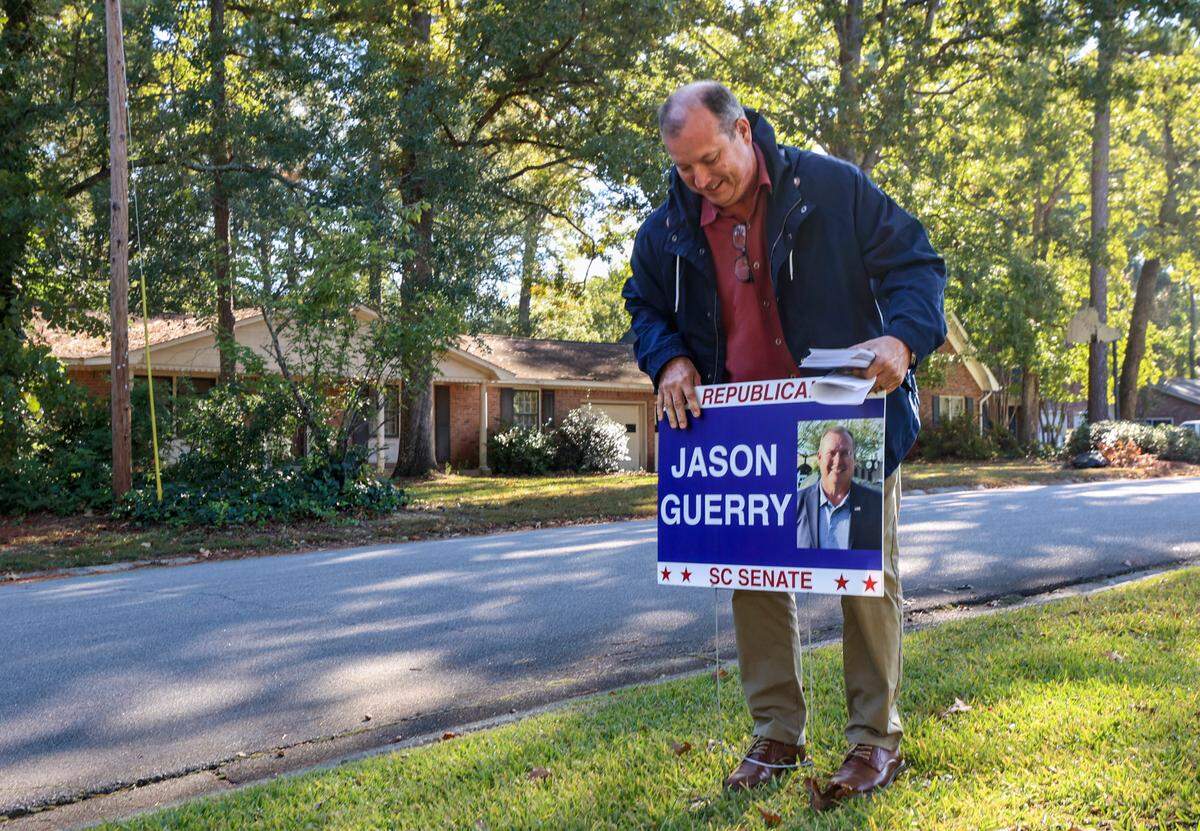
In the mid-morning hours, the people who answer doors are usually retirees.
One woman who answered said she already knew Jason, and her husband knew Guerry’s father, Art.
“He’s got the right information, he’s got the right balance behind him. We know his father, so we know where he’s from. We know his standing politically, and that means a lot to us,” Myra McLane said about why her and her husband are supporting Jason Guerry. “We believe in what this country is founded on, and we’re very concerned about the overflow of the migrants and all of the stuff that we hear about.”
At Ott’s appearance at Still Hopes, he gets grilled by Judy Malone, 76, who moved from New York five years ago, about abortion rights and why he voted for a six-week ban in 2021 and later against one in 2023.
“I just think voting for a six-week ban when you don’t believe in it, despite all this context, is irresponsible,” Malone said.
Previous state law banned abortions after the 20th week of a pregnancy, and Malone asked Ott on why not stay at the longer time frame.
“We weren’t going to be able to do that, because we are in a Republican-controlled General Assembly that has the power to pass legislation when they want to,” Ott said as he explained how he pushed for amendments to try to make the 2021 bill more palatable.
When exceptions were tweaked in the 2023 version, Ott voted against the ban.
Ott has often said he wanted to make a “bad bill better” but those efforts were even fruitless in 2023.
“There’s going to be time, and we don’t always agree that’s right, but I respect each and every one of you enough to tell you the truth,” Ott said.
Ott concedes he has voted differently on six-week bans and this is a hard issue.
Abortion is one of the issues that society has made “black or white,” Ott tells the crowd.
“You’re either pro-life or pro-choice. That’s what society tells us. From what I’ve learned because I’ve talked to a lot of women, I learned a lot through this process is that it’s not that black or white. It’s a very nuanced issue,” Ott said.
How voters are selected to be contacted
At the end of the day, the objective is to get more votes than the opponent.
Political parties are meant to turnout their base voters who they expect to vote for them no matter what. The candidates’ campaigns have to do the persuasion work, to convince those voters who may switch allegiance from election to election or won’t vote straight ticket.
But when parties and candidates decide who reaches out to whom, they’re being deliberate.
The party will reach out to voters who still need to be reminded to show up. These voters may be infrequent participants, but if they do, they’ll vote for the party.
Candidates have to do the persuading and they will reach out to voters who aren’t deemed solid partisans and might be swayed in one direction or another if they hear from a candidate or their campaign.
“I don’t think the party’s the best messenger, because if they are that type of voter, they’re more of an independent voter, and they don’t really want to, in my opinion, identify with the party,” said South Carolina Democratic Party Chairwoman Christale Spain said.
For Guerry, on the Republican side, the list he carries has a blend of potential voters.
“It’s a mix of swing voters and weak Democrats and weak Republicans, And if, like I said, if they’re not on this list, that means they just don’t vote,” Guerry said as he walked the Whitehall area.
Guerry also has relied on volunteers to help him knock doors ahead of the election making efficient use of his time.
“When you have a lot of help, it is, if you had to do it by yourself, no, it’s not. I think you would have to do other things,” Guerry said.
Ott, who has volunteers knock doors for him, has shifted to speaking in front of larger groups where he can deliver his message to more people at once.
During the primary, Ott focused heavily on door-knocking, but that election only had 4,700 voters. The general election could have 10 times the amount of people cast ballots.
“It’s a lot more difficult to justify going door to door and knocking on doors. We did some of it, but at the end of the day, that’s when we tried to conglomerate and hit different groups,” Ott said.
He often posts on his X account about pizza and politics gatherings and other community events where he makes appearances.
Ott says he doesn’t have a standard stump speech he gives to crowds, instead making sure he hits key points, such as his background and what he wants to accomplish.
“I think a lot of people don’t like doing this kind of stuff, because they expect everyone to be the same. There were multiple views in this room,” Ott said after his Still Hopes appearance. “That’s why I just don’t think that you ever need to make any assumptions about where someone is or where they’re coming from, and this is a very savvy crowd. You’re not going to push anything over on them. You’re not going to get anything by them and so you better be authentic.”
Candidates’ messages
Ott didn’t mention Guerry in his remarks at Still Hopes.
“I’m focusing on me. You know, I’m not as I’m not as concerned about him. I’m not focusing on him,” Ott said in an interview in September.
Ott has been critical of extremes on both sides of the aisle, using abortion as an example where the two major parties need to come to a compromise to move on from issue.
“If you don’t believe that a woman should have the opportunity to choose an abortion all the way up to the end of that pregnancy, then we’ve got to be willing to say that we don’t,” Ott said. “If nobody’s doing that, then we should be okay saying that. We don’t think it’s right, and that’s all I’m saying, but we don’t do that. And so I believe that that ends up leaving us susceptible to other arguments.”
Guerry, who has not been able to raise as much money, has been leaning on traditional GOP talking points that can rally the base, including protecting women’s sports, gun rights and inflation.
“You really have to just pick three topics, three or four topics that you think are important for District 26 and those are the ones I’m sticking with. So the social issue is a big issue, and what I’m trying to do is just get it out there so the voters know who they’re voting for,” Guerry said.
But a recent interview with WIS-TV gave more insight on how he would approach a total abortion ban, if one came before the Senate. He said there needs to be more restrictions on abortion in the state that already has a six-week abortion ban. But in an interview last month with The State, he would support putting the question in front of voters, which would only happen as a constitutional amendment, or as an advisory question during a primary.
Guerry said he still believes in exceptions.
“If anything’s gonna go forth with that, I’m 100% pro-life, and I’m not gonna take it away from the voters. So if we pass legislation for it to be put on the ballot, and then voters get to decide,” Guerry said. “I‘m still in the same where I was before, where I said that legislation just passed. Let’s give it time.”
But he added if a total ban came up before the Senate, he would vote for it.
“Then it becomes just so cut and dry, it’s either total ban or not,” Guerry said. “So if it goes total ban, then yes, if that’s our two choices, to vote on, of course, I’m gonna go 100% pro-life.”