
At an SC Holocaust memorial, a rabbi prayed for tolerance. Why were those comments cut?
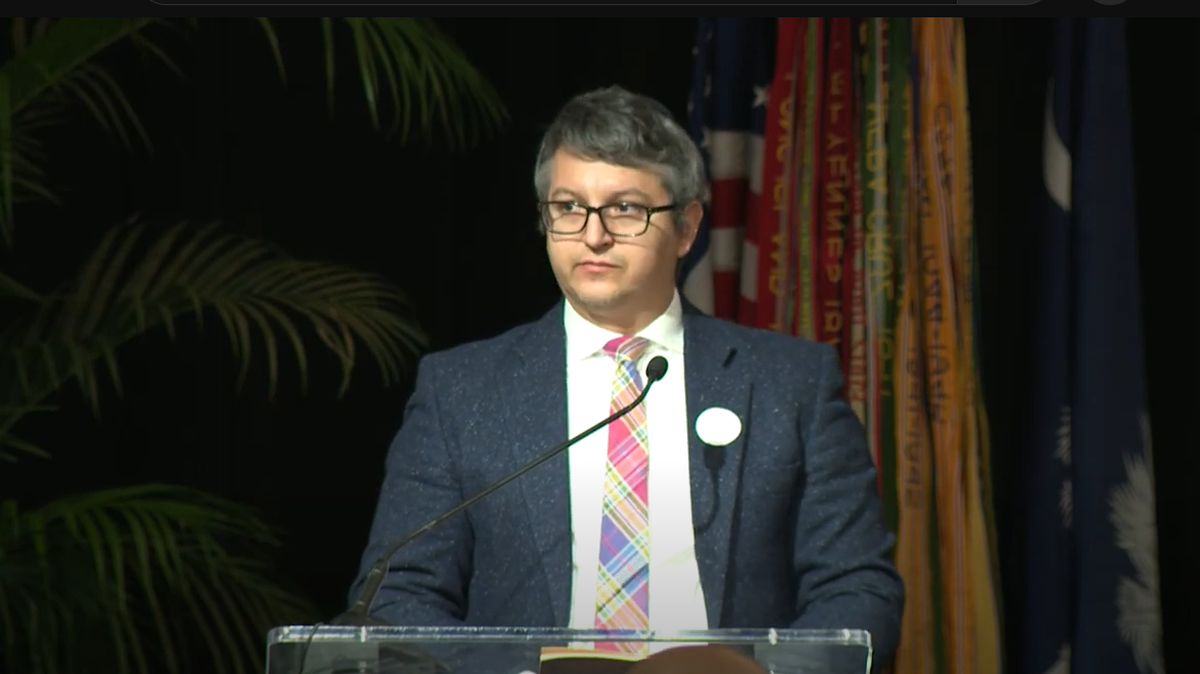
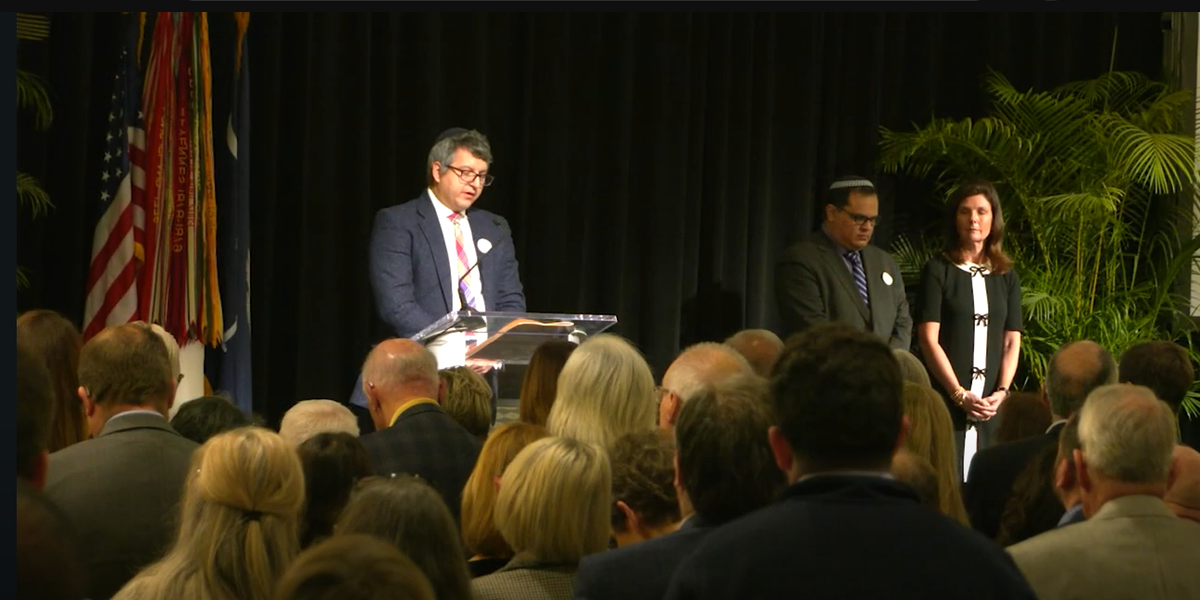
Rabbi Sam Rose of Greenville stood at a podium to deliver a benediction on Jan. 27, Holocaust Remembrance Day.
The prayer closed a service commemorating the 80th anniversary of the liberation of Auschwitz, the concentration camp where over 1.1 million Jews, Romani, Poles, gay men, Jehovah’s Witnesses and prisoners of war were killed. While Rose anticipated his words would be noticed, he didn’t expect the national controversy they’ve generated.
“Holy One, give us the strength to be upstanders in the face of injustice,” he told the crowd of more than 500 people at the Pastides Alumni Center at the University of South Carolina. Among them, seated in the front rows, were the keynote speaker, NBC host Chuck Todd, Gov. Henry McMaster and state Superintendent of Education Ellen Weaver.
“When refugees are turned away, may we open doors,” Rose continued. “When LGBTQ individuals are targeted, may we shield them with love. When immigrants are cast aside, may we embrace them as the Torah commands us 37 times, love the stranger in your midst, as you love yourself.”
His remarks led to a standing ovation from much of the crowd. But not from some in the front rows where McMaster remained seated, as did Weaver.
Almost immediately, the livestream of the event was taken down from online, and when the recording of the event was posted online by SCETV, the state’s public television network, Rose’s injustice comments were deleted at the request of the event’s organizer, the South Carolina Council on the Holocaust.
The decision has caused confusion and hurt among some, with Facebook commenters criticizing ETV’s decision as “shameful,” “tonedeaf” and “hypocritical.” Rose’s remarks, and the backlash, follow criticism by President Trump and his supporters of Mariann Budde, the Episcopal bishop for Washington, D.C., who in an inauguration day service asked the president to “have mercy” on immigrants and LGBTQ children.
ETV has distanced itself from the decision to end the recording after Rose delivered the mourners kaddish, a prayer for the dead, and before his benediction. The broadcaster clarified in a statement and through a spokesperson that the agency was only hired to livestream and record the event. The decision to cut Rose’s remarks came from the Council on the Holocaust, said Landon Masters, the broadcaster’s spokesperson.
“As a public media entity, we do not engage in any form of censorship with our content. Following the event, it was requested the program be archived in a way that best aligns with the Council’s goals for future accessibility and educational use,” read a statement issued by the broadcaster.
Dr. Lilly Filler, the chair of the council’s executive committee, defended the organization’s decision to cut Rose’s remarks from the video. Filler, whose parents were Holocaust survivors, was appointed to the council by the Speaker of the House of Representatives.
“I’m sitting next to the governor, and after a very beautiful Kaddish, he (Rose) starts to talk about present day, current day politics, and I almost became breathless,” Filler said in an interview with The State. “It was certainly an embarrassment to me, as the chair. I can only imagine what it was to the governor, to the lieutenant governor, to the superintendent of education. We are an apolitical council.”
In an interview with local media after the event, McMaster said that he and Lt. Gov. Pamela Evette “respectfully disagree very much” with Rose’s benediction. The governor, who is a prominent and early supporter of President Trump, said that the benediction appeared to criticize Trump’s actions, which McMaster defended as “the proper actions.”
Rose’s benediction was unapproved and premeditated, Filler said. He did not show his remarks to anyone before the event, which Filler said she had clearly described to him as a memorial to the victims of the Holocaust and the soldiers who liberated the camps.
“The subject of our commemoration was memory. It was not politics. It was not political activism. It was not policies of the current administration. It was remembrance,” Filler said.
Had he told her what he was planning to speak about, Filler said that she would not have let him give the benediction. Instead, Filler said she would have invited him to a different venue, like a conference where attendees could have been involved in a discussion about his remarks.
“He decided to transgress and to go elsewhere and to me, that’s taking advantage of the situation,” said Filler. “I felt like it had to be edited such that it doesn’t destroy what the entire event was. We had 88 minutes of a fabulous event. The last minute and a half was hijacked, and that, to me, is not censorship. It’s the ability to maintain what the purpose of the event was.”
Established in 1989, the council works with the state Department of Education to create educational “programming to prevent future atrocities similar to the systematic program of genocide of six million Jews and others by the Nazis,” according to the state legislative manual.
On its website, the organization describes one of its core values as promoting a society free of prejudice and discrimination.
The council receives its funding from the state budget. The governor, House speaker and Senate president each appoint four of the council’s 12 board members. A spokesperson for McMaster said that the neither the governor nor his office had any involvement in the decision to cut the video.
Not everyone on the council share’s Filler’s perspective. One member of the council, Furman University Professor Melinda Menzer, who attends Rose’s synagogue, has resigned.
Menzer said that she was proud to have been a member of the council and was “heartbroken” when she learned of the decision to remove Rose’s remarks.
“I’m just amazed; there is nothing political about applying the lessons of the Holocaust to today,” said Menzer, a descendant of Holocaust survivors. “I am amazed that a religious leader’s comments, spoken eloquently and powerfully, were interpreted as a political statement by one person who then removed his statement on behalf of the council.”
Amidst this apparent dissent, the council has called an emergency meeting for Wednesday, according to several sources.
Leah Chase, a former member of the council, said that she was “embarrassed and ashamed” of the decision to cut Rose’s remarks.
“The whole country is talking about immigration and refugees and USAID being closed down. We cannot just shut our eyes and ears to what’s going down. I’m very pleased with the work the council has done but this was not a good decision.”
What did Rose say?
For his part, Rose said that while he was prepared for a response, he was surprised and overwhelmed by the attention, both positive and negative, to his remarks.
The deletion of the video has been reported in Israel and in the Jewish press in America.
“I didn’t know that it was going to become blown to the proportions that it has been,” Rose told The State. From the start, Rose knew that what he planned to say would cause a stir, and he assumed that if he shared his remarks in advance he would have been censored.
There has been an outpouring of support from his congregation at the Temple Israel in Greenville, and from supporters around the country, including scholars of the Holocaust, Rose said.
Rose, a rabbi in the Reform movement, said he rejects the idea that a Holocaust remembrance should or can be apolitical. He felt an obligation to give a voice to communities who have been pushed to the margins, demonized and scapegoated, much as Jews were in the lead-up to the Holocaust.
He believes that thirty seconds of challenging an administration’s policies were not out of place in a six-minute benediction.
“The rest of my benediction was about appreciating the dignity of difference. People have a right to dignity. But that’s too political?”
Rose said he worries that Holocaust memorials can foster a false sense that enough has been done to stand up against antisemitism and other forms of discrimination.
“You can kind of check off on your list that you’ve done something to combat bigotry in the world by saying you’ve participated in the Holocaust event.”
This story was originally published February 5, 2025 at 3:41 PM.