
SC chief justice John Kittredge sounds caution on perils of extreme gerrymandering
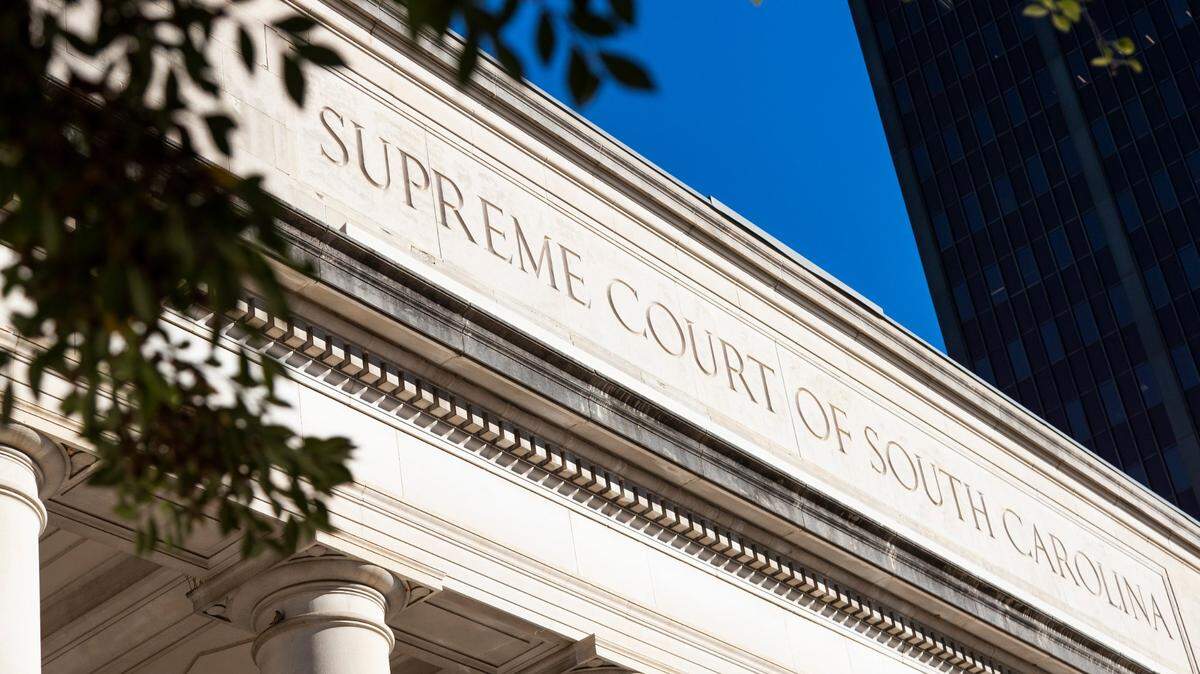
South Carolina Supreme Court Chief Justice John Kittredge warned Wednesday about the perils of extreme gerrymandering that could allow one dominant party to choose all of a state’s Congressional representatives and ride roughshod over voters in the minority party by denying them representation in the U.S. House of Representatives.
Kittredge made his observations in a concurring, or supporting, opinion in a unanimous 5-0 high court decision on redistricting made public Wednesday.
The case was called League of Women Voters of South Carolina vs. Thomas Alexander, president of the S.C. Senate; Murrell Smith, House speaker; and Howard Knapp, director of the State Election Commission. Gov. Henry McMaster intervened on the side of the lawmakers.
The decision rejected an effort by the League of Women Voters of South Carolina to challenge South Carolina’s legislatively-drawn maps of Congressional voting districts as being too gerrymandered, or too overtly partisan, in their granting Republicans voting majorities in six out of seven Congressional districts.
The maps in question in the decision were drawn after the 2020 Censusand approved in 2022 in the majority Republican S.C. House and Senate. The districts favoring Republicans ensure that Democrats only have 14% of the Congressional seats, or one out of the state’s seven seats. However, in statewide elections for posts such as president or governor, Democrats in South Carolina usually draw around 40-44% of the vote.
In his concurring opinon, Kittredge took note of national trends where some legislatures dominated by one party or another are drawing voting districts that heavily favor the majority party.
“We are seeing — and will continue to see — state legislatures race to further minimize and perhaps erase the representation of the state’s minority political party in Congress,” Kittredge wrote.
“These results may, indeed, be in line with each respective state’s constitution and laws, but they collectively have the effect of diminishing our constitutional republic as a whole. This is a troubling prospect for those who adhere to our nation’s founding principle that the People are sovereign,” Kittredge wrote.
Kittredge also noted, in a footnote, that the S.C. General Assembly had not entirely cut out Democratic representation in the U.S. House of Representatives.
“To its credit, the South Carolina legislature has drawn our congressional district lines to virtually ensure the current minority political party has representation in Congress, unlike some other states,” Kittredge wrote.
Kittredge also wrote he “had no hesitation” in agreeing with the “well-reasoned” main opinion rebuffing the League of Women Voters’ efforts, an opinion written by Associate Justice George “Buck” James.
But, Kittredge wrote, he did not see Wednesday’s decision “as creating a categorical rule that all future claims of excessive partisan gerrymandering are beyond judicial review.
“I construe today’s decision as cautious judicial deference, not indifference. It remains conceivable that a future challenge may present more fully developed constitutional violations with a discernable nexus to manageable judicial standards, thereby warranting judicial intervention,” Kittredge wrote.
James’ opinion cited landmark U.S. Supreme Court decisions in 2019 and 2024 that basically gave the green light to partisan gerrymandering by saying the matter should remain in the arena of the legislature.
“As far as the Federal Constitution is concerned, a legislature may pursue partisan ends when it engages in redistricting,” James wrote, quoting one Supreme Court decision.
Partisan gerrymandering has been in the news lately.
In August, at the bidding of President Donald Trump, who wants Republicans to win more Congressional seats in the 2026 election to ensure the House remains in GOP hands, Republican-dominated Texas redrew lines in five districts to make it more likely that Republicans would win in those districts than Democrats. The matter is now in the courts.
Meanwhile, to counter Texas, majority Democratic California will vote on Nov. 4 whether to do away with its independent redistricting commission and allow partisan redistricting.
Ironically, all the partisan power struggles, polls show that some 80 percent of Americans favor having Congressional districts drawn by independent commissions rather than the dominant political party.
In his concurrence, Kittredge cited Federalist Paper No. 10, which celebrates diverse representation in a legislative body, saying that in a republic like ours, when “you take in a greater variety of parties and interests; you make it less probable that a majority of the whole will have a common motive to invade the rights of other citizens.”
Kittredge noted Wednesday’s decision and his concurring opinion, which was joined by Associate Justice David “Gary” Hill, might be controversial.
“Today’s decision will invariably attract praise and criticism from all corners of the political spectrum. To those on either side of the debate, I point to the constitutional bedrock of this nation: the sovereign power of the People to shape legislative outcomes through advocacy and the ballot box ... Our judicial constraint today in no way muffles the People’s voice in shaping the laws that govern us,” Kittredge wrote.
Reaction was swift after the decision came out.
Allen Chaney, legal director of the American Civil Liberties Union of South Caroliana, which represented the League of Women Voters, said, “Democracy relies on a careful balance of power between our three branches of government. By washing its hands of redistricting, the Court marks itself satisfied with the idea that politicians can game the system to retain their own power and ushers in an even greater entrenchment of political extremism.”
Alexander said, “our maps were meticulously crafted to comply with statutory and constitutional requirements, and today’s decision affirmed the hard work of South Carolina Senators.
“After years of litigation – only for the federal and state supreme courts to tell us what we knew all along – I am grateful to see this matter finally resolved.”
Senate Majority Leader Shane Massey, R-Edgefield, said, “When Republicans drew new maps just a few years ago, we worked hard to ensure that South Carolina’s districts reflected the politics of South Carolina’s voters ... If the ACLU and the League of Women Voters aren’t happy with the results at the ballot box, maybe they should ditch their far-left positions, like gender-transitions for children, and get in step with South Carolina values.”
Lynn Teague, vice president at the League of Women Voters, said, “Partisan gerrymandering is an attack on our most fundamental right as citizens, the right to vote. But the League of Women Voters of South Carolina will not stop fighting for fair redistricting. If a constitutional amendment is needed to protect voters, the people of South Carolina must demand that amendment.”
Reporter Joe Bustos contributed.
.
This story was originally published September 17, 2025 at 4:43 PM.