‘I’m not a sacrificial lamb.’ Jermaine Johnson launches his bid for SC governor
On one wall of state Rep. Jermaine Johnson’s home office are photos of him playing basketball at the College of Charleston.
On other walls are newspaper clippings, plaques and certificates. In the office are is palm cards he printed for his state House runs.
Now on Tuesday he will formally jump into a larger figurative arena, that will test how well he can make his name known across the Palmetto State.
His personal story and speaking ability may be keys to helping the Democratic Party down ballot and giving its supporters and voters a reason to be excited during the 2026 cycle.
Johnson kicked off his bid to be governor of South Carolina, making him the second Democrat to launch a campaign.
In seeking the office, Johnson is trying to pull off a feat that hasn’t been accomplished since 2006: Be a Democrat to win a statewide election in South Carolina.
“I absolutely do not view myself as a sacrificial lamb,” Johnson said in an exclusive interview with The State ahead of his campaign launch. “I’m running to win, and when we do win, we’re going to get the priorities right in this state.”
Johnson, 40 of Richland County, has been elected to the state House three times. He’s had passionate floor speeches catch attention outside the state, and he received some of the loudest cheers at this year’s S.C. Democratic Party Convention when he announced his exploratory committee.
Whoever wins the Democratic nominations for governor and U.S. Senate will be charged with trying to energize the party across the state and harness anti-Trump sentiment seen during the No Kings protests and turn both into votes at the ballot box.
“This state has never seen a candidate like myself run for statewide office, in terms of for the governor position. And I’m something different. I’m somebody who’s just unapologetic about leading. I’m unapologetic about speaking out,” Johnson said. “Using my ability to communicate across the different aisles, the different political ideologies, I think that’s the way we can channel the energy.”
Even before thinking about the general election, Johnson needs to win the nomination for governor and will have to beat Charleston attorney Mullins McLeod. It’s a daunting task because McLeod has put more than $1.3 million of his own money into the campaign giving it an ability to be on television with his message.
“I’m not concerned about what anybody else is doing,” Johnson said. “I’ve heard from a lot of elected officials in the state, state House or in the Senate. I’ve heard from county council (members), heard from coroners, town councils, mayors and all of them that I’ve talked to have said, ‘Jermaine, we’re behind you. We’re with you on this one.’ ”
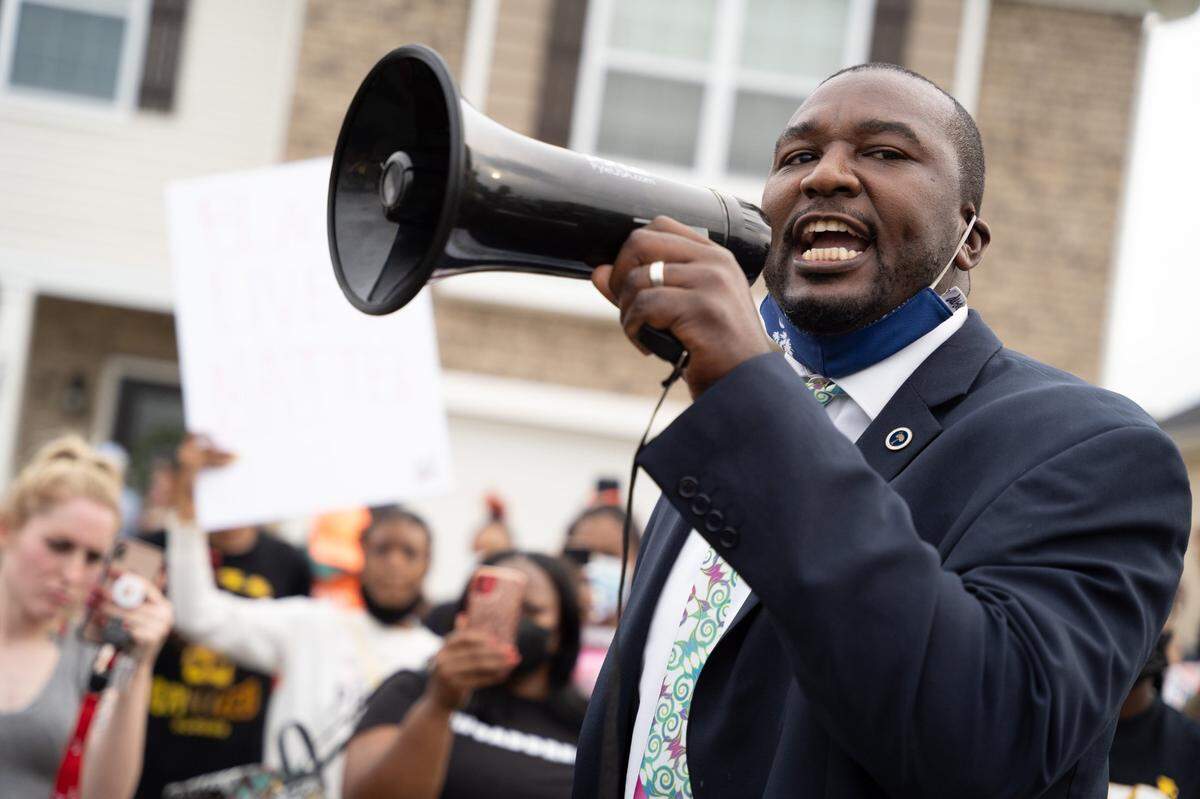
He’ll also have to convince Democratic voters to deviate from nominating a white man for governor, such as former state Sen. Tommy Moore, Camden Mayor and former state Sen. Vincent Sheheen, former state Rep. James Smith and former U.S. Rep. Joe Cunningham, who were the last four Democratic nominees for governor.
Growing up, Johnson experienced homelessness, lost a brother to gun violence, lost another brother in a car crash and attended seven high schools.
“I’m Jermaine Johnson. And Jermaine Johnson is a different guy. He’s a different type of Democrat,” Johnson said. “I understand what it’s like to be the least of these. And because I understand what it’s like to be the least of these, that that means I’m going to leave from a place of compassion, a place of love, a place of understanding, and an individual who’s not going to see race, color, gender, ideology, any of that type of stuff. I’m going to see the struggles of the people of South Carolina.”
State Rep. Justin Bamberg, D-Bamberg, who is Johnson’s colleague in the state House, said Johnson is an authentic personality and there will be no doubt about what he believes in.
“There are far too many people who are willing to lie to the public for political wins, there are far too many people who shape-shift like a thing in order to try to trick people into liking them. And we do need real people running,” Bamberg said. “One thing about Jermaine running is he’s a real guy. Yeah, like he is who he says he is. He stands for what he’s what he says he stands for.”
Still, a Democrat winning a statewide election is unlikely where Republicans hold supermajorities in both chambers, six out of the seven seats in Congress, both U.S. Senate seats and won all the constitutional officer positions in 2022. But Democrats can’t afford to just concede races.
“It’s important to the people of South Carolina to have good choices in an election. And if you just say, ‘Well, it’s an uphill battle, so I’m not going to do it.’ That doesn’t demonstrate much affection or concern for the people of South Carolina,” said former SC Democratic Party Chairwoman Carol Fowler.
If coupled with a strong U.S. Senate nominee at the top of the ticket, the Democratic hopefuls can energize the voting base and potentially help down ballot and flip some state House seats and other partisan positions on the 2026 ballot. Former South Carolina Democratic Party Chairman Trav Robertson said the candidates in the highest profile races will have to work together.
Both Johnson and Annie Andrews, the leading candidate for the Democratic nomination for U.S. Senate in 2026, already share two senior advisors: Scott Harriford and Renee Harvey, who are both South Carolina political strategists.
“I think that when you have a group of candidates that have a dynamic and a relationship, then that is a significant opportunity,” Robertson said. “The question is, does Jermaine pull the money so that he can put his personality and his gravitas, but most importantly, the magnificent narrative of his life story, in front of voters and conversely, does the candidate for the United States Senate raise enough money that they can put together a significant field program coupled with the governor’s candidate, and lift all those boats.”
Running a campaign that may be destined not to win the governor’s office could still have some positive benefits, whether it be for the candidate or the party.
In 2020 Adair Ford Boroughs ran for Congress against U.S. Rep. Joe Wilson in a race that was an uphill battle for her. She lost by 13 points. Jaime Harrison took on the task of running against U.S. Sen. Lindsey Graham. He lost by 10 points in a race that at the time was the most expensive U.S. Senate race in history.
But Joe Biden won the 2020 presidential election, and Boroughs and Harrison found themselves in new roles during Biden’s administration. Boroughs was appointed U.S. Attorney for South Carolina. Harrison became chairman of the Democratic National Committee.
“The story in all of that is they gave it everything they had, and they were rewarded for being the good stewards of resources, people’s belief in them, as well as the trust of the voters, and I think at the end of the day that’s what it’s all about,” said Antjuan Seawright, a Democratic strategist in South Carolina.
Seawright added that he hoped other jobs down the line aren’t on the mind of those seeking office in an uphill race.
“I would hope that they want to serve our state and our community and in a way they have not had the opportunity to do before,” Seawright said.
Also, those who run and are able to generate lots of media attention can bring to the forefront issues important to the Democratic Party and its supporters and voters.
“Say, you run a great campaign, whether you’re a Republican or a Democrat, at the end of the campaign, if you don’t win, you have increased the respect that people have for you.,” Fowler said. “The more people think of you and respect you, whether you’re a candidate or not, the more capacity you have to accomplish things.”
For Johnson, he says his pay-off if he doesn’t win is being an inspiration for the younger people who have come so far to see him speak.
“I quote Dr. King a lot where he says, ‘I’ve been to the mountain top. I’ve looked over and I’ve seen the promised land,’” Johnson said. “I may not get there to (the) promise land, but the people of South Carolina will get to the promised land, and one of those children who have come to see me or listen to me speak, that person might be governor one day, just because I had the courage to stand up and attempt to represent the people of South Carolina the way that I’m doing.”
This story was originally published October 28, 2025 at 5:00 AM.