
SC Democrats want to break GOP supermajority in House. Can they swing 6 seats?
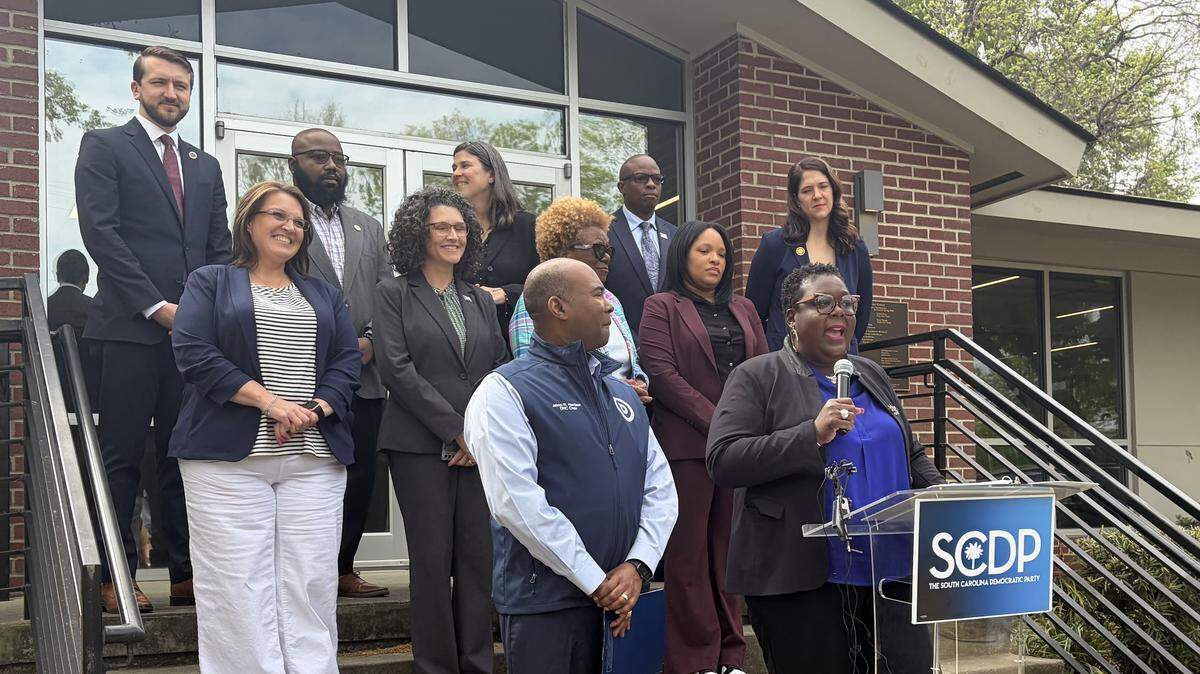
With Democratic candidates competing in every South Carolina House race this year, the state party hopes to win 42 of the 124 seats to break the Republican parties’ supermajority. But political scientists say it will be challenging for the minority party to gain at least six seats.
In a state where politics are dominated by Republicans, the South Carolina Democratic Party spent months trying to recruit someone to run for every state House seat. By the March filing deadline, the party had a candidate running for every seat, even in deep red districts.
“That’s not just a milestone, that’s a message,” said SCDP chair Christale Spain during a March 31 press conference. “A message that Democrats in South Carolina are no longer sitting on the sidelines.”
The party’s goal for this year: Break up the GOP’s House supermajority to gain more power in the lower chamber.
When the party sticks together, its supermajority allows Republican lawmakers to pass virtually any policy. In 2024, South Carolina voters elected a supermajority in both the House and Senate.
To break up the powerful GOP’s two-thirds supermajority in the House, Democratic candidates will need to flip at least six seats and not lose any races they won in 2024. They’ll also need to beat incumbent state Rep. Lucas Atkinson, D-Marion, who opted to run as a Republican instead in 2026, or win a seventh seat.
It’s unlikely Democrats pick up enough seats to crack the supermajority this year, said Drew Kurlowski, an associate professor of political science at Coastal Carolina. While national politics are favorable to the minority party in 2026, he still doesn’t see South Carolina Democrats being able to meet the threshold.
“It’s an uphill battle,” Kurlowski said. “I mean, there are maybe enough seats there that are close so that it’s not impossible.”
“If there were ever conditions favorable in South Carolina for Democrats to have a good year, that’s this year,” Kurlowski continued. But winning at least six House seats in South Carolina will be challenging, he said.
In addition to flipping seats, they’ll also have to defend swing districts from Republicans, Kurlowski said. And while several Republican-held House districts could be a tight race, Democratic lawmakers in the lower chamber also live in swing districts.
While the party initially touted a full slate of candidates when filing closed, the sole Democratic candidate in a potentially swing district dropped out April 3. Three Democratic candidates decided to run after filing reopened.
More GOP candidates filed this year than Democrats for all elections, according to a news release from the state Republican Party. It points to voters aligning with conservative principles, the news release said.
“The reason for that is the same as why so many people are leaving the Democrats behind: Because the Republican Party represents the vast majority of voters in South Carolina and our shared conservative values,” state Republican Party chairman Drew McKissick said in the release.

Which seats do the Democratic Party want to flip?
Many districts in South Carolina are drawn to favor either Democratic or Republican candidates, so there are few districts considered to be up in the air, Kurlowski said.
In 2024, more than half of House districts didn’t have two major party candidates on the ballot. Just over 20 races were within 20 points of each other in 2024, and the winning candidate likely received more than 60% of the vote.
The state Democratic Party will target districts Republicans flipped in recent years, executive director Jay Parmley said.
After state House districts were redrawn ahead of the 2022 election, the party lost seats now held by four Republican lawmakers:
- Daniel Gibson, R-Greenwood
- Fawn Pedalino, R-Clarendon
- James Teeple, R-Charleston
- Bill Hager, R-Hampton
Democratic incumbent state Rep. Joe Jefferson also lost his Berkeley County seat to state Rep. Harriet Holman, R-Dorchester, by a less than four point margin, or 800 votes, in 2024.
Those seats, which were flipped in 2022 and 2024, will be targeted by the Democratic Party this year.
While Democratic candidates lost seats previously, Parmley said discontent with President Donald Trump’s administration and affordability challenges makes the 2026 elections different.
“We really felt strongly that the political climate is such that we should give everybody a choice to vote at the state House level,” Parmley said. “Every single South Carolinian should see a Democratic name on their ballot.”
Less obvious, up-for-grabs districts in counties like Charleston, Greenville and Beaufort will also be targeted, Parmley said in an interview with The State. Districts there are growing and changing, giving some candidates a path to victory, he said.
Affordability issues, controversial national politics and a growing population with potentially shifting demographics could help the Democratic Party in South Carolina this year, said Shannon Bridgmon, a political science instructor at the University of South Carolina. Her research specializes in Southern politics. It likely won’t be enough to help them flip six seats, but they do have favorable conditions to succeed, she said.
“You’ve got a recipe for success,” Bridgmon said. “So if they can’t make it work, it’s going to be hard for them moving into 2028.”
The Democratic Party is also gunning for Atkinson’s seat. Neither him nor challenger Cynthia Ford have primary challengers, so they’ll face off for the seat held by Atkinson since 2017.
“We will rain down on his head as much as humanly possible,” Parmley said.
Building up the state party
While flipping at least six seats may be a tall order this year for Democratic candidates, the recruitment effort is an indication of growing strength of the state party, Kurlowski and Bridgmon said.
In 2024, just under half of all House races did not have a Democratic candidate on the ballot. This year, the party has candidates in nearly every race.
The political climate is also different this year from 2024, Democratic Party leaders and the political scientists pointed out. National politics, including the war in Iran and elevated prices, could impact some local races.
While Republican candidates aren’t running in every district, additional competitive elections are a good sign for democracy to keep both sides in check, Bridgmon said.
“You can’t win if you don’t compete,” Bridgmon said. “So the fact that Democrats have managed to recruit candidates in every race is a wonderful first step towards competition between the parties.”
This story was originally published April 8, 2026 at 5:00 AM.