
Veteran educators vie for Democratic nomination in SC superintendent’s race
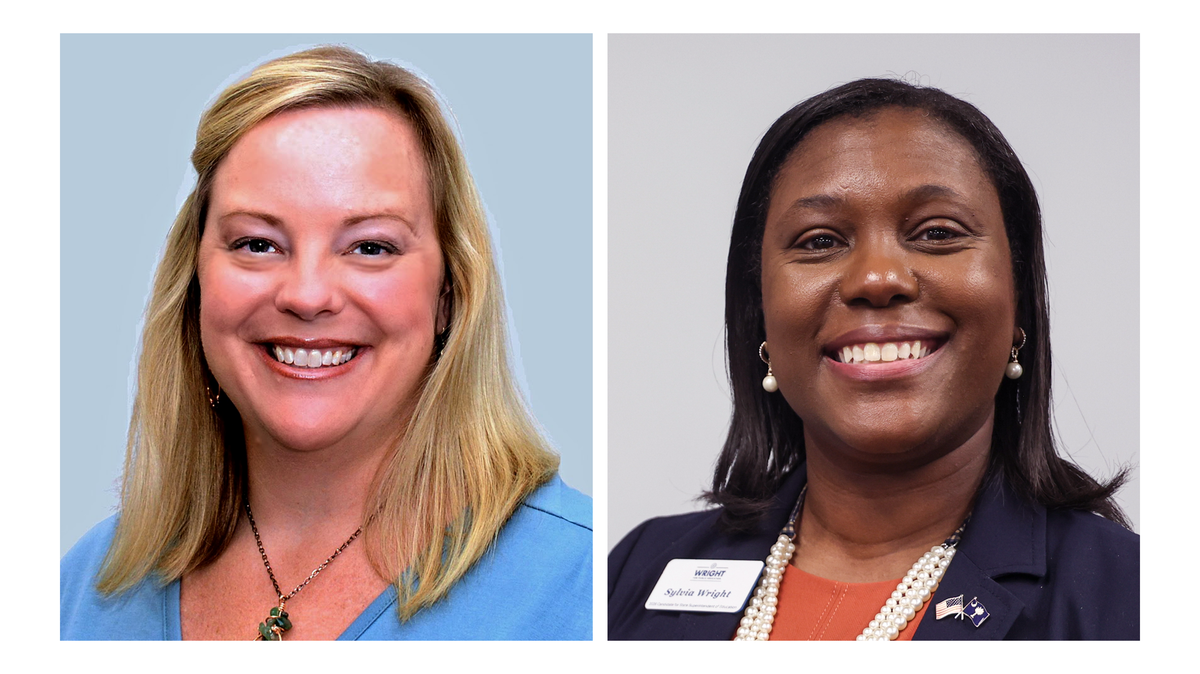
When Democratic voters head to the polls Tuesday, they’ll have a choice between two veteran female educators for state superintendent.
SC for Ed founder Lisa Ellis, who won the party’s nomination four years ago, is back on the ballot against first-time candidate Sylvia Wright, a former teacher and district curriculum coordinator who has been campaigning since 2024.
The victor will square off with Republican incumbent Ellen Weaver, who drew no challengers within her own party and will be a heavy favorite to win reelection come November.
In interviews with The State Media Co. earlier this year, Ellis and Wright both expressed distaste for what they perceived as Weaver’s politicization of the office and said their experience in schools gave them a better handle than the Republican on how to address the state’s education issues.
Ellis, who campaigns on nights and weekends while working full time as student activities director at Blythewood High School in Richland School District 2, said she decided to run again at the urging of some political consultant friends who told her they believed she had a real shot at winning this time. (Ellis lost to Weaver by nearly 13 points in 2022).
“It had nothing to do with Sylvia Wright,” Ellis said of her decision to get into the race last September. “It had to do with me and my own push to be a voice for teachers and students in this state at a level where they have to listen to me.”
The teacher advocate, whose SC for Ed organization rallied thousands of educators at the State House in 2019, emphasized her continued connection to the classroom as a differentiator from Wright.
“I feel like everything that has happened since Ellen Weaver has been superintendent of education has had a negative outcome on our students, our teachers, our public schools,” Ellis told The State. “And again, just being in the trenches, I’ve seen how to fix that.”
Unlike Wright, who quit her district office job last year to focus on campaigning, Ellis said her daily interactions with students, teachers and school administrators continue to provide her valuable insights that inform how she’d serve in the role of state schools chief.
“I’m still in the classroom,” she said. “I still see everyday things that are happening that I’m like, well, here’s how you make that better immediately.”
Wright, a North Charleston native who has taught in multiple states and most recently served as district coordinator for secondary education in Dorchester School District 4, said she was inspired to run for state superintendent while researching private preschools for her young grandson.
The experience instilled in her a “deep conviction” that all young children across the state deserved equal access to early learning opportunities, she said.
“I sat back in my chair and I said, ‘OK, Lord. What would you have me to do?’ ” Wright told The State. “And that’s when superintendent came to my mind.”
The career educator said she’d never previously pondered the statewide elected office, but that after looking into the requirements realized she had all the qualifications and experience necessary for the job.
“I was like, this is stuff that I’ve already done as a leader,” Wright said. “Building the relationships; managing funds; managing people, departments; building capacity in others; using data to move things forward. That’s what I’ve been doing my whole career.”
Wright said while she respects Ellis as a fellow educator, she believes her leadership experience gives her a leg up on her primary competitor.
“We’ve been so low for so long,” she said. “South Carolina needs someone in the superintendent role who actually has worked in every level of the system, who has built relationships, who knows how to use data to move things forward.”
What would Wright do as SC schools chief?
Wright’s No. 1 priority — the reason she quit her job and began withdrawing early from her retirement — is to bolster early childhood education.
“That’s been neglected for so long,” she said. “We need to do a better job or be more intentional and strategic about how we use that money.”
Her goal is to ensure that every 4-year-old in South Carolina, regardless of income, has access to a Pre-K program.
“Universal Pre-K,” Wright said. “Because that’s the foundation.”
Her other priorities, if elected state superintendent, are school safety and educator recruitment and retention.
By school safety, Wright clarified, she doesn’t just mean protecting kids from armed intruders.
She also wants to address the health and safety hazards posed by deteriorating school buildings; the disciplinary issues exacerbated by overcrowded classrooms; and the mental health strain students experience from unchecked bullying.
“We’ve got to do a better job with meeting the needs of the students,” said Wright, who upon taking office wants to convene an advisory council to comprehensively audit school safety and use the findings to develop policy solutions.
“Kids can’t learn if they don’t feel safe,” she said.
The last pillar of Wright’s platform deals with growing South Carolina’s educator base.
Her plan involves using tuition scholarships to financially incentivize local high school students to become teachers; increasing starting salaries up to $60,000; and improving working conditions by reducing paperwork requirements that drive some teachers out of the classroom.
What would Ellis do if elected state superintendent?
Ellis is big on taking better care of public school employees — from teachers and school administrators to bus drivers and cafeteria workers.
“I’ve said for years that a teacher’s working conditions are a student’s learning conditions,” she told The State. “And so, we’ve really got to take care of those people that are interacting with our students every day.”
A significant part of creating a better work environment is eliminating requirements that make busy work for teachers and detract from their ability to focus on more important tasks, such as educating students, Ellis said.
“There’s so many things that we’re like, ‘Well, we have to do that to check this box,’ ” she said. “But it makes no sense in 2026.”
Ellis said the state must also do more to take into consideration the needs of students.
In addition to reducing the frequency of standardized testing and decreasing class sizes, she stressed the importance of studying the negative effects of student technology use and prioritizing student self-regulation to get at the root of increased behavioral problems.
In Ellis’ estimation, the systems currently in place are failing both teachers and students, and she wants to begin peeling away at those systems to get back to what is important for South Carolina students.
“We’ve been Band-Aiding public education in South Carolina for decades,” she said. “It’s not working. So we’ve got to go back and look at the system, and fix the system.”