
Incumbent SC Supreme Court justice Few withdraws from race. What happens now?
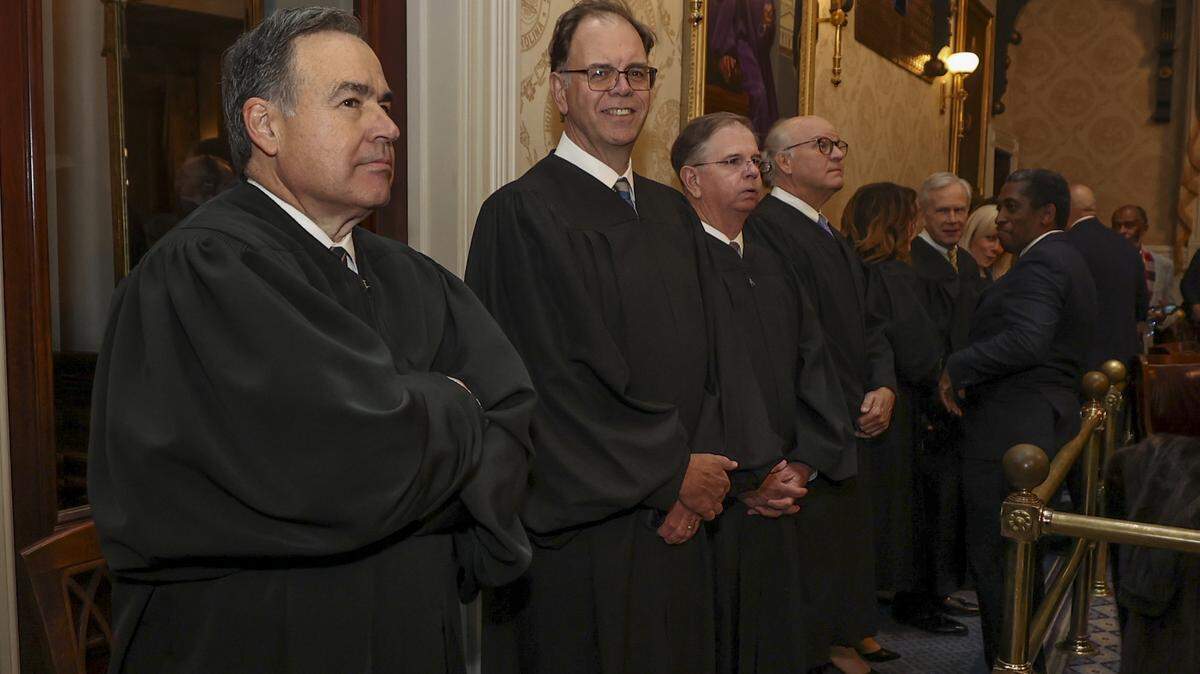
Incumbent SC Supreme Court associate justice John Cannon Few, facing a tough challenge from a longtime politician with scant judicial experience but strong ties in the conservative General Assembly, has withdrawn from the race.
Few’s withdrawal came a little more than 24 hours before Wednesday’s scheduled Supreme Court election in a joint session of the Legislature. It was apparent to most that Few would have been defeated in any vote involving the 170 lawmakers, who under state law choose judges and justices.
Few’s withdrawal denies former House Speaker Jay Lucas, now in private practice as a lawyer, the prize of a prestigious seat on the Supreme Court when the former speaker was on the verge of capturing it.
That’s because instead of the Supreme Court justice election going forward, it will now be canceled.
Under state law, when an incumbent judge drops out of the race, the lengthy process of qualifying candidates for the post and selecting a new judge must begin anew, according to the Judicial Merit Selection Commission, which screens judge and justice candidates for fitness for state judicial posts.
“The whole process of selecting people for that seat will be reopened, and new people can apply,” said Erin Crawford, Senate Legislative counsel. Crawford cited a state law, 2-19-80 (C) (2), governing withdrawals by incumbent judges.
Few announced his decision on his social media accounts on X, formerly known as Twitter, and also on Facebook, on Tuesday morning. Earlier, he had sent a letter with his withdrawal statement to the offices of the Judicial Merit Selection Commission, the body that oversees judicial candidates.
Lucas, Few’s main challenger, is a Darlington County Republican with numerous connections in the 124-member House, including close ties to current Speaker Murrell Smith, R-Sumter. Lucas was speaker from 2014-2022.
Lucas apparently had a sizable batch of pledged votes in the 124-member House. His support in the much smaller, 46-member Senate was believed to be nowhere near as strong.
To win a seat on the Supreme Court, a candidate would have to have a majority of the 170 lawmakers’ votes, or 86 votes. That means any candidate who could round up 86 votes in the House alone wouldn’t have to have a single vote from the Senate.
On Feb. 18 Senate Majority Leader Shane Massey, R-Edgefield, took to the Senate floor and excoriated Lucas for his lack of judicial experience, saying that putting him on the Supreme Court would “soil” the state’s judiciary.
“It looks like backroom deals are being made for someone who is not as qualified for or deserving of the position. It looks like the legislators are cooking the books,” Massey told his fellow senators.
Sen. Luke Rankin, R-Horry, chairman of the Senate Judiciary Committee and whose father was a judge, said in a public filing with the Judicial Merit Selection Commission that electing the judicially inexperienced Lucas to the Supreme Court would cause some to believe that Lucas’ ascension was “driven by legislative influence.”
Supporting Lucas in the House were leaders such as Speaker Smith and Ways and Means Committee chair Bruce Bannister.
“Jay Lucas is the most proven, conservative voice for the bench at a time when our state needs rock-solid constitutionalists who will uphold the rule of law,” Smith told The State recently.
Tuesday afternoon, Smith told The State, “I’m not disappointed. It’s the process. I thought Jay Lucas was the best candidate, and I would have liked to have seen him elected. But that is the way elections go. They always don’t turn out the way you want.”
Also running for Few’s seat were Court of Appeals Judge Blake Hewitt and Administrative Law Court Chief Judge Ralph King “Trip” Anderson III. No one questioned their qualifications.
An independent judiciary?
Few had reportedly angered religious conservatives in the General Assembly three years ago, when he authored a 3-2 majority opinion that ruled the state’s new strict abortion law was unconstitutional.
He reversed himself the next year after the Legislature tweaked the law, but right-to-life lawmakers didn’t forget his first opinion. Another factor was that Lucas had the support of Speaker Smith — and few lawmakers want to oppose the leader who wields great influence over committee assignments.
Few’s other purported transgression that upset lawmakers was joining a 5-0 unanimous opinion in November that said lawmakers could not vote themselves a pay raise in an ongoing legislative session.
Traditionally, and with few exceptions, people who win Supreme Court seats are those members of the judiciary who have a long track record as a judge in circuit court or the Court of Appeals.
The judicial branch of government is supposed to be independent of the legislative and executive branches, and it remains to be seen what effect Lucas — a creature of the legislature — would have on the state Supreme Court, should he win.
Few has a 26-year career as a jurist, with 10 years as a circuit court judge, six years as chief judge of the Court of Appeals and 10 years on the state Supreme Court.
Of the four candidates, Few had the most to lose. Because he is the second-ranking justice on the high court in terms of seniority, Few is next in line to succeed Chief Justice John Kittredge, 69, when Kittredge retires in a few years.
But Few’s withdrawal means that after 27 years rising through the judicial ranks, he is withdrawing from a race that, had he won, would have given him the crown jewel of South Carolina’s judiciary.
Following Few’s withdrawal, Sen. Josh Kimbrell, R-Spartanburg, called his dropping out “an act of patriotism ... the right thing in the 11th hour.”
Standing in the well of the Senate, Kimbrell said, “What Justice Few did today preserves the integrity of the Supreme Court and the legislature. It was the right call to make.”
Kimbrell went on to say that to elect a former speaker of the house to the state’s highest court “sends the wrong signal to the people of our state.”
Hopefully, Kimbrell said, the “reset” involved in filling Few’s now open seat will allow a new slate of candidates to surface.
Few’s statement on X and Facebook said, “It has become clear to me over recent weeks that I do not — and will not — have the votes to be reelected to the Supreme Court of South Carolina.
“It is customary in judicial elections for the candidate who cannot win to withdraw from the race.
“Earlier this morning I submitted my withdrawal letter to the Judicial Merit Selection Commission.
“I accept this reality with only positive thoughts and feelings about what the future holds. I take pride in everything I have done over my 26 years of judicial service, no regrets.
During the same time I have been coming to grips with the reality that I cannot win this race, my excitement over returning to the private sector has grown exponentially. There will be no soft landing for me, as I plan to return to the active practice of law with the same energy and enthusiasm that has defined my career as a judge and Justice.”
This is a breaking news story and will be updated.
This story was originally published March 3, 2026 at 11:50 AM.