
Black Lives Matter SC partners with Richland sheriff’s office. Both have critics
The partnership seems unlikely in 2020. Black Lives Matter South Carolina, whose members helped organize Columbia protests in May that escalated into violence beyond their control, and the Richland County Sheriff’s Department, accused by protesters of instigating some of the violence, agreeing to work together?
But it’s true. While the arrangement has its critics, both groups said they want to make it work. Not surprisingly, the arrangement started with some detective work.
Capt. Wendall Harris had to track down Lawrence Nathaniel’s phone number. Nathaniel, the founder of Black Lives Matter SC, and Harris were going to be on a panel about the protests that followed the killing of George Floyd while in police custody in Minneapolis.
As Nathaniel himself put it: “Everybody knows that Lawrence likes saying things he don’t need to be saying. He (Harris) wanted to call to make sure I wasn’t going to say anything I don’t need to be saying.”
That call got Nathaniel, a vocal critic of the current state of policing, and Richland County’s Sheriff Leon Lott into an office together.
The partnership emerged from that office meeting, according to Nathaniel.
Lott also met with BLM SC Director Kayin Jones, solidifying the partnership.
“After the riot in May I wanted to do whatever we could to make sure we didn’t have anything like that,” Lott said. “Instead of working against each other, why don’t we work together and do it in a peaceful way?”
A police and activist partnership may seem at odds when cries for defunding and reforming agencies echo through marches and protests. The partnership has critics among activists calling for such action. They call Black Lives Matter SC working with the sheriff’s department an unholy alliance meant to drowse the flames of a movement.
But both Lott and Black Lives Matter SC’s leadership believe working together will allow better lives in Black communities and better outcomes during interactions between Black people and police while adding transparency to the sheriff’s department.
Common goals
At 10 a.m. on Sept. 11, Sheriff Lott got an email from Nathaniel.
Nathaniel wrote about new ideas he wanted the sheriff’s department to be a part of and praised Lott for taking action against a deputy who assaulted a person in cuffs.
“Over the past week you have shown accountability and transparency among your officers [and] it shows the movement and understanding the sheriff department has in today’s current climate,” Nathaniel wrote.
“It shows you this is working,” Lott said about the email in an interview with The State.
How exactly does a partnership between the sheriff’s department and Black Lives Matter SC work?
Essentially, the police agency and the activist organization agree to communicate.
Nathaniel said Black Lives Matter SC will begin communicating with the sheriff’s department on three issues: analyzing use of force, responding to police shootings and reducing gun violence in communities disproportionately affected.
The activist organization wants to better understand the circumstances in which deputies use force, particularly against Black men, Nathaniel said. Working with the sheriff’s department makes getting reports on the those incidents simpler and allows Black Lives Matter SC’s leadership to call for the department to discipline or even fire a deputy if excessive force is used.
Black Lives Matter SC is creating a team to respond when deputies shoot someone. The members of the team will be trained to help and advocate for family members of the shooting victim, Nathaniel said. They want to know as soon as the sheriff’s department does about deputy shootings.
Like other groups, Black Lives Matter SC will be working with the sheriff’s department to try to reduce gun violence in areas like north Columbia, which, police say, has more violent crime than any area in Richland County, while community leaders strive for positive change.
“We don’t want another Knowledge Sims,” Nathaniel said, referring to a 7-year old killed in a north Columbia shooting.
Nathaniel described Black Lives Matter SC’s relationship with the sheriff’s department as a partnership that allows the activist group to better vocalize its critiques and for the police agency to better listen.
“Sheriff Lott and them know that we’re Black Lives Matters and we know that they are still the Richland County Sheriff’s Department,” Nathaniel said. “There’s still that line.”
Partnering with the sheriff’s department means the activist group has a seat at the table for police reform. Jones, the Black Lives Matter SC’s director, now sits on the department’s citizen advisory committee.
When seemingly opposing groups start talking, something unexpected tends to happen, Lott said.
“Everybody’s goals when you reach out to them are the same,” he said.
People want to feel like the police are protecting them and don’t want to feel discriminated against or scared of law enforcement. His department wants the same things, Lott said.
“The only way to accomplish that is you got to have some sort of communication,” he said.
But some activist groups believe partnering with police is the first step in keeping a broken status quo.
A ‘treacherous betrayal’
Jerome Bowers called Black Lives Matter SC partnering with the sheriff’s department a “treacherous betrayal” of black communities and the social justice movement.
“Our primary concern regarding the partnership of Black Lives Matter South Carolina and the Richland sheriff’s department is the inevitable compromise of the integrity of social justice efforts,” Bowers said.
Bowers is the chief executive of One Common Cause, an activist group that works to better lives in Black communities.
The sheriff’s department is infiltrating the current social justice movement through Black Lives Matter SC in order to destroy calls for major police reform and to squash future protests, according to Bowers.
“Richland County Sheriff’s Department is using Black Lives Matter SC to potentially shield itself from accountability,” he said.
A partnership with an activist group gives a police agency justification for having a heavier presence in Black communities that are already experiencing over-policing, according to John Tyler, One Common Cause’s chief operating officer. Getting a thumbs up from an activist group allows police to keep the status quo instead of evaluating the agency’s policies and training.
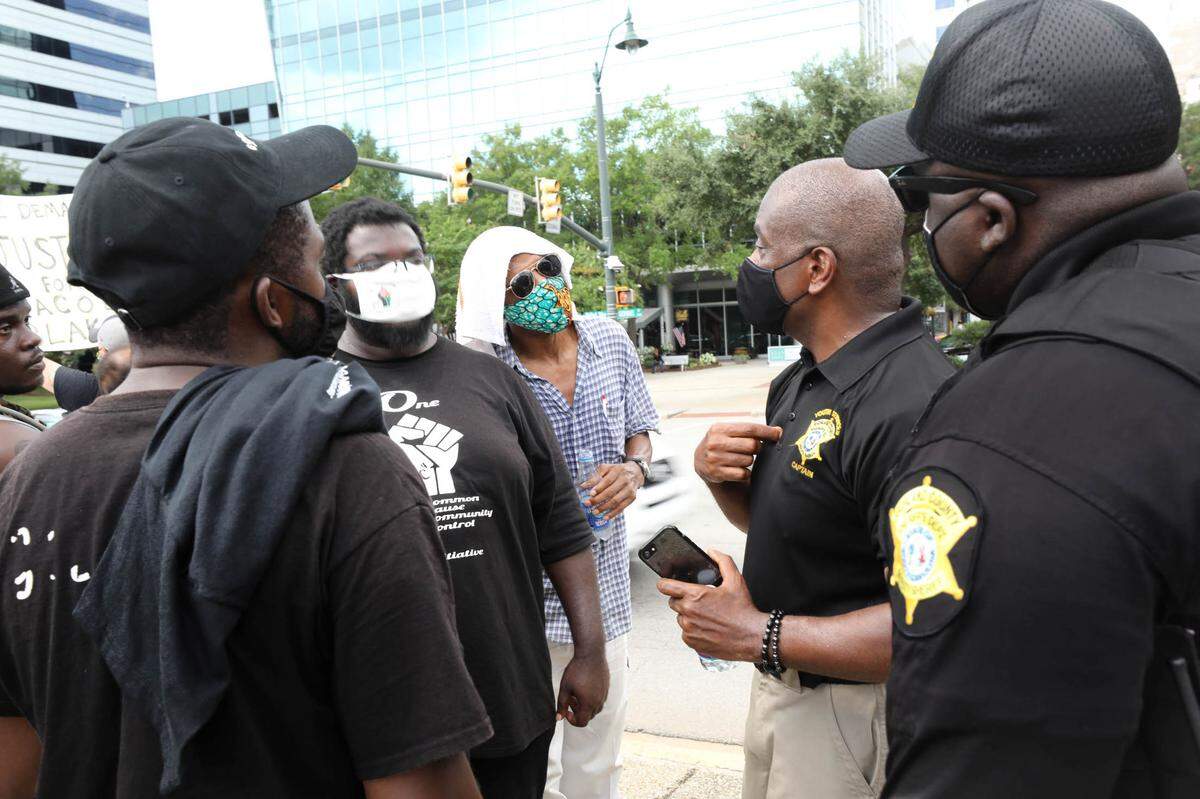
Police need more training on deescalating situations and dealing with mental health crises before they’re awarded the endorsement of activists, Tyler said.
New policies and training may mean “breaking down the system and rebuilding it from the ground up,” Tyler said.
One Common Cause isn’t calling for complete defunding or abolition of police. Its members recognize the necessity of police for security. The organization’s vision for the future is better trained and fewer police in Black communities.
“We’re not anti-police,” Bowers said. “We’re anti-corruption.”
Instead of more police, One Common Cause wants more investment and resources for Black communities to create economic growth and mobility. The group wants support in Black communities to undo the psychological effects of centuries of racism and to support the building of conflict resolution skills among Black community members.
“We’re confident these measures will effectively decrease crime and thereby decease the necessity for law enforcement’s presence in our community,” Bowers said.
The result would be less government spending on police agencies.
Beyond activist groups like One Common Cause, take a look on social media and its easy to find people and online groups wrongfully calling Black Lives Matter a “domestic terrorist” group and at the same time proclaiming they “Back the Blue.”
That puts Richland County Sheriff’s Department in an awkward spot.
Lott hears criticism from those who don’t believe his department should be partnering with Black activist organizations.
People point toward protests they see on television in Portland and other cities that escalated into property damage and arson. But what happens in other places has nothing to do with what Black Lives Matter SC is doing, Lott said.
The partnership has already proven effective.
Black Lives Matter SC announced their partnership with the sheriff’s department on Sept. 3, the day before a new round of protests and marches kicked off, and called for non-violence.
Unlike protests in late May, protests were peaceful.
“Someone has to be at the table in order to change the system,” Nathaniel said.
Defund becomes reform
At the Sept. 3 news conference by Black Lives Matter SC, Jones stood beside other activists and community leaders on the corner of Main and Gervais streets across from the State House. Another person with different credentials stood with them. Capt. Wendall Harris of the Richland County Sheriff’s Department was in his full uniform, his badge reflecting the sun.
Jones called the shooting of Jacob Blake by Kenosha, Wisconsin, police an attempted murder. Harris was reserved and kept his composure.
The reaction of Harris, who was appointed as liaison to activist groups, showed Nathaniel that Richland County Sheriff’s Department “was listening,” he said.
Because the department and the sheriff are listening, Black Lives Matter SC shifted away from calls for defunding the department to reforming.
The organization has more practical reasons for this change as well.
The sheriff’s department funnels millions of dollars to youth and crime prevention programs in Black communities, Nathaniel said. Black Lives Matter SC doesn’t want those funds taken away.
Maybe the most pragmatic reason of all for Black Lives Matter SC’s focus on reforming instead of defunding in Richland County is Lott’s popularity.
In the June Democratic primary, Lott won with nearly 75% of the vote. He’s nearing a quarter of a century of being Richland County’s sheriff. Lott is liked by a majority, though not all, of Black voters in Richland County, Nathaniel said.
If Black Lives Matter SC is going to make any dent in Richland County, it has to work with the reigning sheriff, Nathaniel said.
But that doesn’t mean the organization won’t call for defunding agencies in other counties.
As the group grows and its influence reaches outside the Columbia area, it will look into other police agencies and sheriff’s offices to make decisions on whether Black Lives Matter SC’s stance will be to defund or reform.
For now, the focus of Black Lives Matter SC remains partnering while analyzing Richland County Sheriff’s Department.
“We’re there to be that thorn in their side,” Nathaniel said.