
New cash crop being tested at Clemson Extension
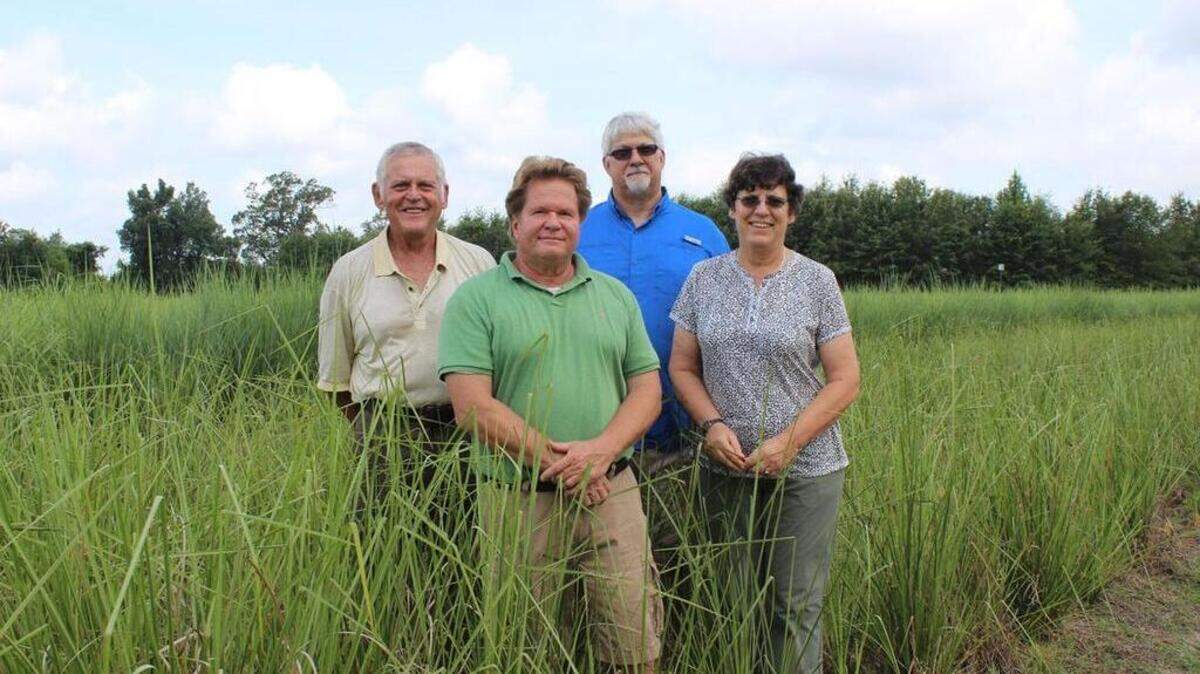
If all goes well, South Carolina could soon have another cash crop: vetiver grass. Through a partnership between the Clemson Extension, South African company Hydromulch and Environmental Solutions out of Summerville, South Carolina the grass was first planted at the Pee Dee Research and Education Center last year.
Vetiver originates in India but has been grown in many other parts of the world for hundreds of years. It has grown in the United States since the early 1900s but in very limited quantities in just a few areas. Now researchers are working to see if the crop can survive in the weather conditions in South Carolina as well as thriving through other factors, such as the sandy soil in many parts of the state.
Bruce Coy, with DCI Marketing Group, said the vetiver project at Clemson Extension grew out of a working relationship that he had with Roley Nöffke, of Hydromulch, who has been doing work with the crop for several decades.
“We originally met Roley in the equipment business,” Coy said. “We were over (in South Africa) visiting Roley and I probed the question many times why the vetiver grass is not here; we discovered that it is over here but in a small way. Roley is one of the experts in the world and has been using it for almost 30 years. We thought it would be interesting to investigate its value here for erosion control and bioremediation. What we’re really excited about, and why we are here (at the Clemson Extension), is because of its potential for biofuel.”
Nöffke said that he has seen research on other alternative fuel possibilities and wanted to see how vetiver might stack up against them.
“I’ve been in many, many countries … and I always saw the value of using vetiver grass. If it can succeed under the climatic conditions here it can be used as an alternative to the food source, which is corn, which is being used (for fuel). I know a lot of research has been done with miscanthus and switchgrass and I thought this would be a good opportunity to evaluate vetiver grass against the other types of grass that are available.”
Nöffke is quick to point out that unlike other foreign plants brought in -- think kudzu -- vetiver is a noninvasive plant.
“That is a very important thing,” Nöffke said. “You get the seeding types in West Africa and Central Africa that regenerate by seed but we don’t use that. The only way this propagates is by splitting the mother plant and replanting.”
Clemson professor James Frederick has been involved with the project and sees lots of potential for the plant if their testing goes well.
“A lot of our job at Clemson is to test these new products, new types of equipment, new plants and make sure that they do work in this area,” Frederick said. “Just because they work somewhere else doesn’t mean that they will do well here. We want to test them, rather than put them out on a farmer’s farm and find out they don’t work for whatever reason.”
Frederick said that he could see the possibility of a farmer or two testing the crop in small plots on their land in the next year; in two or three years, if the testing proves it to be a valuable investment, Clemson Extension agents will begin working with the Department of Commerce to find ways to market vetiver grass products.
“Farmers always want to experiment a little bit,” Frederick said. “One a bigger scale…when we see where the numbers of falling, we have to make connections with the industries that will use the end product, whether it’s the oils, the biofuel; you’ve got to have that market there.”
This story was originally published July 7, 2016 at 10:09 PM with the headline "New cash crop being tested at Clemson Extension."