
Young people are marching in the streets. Will they march to the polls in November?
Before the shooting in Parkland, Florida, Leesville Road High School sophomore Amber Mitchell was still trying to figure out her own views on politics by learning as much as she could from books, articles and the like.
But when 17 people were shot and killed at Marjory Stoneman Douglas High School — many of them about her age — she felt an emotional connection to politics for the first time. It’s what led her to help organize the March for Our Lives in Raleigh last weekend, which drew a crowd of thousands.
“I had the personal drive within me to go and get something done about it because I knew it could affect the people I care about,” Mitchell, 15, said. “When it comes to politics, I just feel like people feel so distanced from it because they feel like it might not directly affect their own lives, but when it came to Parkland, I just knew this was something that could affect my day-to-day life, because I go to school so often.”
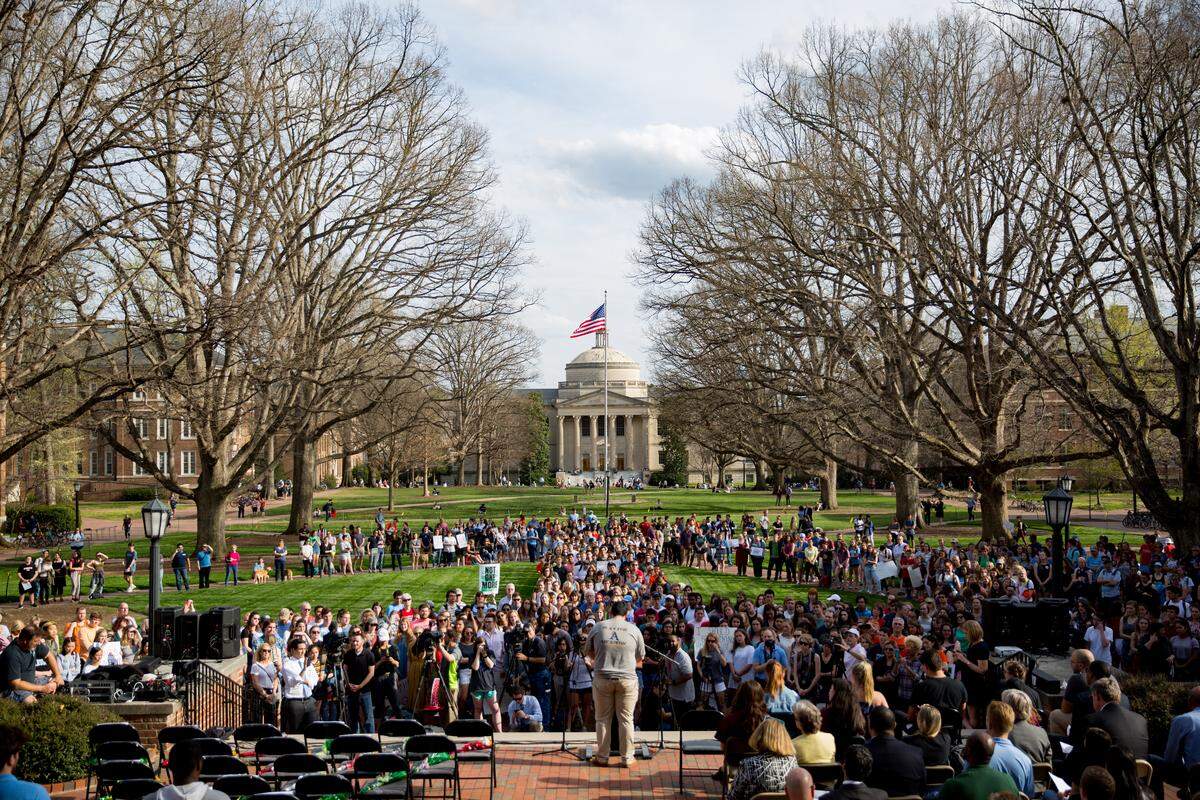
Across the country, students like Mitchell have walked out of their schools and marched, generally in support of gun control or other legislative changes. On Thursday evening, more were expected to show up for a Rally for Our Lives at UNC-Chapel Hill, which will feature several Parkland survivors.
But the movement’s real impact could be not just on the streets, but at the ballot boxes this November — if they can keep the momentum going.
Based on past elections, that’s uncertain. But this time, the students and activists standing alongside them say the conversation is different. It’s personal.
Overcoming low turnout
For their movement to have a political impact, leaders will have to motivate what has historically been a less active group of voters.
In 2016, 53 percent of those ages 18 to 25 voted in the general election in North Carolina, compared to 69 percent of the population overall.
But young people are a significant portion of what the nonpartisan Voter Participation Center calls “dropoff voters” — those who vote in a presidential election year, but not the midterms. The organization predicts that just over 1 million “drop-off voters” — which includes millennials, people of color and unmarried women — who turned out to vote in North Carolina in 2016 will not vote in 2018.
Just 18 percent of voters aged 18 to 25 voted in the 2014 midterms in North Carolina.
“It would make sense to look at that number and say, ‘oh, well they’re not turning out because they’re lazy, or they don’t care or because they’ve had such a good life that they don’t have to focus on politics,’” said Alexa Clymer, 18, a senior at Holly Springs High School who helped organize a walkout at her school. “But I don’t think it’s true.”
She said young people don’t vote because they feel like their voices don’t matter.
“People my age need to start recognizing that our parents can’t keep voting and controlling what goes on in this country, because now it’s not just them, we’re not children anymore, “ she said.
The fact that Democratic presidential nominee Hillary Clinton won the popular vote in 2016 but still lost the general election was particularly disheartening for Clymer.
"People my age look at that, and it’s like, well, why even bother?” she said. “I think there’s been a push for people to ... discourage us from voting.”
When the federal courts struck down North Carolina’s 2013 voter ID law, they also reinstated the pre-registration process for 16 and 17-year olds, which was originally put in place in 2010. North Carolina is one of just 13 states in which students can pre-register starting at age 16 so that they are eligible to vote when they turn 18.
While state law requires public high schools to have voter registration forms available, it’s up to the school how much they want to publicize them. Every Wake County public high school has a designated coordinator who works with the board of elections to encourage students to register to vote.
Clymer and Mitchell said they’ve heard very little at their schools about how to register to vote, though both are working to change that.
“It’s not something that’s on the forefront of people’s minds,” said Jen Jones, spokeswoman for election reform group Democracy North Carolina. “I think most people think, OK, you can’t vote until you’re 18, so that’s when civic engagement begins.”
‘A generational sea change’
Even before the shooting in Parkland, the tides were beginning to change.
According to a Pew Research Center analysis, millennials — those born between the early 1980s and the late 1990s — caught up to the baby boomers as the largest generation of eligible voters in the U.S. electorate in May 2016.
“We think that this is kind of a generational sea change that we’re seeing in 2018,” said Robert Howard, spokesman for the North Carolina Democratic Party.
And that could be a big boost for the party: exit polls show that nearly 55 percent of millennials voted for Clinton in the general election, the largest proportion of any generation.
But millennials were still eclipsed by the aging Baby Boomer population by more than 14 million votes, according to Pew Research.
Democratic presidential candidate Bernie Sanders received more than 2 million votes from millennials in the 2016 primaries — more than double the millennial votes for Trump and Clinton combined in their primaries. So when the general election rolled around, some young people were apathetic about their options.
“In ‘16 we saw what happened when millennials sit things out and when they don’t feel like someone is speaking to their needs and issues,” said Marissa McBride, executive director of the Voter Participation Center.
But for 18-year-old Vincent Schiffiano, former chairman of the North Carolina Teen Republicans, Donald Trump’s campaign resonated.
"The problems he was trying to stop were not going to be problems that were going to manifest themselves in six months or a year,” Schiffiano said. “These are going to be problems that are really going to rear their ugly heads in 10 years, 15 years, 30 years — when I’m the one having to shoulder things.”
Schiffiano worries that the March for Our Lives movement is painting a picture that young people unanimously support gun control. And he said not only is that incorrect, but it discourages conservative students from speaking out.
“You think about these young people: (Stoneman Douglas students) Emma Gonzalez, David Hogg, and all these folks getting up there talking very loudly, and putting this image out there that all young people are in support of this,” he said. “So when you find this group of conservative young people, they feel alienated, and they feel they are the only ones.
“And that can pressure them into silence.”
In an effort to appeal to more millennials, some Republican candidates are emphasizing their socially moderate viewpoints, like Catherine Whiteford, a 21-year-old candidate running against Democratic state Rep. Grier Martin for North Carolina’s House District 34. According to a Pew Research Center poll, 74 percent of millennials support same-sex marriage.
“I think that if you’re truly limited government you need to be willing to allow other people to do what they want in their own personal life and not get involved in it,” said Whiteford, who is also the national committeewoman for the North Carolina Federation of Young Republicans. “I definitely think that we need more people that are more moderate like myself running.”
Whiteford said the state Republican Party and local GOP groups are tackling some of these controversial issues through forums, such as the ‘young but not blue’ panel she participated in last month.
A key demographic that attended the panels, she said, is unaffiliated voters. Forty percent of North Carolina’s millennial registered voters and 48 percent of Generation Z registered voters — those born in and after 1998 — are unaffiliated, according to a January analysis by Michael Bitzer, a political science professor at Catawba College.
Meanwhile, Democrats are latching onto the anger sparked by the Trump administration’s policies to energize those young voters. In Virginia’s 2017 elections, youth turnout reached a historic high. Young voters turned out at a rate of 34 percent in the gubernatorial election, and 69 percent of those voters supported Democratic candidate Ralph Northam.
But David McLennan, a political science professor at Meredith College, said organizers won’t have an easy job this year because there’s no statewide race for governor or Senate or single candidate to focus on.
"Will this issue or set of issues be sufficient to motivate young people to come out in 2018?” McLennan said. “I don’t think people will simply come out to vote against Trump.”
Even with no marquee race, if North Carolina’s young voters come out in droves in 2018, it could alter the political landscape of the state. Republicans hold large enough majorities in the NC legislature that they can override the vetoes of Gov. Roy Cooper, a Democrat. Cooper’s party would need to gain six votes in the state Senate or four in the state House to break that supermajority. Democrats are hoping they can go beyond that and take over the House, Senate or both.
In Congress, NC Republicans control 10 U.S. House seats to Democrats’ three. But if there’s a surge of youth voting, that balance could shift in some Republican-held seats. Among those studied by the Center for Information and Research on Civic Learning and Engagement at Tufts University, the following congressional districts with a Republican incumbent are most likely to be influenced by the youth vote:
NC 13th (among the top 50 most likely to be influenced by the youth vote nationally): Currently held by Ted Budd of Davie County.
NC 2nd: Held by George Holding of Raleigh.
NC 9th: Held by Robert Pittenger of Charlotte.
Students are trying to harness that influence.
Ben Wallace, a 17-year-old junior at Apex Friendship High School, has been leading a voter registration drive at the school. The Student Political Awareness Club he helped found will encourage students to vote in the May primary. It will also arrange rides to polling places for students who don’t have a driver’s license.
In the fall, Wallace said the club will launch another voter registration drive as well as encouraging people to vote in November.
“(Voting is) more effective than political protest,” said Wallace. “Political protest sends a message, but voting sends a direct message to representatives about what we want.”
The voter registration drive was planned long before the Florida school shooting but Wallace said the shooting has empowered students at the western Wake school to want to get involved in the political process.
“It’s why students are excited,” Wallace said. “It’s the way we can tell Congress what we want.”
And for the first time, state Democrats are arming students with training and voter data to help make phone calls and reach out to their peers, Howard said.
“It’s something that coming out of November 2016 elections we saw as a key demographic and key group that we needed to reach if we were going to be successful in 2018,” he said. “That’s only grown with the events of Parkland and with the March for our Lives where young people are paying attention to politics and talking about politics in these inspirational and impassioned ways. And so we’ve recognized that energy and that passion and tried to support it, tap into it as best as we can.”
Mitchell is hopeful that her fellow students won’t let that passion go. In April, Why Wake Walks, a student-led group with representatives from 16 different Wake County high schools, is hosting a rally in downtown Raleigh, where organizers plan to register people to vote.
“Every day after every single march, speech, town hall, there’s something new to attach the public eye, so they don’t forget this story,” Mitchell said. “We don’t want people to think that this is the end.”
This story was originally published March 29, 2018 at 5:11 PM with the headline "Young people are marching in the streets. Will they march to the polls in November?."