New earthquake study pegs SC and TN cities as ‘high risk’ for quakes, USGS says
California is — as expected — a sea of red in the U.S. Geological Survey’s latest earthquake prediction model. But parts of Tennessee and South Carolina, tucked in and among a swath of low-risk states, aren’t far behind.
The federal agency released Wednesday its updated National Seismic Hazard Model, which predicts where earthquakes are likely to occur, and at what frequency and strength.
“About a third of the population live in places where very strong shaking from rare earthquakes is anticipated,” USGS said. “High risk is recognized along the west coast of the U.S., in parts of Nevada and Utah, and in parts of the central and eastern U.S. near Memphis and Charleston.”
That’s reflected in the agency’s risk map, which highlights the chance of a “damaging earthquake” striking a given location in the next century.
Most of the southeast is green, meaning the risk is low.
But for a large chunk of South Carolina, that risk jumps to between 19 and 36 percent. The same is true for most of western Tennessee and a sliver of land in the southeastern portion of the state.
In Charleston and Memphis, the chances of a damaging quake scoot up to between 36 and 74 percent — one percentage bracket lower than a California-level disaster.
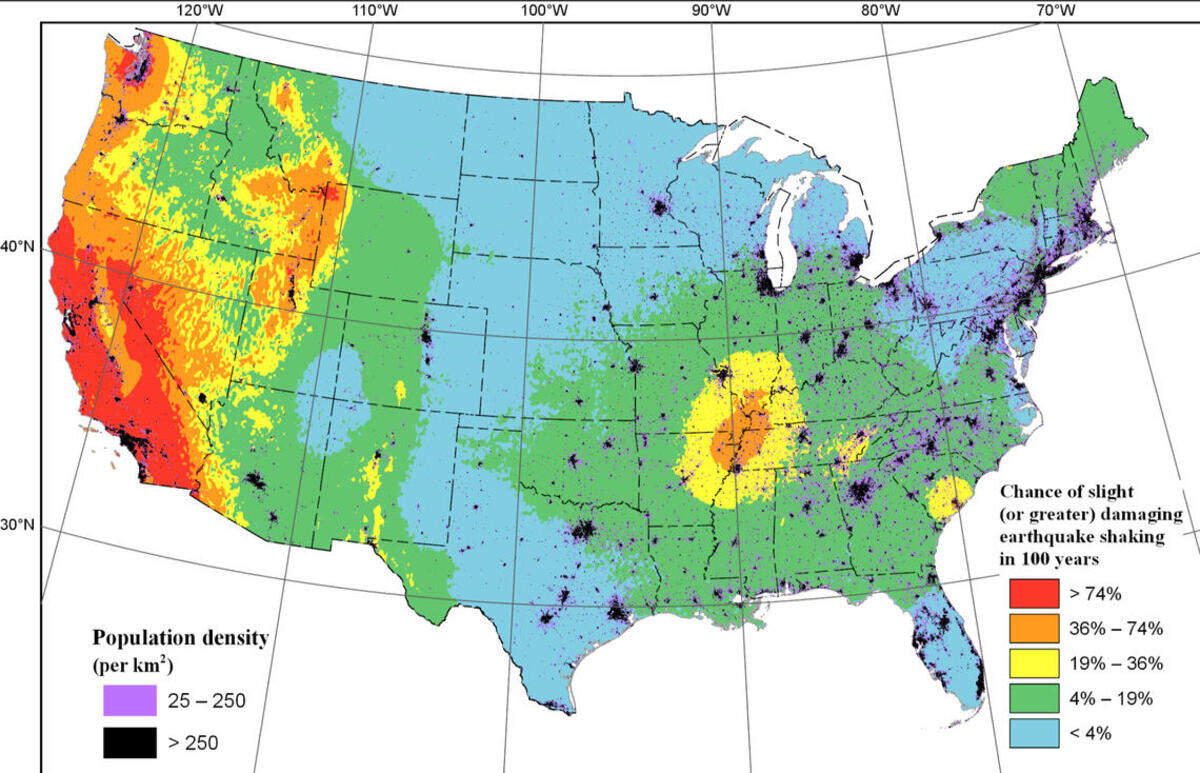
Several areas in the Midwest and eastern United States experienced this “uptick” in what USGS refers to as “ground shaking hazard.” The agency attributes the higher risk to population spikes and improvements to their estimation methods.
“Many populated centers are coincident with areas of higher ground shaking hazard, not only across the western U.S., where most earthquakes occur, but also within the central and eastern U.S. where earthquakes are less common,” USGS said.
According to the report, earthquakes with magnitudes greater than 4.0 occurred in 21 states over the last six years. The list includes some more obvious locations, such as California and Alaska, but also snippets of the Midwest and East Coast.
Observations from those quakes are factored into the prediction models, which are in-turn used in building-code updates, USGS said.
Given humans’ propensity to live in areas where earthquakes occur, those updates are critical.
“More people live or work in areas of high or moderate seismic hazard than ever before, leading to higher risk of undesirable consequences from future ground shaking,” USGS said. “For example, about 1 in 10 people in the U.S. now live in high-hazard areas where strong shaking is likely during their lifetimes.”