Monster goldfish found in South Carolina lake. ‘I have no clue how long it’s been there’
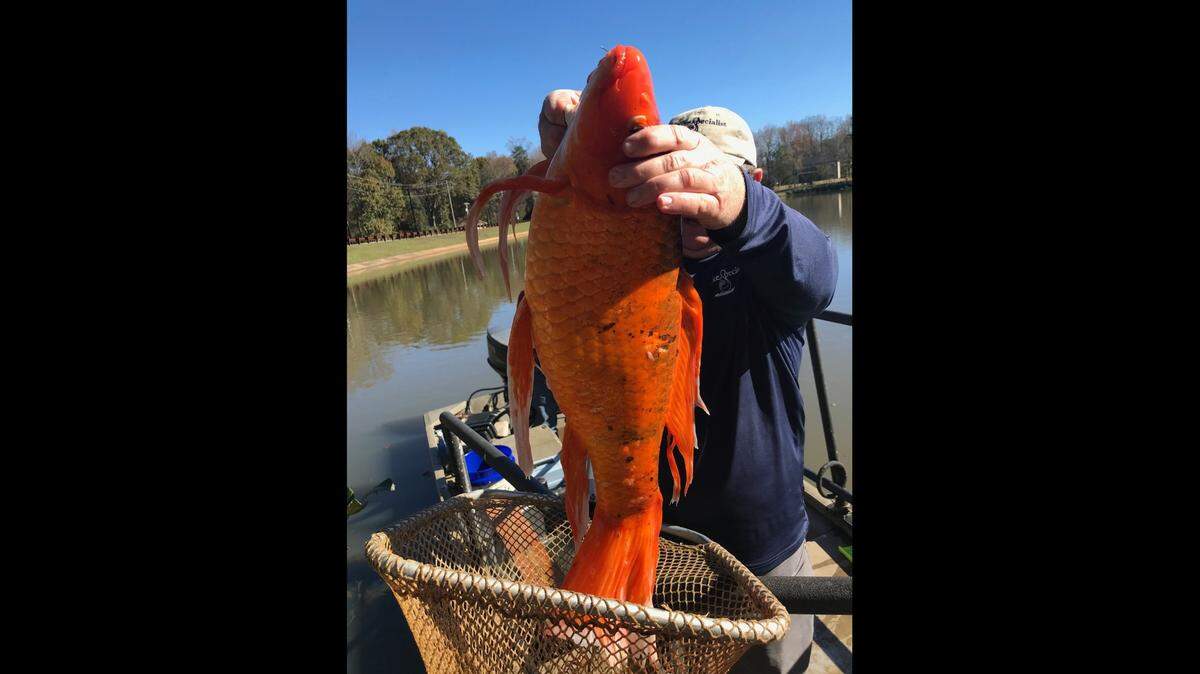
A routine water quality test of a small lake in South Carolina turned up two important discoveries for parks and recreation officials concerned about the ecosystem’s well-being.
One is that the 12-acre lake is actually quite healthy.
The other is that a 9-pound goldfish has made its home in the lake’s murky waters.
Ty Houck is the director of greenways, natural and historic resources at the Greenville County parks department. He said he has “no clue how long it’s been there,” only that the monster fish didn’t make an appearance 10 years ago when the Department of Parks, Recreation and Tourism last studied Oak Grove Lake.
A routine test
Oak Grove Lake is just east of Greenville near Interstate 85. It’s surrounded by a less than mile-long road frequented by runners and bikers, according to the parks department, and it’s mainly used for fishing during designated times on Wednesdays and Saturdays.
The lake is full of bass, bream and catfish, but Houck said fisherman are encouraged to throw the fish back after catching them.
Part of the testing the parks department is performing on the lake includes electrofishing, in which an underwater shock is sent out to stun the fish. The shock forces them to float to the surface and allows surveyors to check the health of the fish population, according to Houck.
His son affectionately refers to it as “tasing fish,” but Houck said they aren’t hurt during the process.
Instead, the fish are measured and checked for lesions that would be indicative of troubled waters, before being thrown back in, he told McClatchy News in a phone interview Monday. Scott Robinson, who is performing the electrofishing tests, just happened to be at the lake one day when Houck had picked up his son from school and offered to take the teenager out with him.
When Robinson and the teen got back to the bank, Houck said they had a 9-pound goldfish in hand.
The ‘Methuselah’ of Oak Grove Lake
According to Robinson, it’s difficult to tell the difference between goldfish and koi. Both are carp that feed on underwater vegetation, but the biggest difference is that people will pay a lot of money for koi.
“You can sell koi for ponds,” Houck said. “Goldfish, you get those at fairs.”
That’s why Houck and Robinson think this behemoth is a goldfish. They reason no one would throw a koi that big into Oak Grove Lake given how much it’s worth.
“Our guess is someone didn’t want to kill their fish but couldn’t take care of it anymore,” Houck said.
The discovery brought back memories of a childhood pet for Houck. His mother was a teacher, and growing up he said they had a goldfish that lived in a small bowl. One day they moved it to a bigger aquarium, and the fish got bigger.
“They grow to the size of their environment,” he said.
Houck told McClatchy News their little goldfish seemed to live an abnormally long time, though goldfish kept in captivity can reportedly live for up to 15 years. His mother called it Methuselah, after the longest-living person in the Bible.
“This might be the Methuselah for Oak Grove Lake,” he said of the 9-pound fish, which they put back in the lake after inspection.
In addition to its longevity, Houck said the goldfish must have some pretty good survival skills after some dredging was done at the lake’s headwaters earlier this year.
“This guy is even harder — he went from a 12-acre lake to a probably less than a half acre puddle and survived in that for at least two weeks,” he said.
Healthy lake, happy fish
Goldfish aren’t native to South Carolina lakes, Houck said, but they aren’t considered an invasive species. In fact, some people pay good money to have carp put in their ponds.
“This is a freebie,” he told McClatchy News. “He seems happy. We’re like ‘let’s just go with it.’ ”
Contrary to what it seems, the goldfish’s size isn’t indicative of any chemical exposure. “We are not downstream of nuclear power plant,” Houck said. “It’s actually just the opposite.”
Though fisherman previously complained of not being able to catch anything, Houck said studies done on Oak Grove Lake indicate it’s a good environment for fish. He reiterated something Robinson told him about fish during the last study a decade ago: “When they’re happy, they’re not hungry.”
To Houck, having a 9-pound goldfish in the lake indicates they must be doing something right.
“It is obviously healthy enough at Oak Grove Lake for that goldfish to get that big,” he told McClatchy.
This story was originally published December 7, 2020 at 7:02 PM.